
Drafted — not technically validated
Record revision 1 · The helicopter tank buster with laser or radar seekers, now also the drone strike weapon.
Real-world weapon as described in public sources. Weights and dimensions change with the fins, fuzes and variant fitted; the data plate names the variants its figures describe, and differences are noted beside the number they affect. The record describes the weapon; it is not a guide to employing it.
AGM-114 Hellfire · AGM-114
- Type
- 100 lb class air-to-surface missile, first built as a helicopter-launched tank-buster [1]
- Origin
- United States
- Weight
- 100–108 lb (45–49 kg) [1]
- Dimensions
- Length 64 in (1.63 m); diameter 7 in (178 mm); wingspan 13 in (330 mm) [1]
- Warhead or payload
- HEAT anti-armour (AGM-114K), blast-fragmentation (M), metal-augmented charge (N) and others [1]
- Guidance
- Semi-active laser homing on most versions; millimetre-wave radar on the AGM-114L Longbow Hellfire [1]
- Fuzing
- Not given in the cited source
- Delivery
- The laser spot can come from the launcher, another aircraft or a ground observer, so the launcher can break line of sight and take cover; the Longbow version is fire-and-forget [1]
- Range
- 0.5–11 km (0.3–5.9 NM) [1]
- Carried by
- US Army: AH-64 ApacheAH-64D Apache Longbow AircraftThe US Army's twin-engine attack helicopter, flown from Panama and Desert Storm to Afghanistan; the Longbow adds a mast-mounted radar., up to 16 [1]; OH-58DOH-58D Kiowa Warrior AircraftThe US Army's armed scout helicopter, with its ball-shaped sight above the rotor, flown from the Persian Gulf to Afghanistan. [2]
- US Marine Corps AH-1 Cobra [1]
- MQ-1 Predator and MQ-9 Reaper drones; ships and ground vehicles [1]
Heliborne, laser, fire and forget
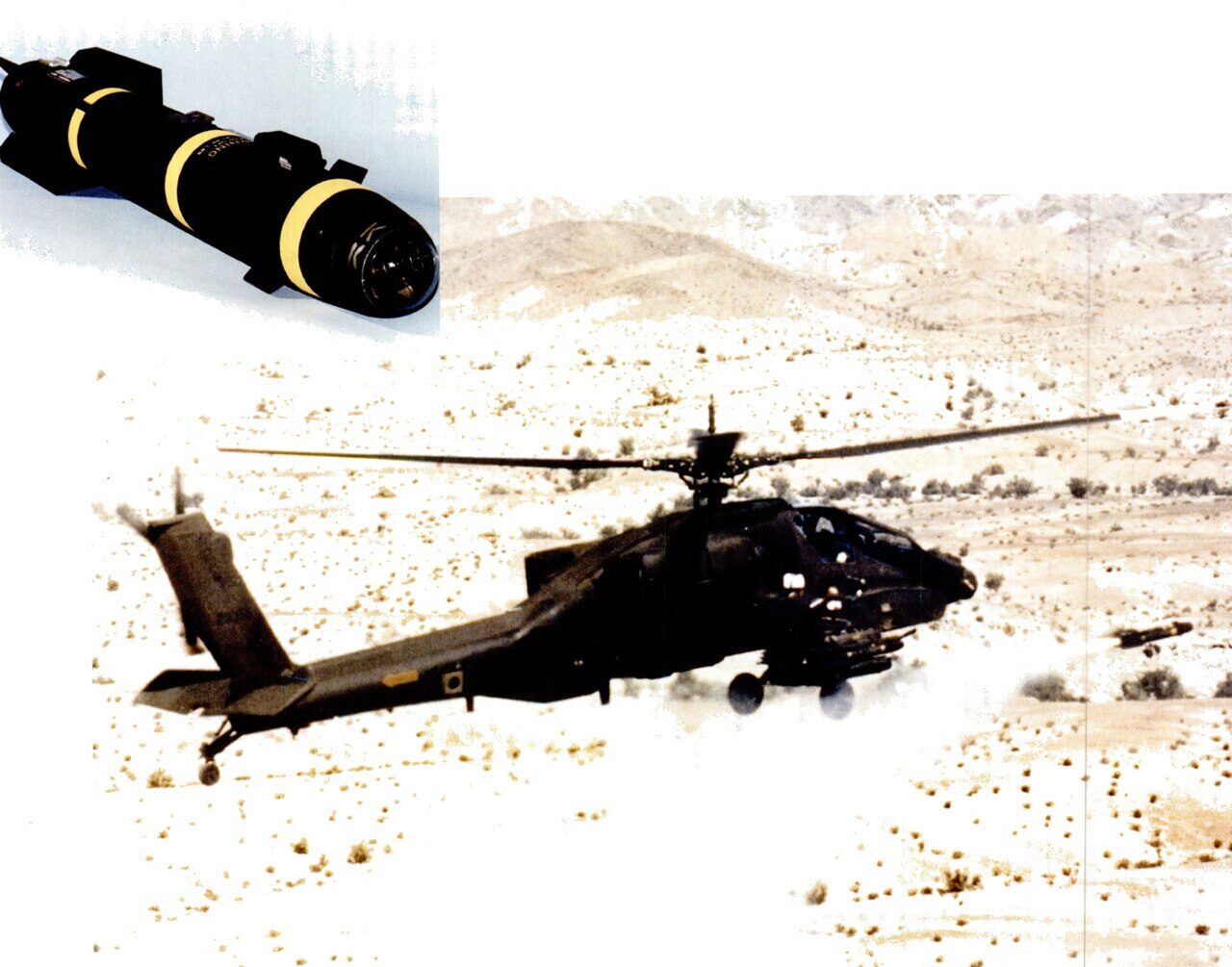
The Hellfire began in 1974 with a US Army requirement for a tank-buster that helicopters could launch against armoured vehicles. [1] Its working name, “Heliborne laser, fire-and-forget missile”, gave it the nickname Hellfire, which became its formal name. [1] It is now the main 100 lb class air-to-ground precision weaponPGM GlossaryWeapons: Precision-guided munition. A guided weapon intended to destroy a point target and minimize collateral damage. Also called a smart weapon or smart munition. of the US forces and many others, and has been adapted for drone strikes against high-value targets. [1]
Laser or radar
Most versions are laser-guidedLGW GlossaryWeapons: Laser-guided weapon. A weapon that uses a seeker to detect laser energy reflected from a laser marked/designated target and through signal processing provides guidance commands to a control system, which guides the…. The designator can be the launcher itself, such as the nose sights of the AH-64 ApacheAH-64D Apache Longbow AircraftThe US Army's twin-engine attack helicopter, flown from Panama and Desert Storm to Afghanistan; the Longbow adds a mast-mounted radar., another aircraft, or an observer on the ground; the last two let the launching helicopter break line of sight with the target and stay in cover. [1] The AGM-114L Longbow Hellfire is different: its millimetre-wave radar seeker makes it fire-and-forget, able to lock on even after launch, and it works in weather, smoke and fog that would hide a target or stop a laser spot forming. [1]
Platforms
Helicopter gunships such as the Apache and the AH-1 Cobra are the most common Hellfire platforms, carrying up to 16 each, though the Predator and Reaper drones carry the Hellfire II too. [1] The Hellfire II, a modular family of warheads for different targets, entered Army service in 1996. [1]
Sources
- AGM-114 Hellfire. Wikipedia (secondary source). https://en.wikipedia.org/wiki/AGM-114_Hellfire (accessed 2026-10-27).
- Bell OH-58 Kiowa. Wikipedia (secondary source). https://en.wikipedia.org/wiki/Bell_OH-58_Kiowa (accessed 2026-10-27).
Wikipedia articles are secondary sources and can change; they are cited with the date they were read. NAVEDTRA training manuals and budget justification exhibits are official US publications, but each describes the weapons in service when it was written.