
Drafted — not technically validated
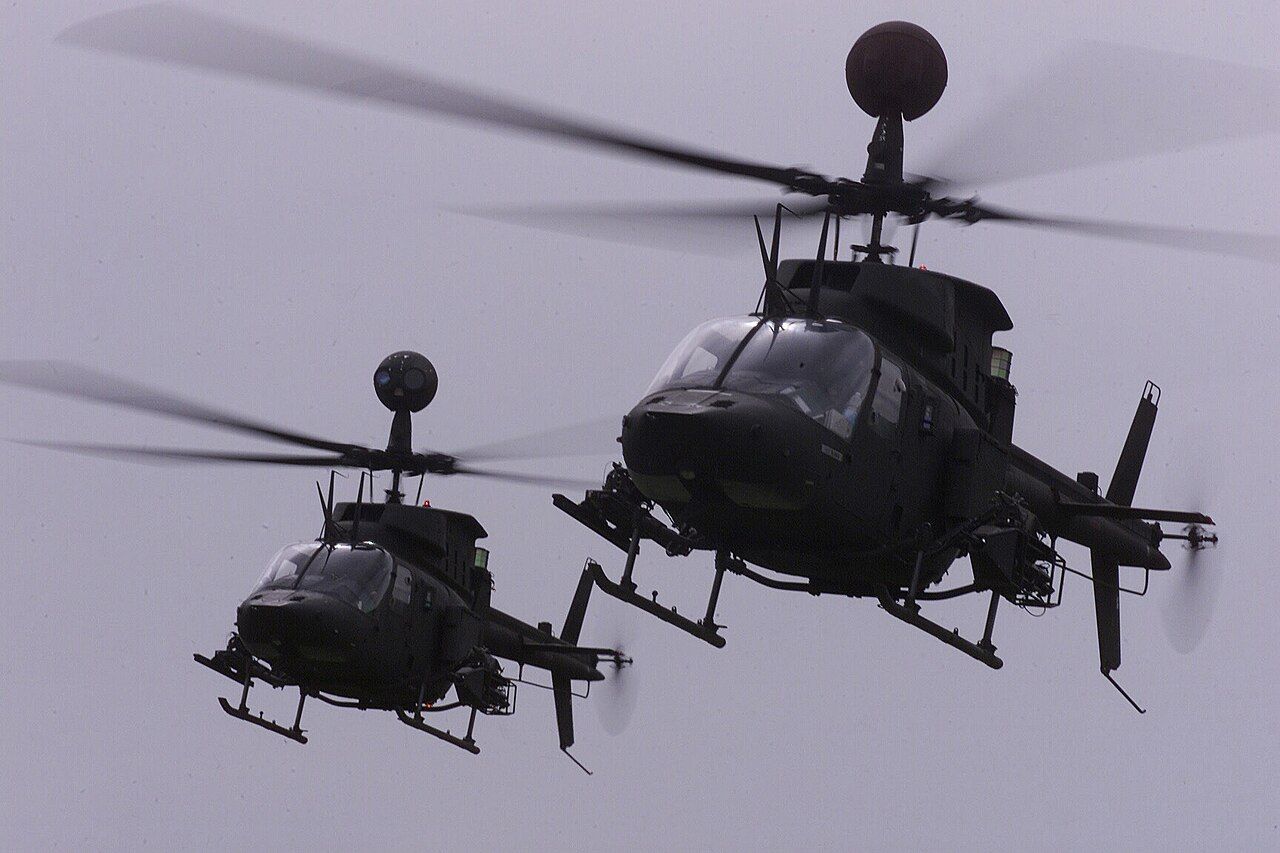
Record revision 1 · The US Army's armed scout helicopter, with its ball-shaped sight above the rotor, flown from the Persian Gulf to Afghanistan.
Real-world aircraft as described in public sources. Figures vary between variants, loads and sources; the data plate names the variant its figures describe, and differences are noted beside the number they affect.
OH-58D Kiowa Warrior · Bell OH-58D Kiowa Warrior
- Origin
- United States
- Manufacturer
- Bell Helicopter [1]
- First flight
- Bell 206A: 10 January 1966; OH-58D: 6 October 1983 [1]
- Status
- Retired by the US Army (last OH-58Ds 2017, last OH-58Cs 2020); 2,325 of the OH-58 family built; ex-Army OH-58Ds serve with Croatia, Greece and others [1]
- Service ceiling
- 4,575 m (15,000 ft) [1]
- Armament
- Two universal weapons pylons [1] [2]
- One .50 calibre (12.7 mm) M3P or M296 heavy machine gun [1] [2]
- One seven-tube pod of 70 mm Hydra 70Hydra 70 (2.75 in) rocket OrdnanceThe 2.75 in rocket that began as the 'Mighty Mouse' bomber-killer and became the standard rocket of US attack helicopters. or APKWS rockets [1] [2]
- Two AGM-114 Hellfire missiles; Air-to-Air Stinger (ATAS) missiles for self-defence [1] [2]
- Sensors and avionics
- Purchase
- DCS WorldDCS: OH-58D Kiowa Warrior by Polychop SimulationsDCS Store
Store pages checked 2026-10-28. Prices and availability change.
The Ugly Duckling that won anyway
The Kiowa began as a loser. Bell’s YOH-4A flew on 8 December 1962 in the Army’s Light Observation Helicopter competition, where it was nicknamed the “Ugly Duckling” beside its rivals, and in May 1965 the Army chose the Hughes OH-6 Cayuse instead. [1] Bell gave the design a sleeker fuselage with more room for cargo and sold it to civilians as the Model 206A JetRanger. Then, in 1967, the Army reopened the competition because Hughes could not deliver helicopters fast enough. Bell underbid Hughes with the JetRanger and won, and the Army named its new OH-58A the Kiowa, after the Native American people. [1]
The first OH-58A was handed over in May 1969, and three months later Kiowas were in South Vietnam, flying alongside the Cayuses they had been meant to replace. One of the first lost, on 27 March 1970, was spotting for artillery when heavy machine-gun fire brought it down; about 45 OH-58As were destroyed in the war by combat and accidents. [1] In Australia, where the type was built under licence, the army minister had the first ones renamed Kalkadoon after a Queensland people; soldiers called them “Kattercopters” after him, and the name was dropped when he left office. [1]
A beach ball above the rotor
By the 1970s the Army wanted a scout that could find targets by day, by night and in bad weather for its coming AH-64AH-64D Apache Longbow AircraftThe US Army's twin-engine attack helicopter, flown from Panama and Desert Storm to Afghanistan; the Longbow adds a mast-mounted radar. Apaches. With no money for an all-new helicopter, it chose in 1979 to upgrade the airframes it already had, and in September 1981 Bell won the Army Helicopter Improvement Program (AHIP) with a heavily modified OH-58. The first prototype flew on 6 October 1983, and the OH-58D entered service in 1985. [1]
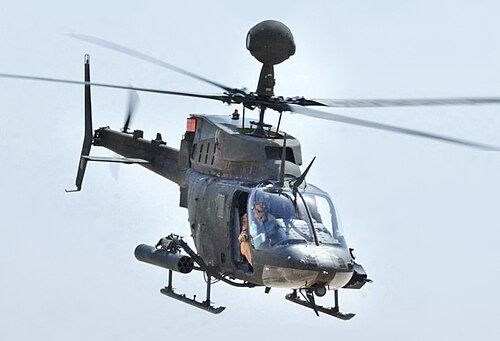
Its signature is the Mast-Mounted Sight, a ball perched on top of the rotor mast that looks like a beach ball. Inside a stabilised mount are a television camera, a thermal imager and a laser rangefinder and designator. By day or night and in poor weather, the crew can find a target, work out its exact position and mark it with the laser, and the data bus passes the target straight to precision-guidedPGM GlossaryWeapons: Precision-guided munition. A guided weapon intended to destroy a point target and minimize collateral damage. Also called a smart weapon or smart munition. weapons. [1] [2] The Navy liked the sight so much that it chose it for use on its ships. [2]
Born on a barge in the Gulf
The Kiowa Warrior was armed in a hurry. In 1987, during the Iran–Iraq War, Iranian gunboats were attacking tankers in the Persian Gulf at night, and the US needed a small armed scout to hunt them. The armed version was developed in under 100 days. [2] In February 1988 two of the new helicopters landed on the Wimbrown VII, a barge anchored in the Gulf as a mobile sea base, to escort tankers in Operation Prime Chance. Army crews took Navy training in deck landings and underwater escape before they went. [1]
That experience convinced the Army to arm the whole fleet. From May 1991 every new OH-58D was built as a Kiowa Warrior with a weapons pylon on each side for Hellfire missiles, rockets, Stinger air-to-air missiles and a .50 calibre machine gun, and the earlier aircraft were converted. [1] [2] All that equipment had a cost: the helicopter grew so heavy that, if its engine failed, it came down faster in autorotationAutorotation GlossaryFlight: Descent with the rotor turned by the upward flow of air instead of the engine. After an engine failure the pilot lowers the collective at once to keep the rotor turning. and slid further on landing, and the Army had to add a safety programme with a more powerful engine and crash-resistant seats. [2]
Desert Storm to the DMZ
In Desert Storm, 130 OH-58Ds flew alongside 145 Cobras and 277 Apaches. Over the build-up and the war they flew nearly 9,000 hours with a 92 percent fully mission-capable rate, and they had the lowest ratio of maintenance hours to flight hours of any combat helicopter there. [1]
The most famous Kiowa incident involved an older, unarmed OH-58C. On 17 December 1994 Chief Warrant Officers David Hilemon and Bobby Hall set out on a training flight along the Korean Demilitarized Zone. Navigating over snow-covered mountains, they strayed nearly four miles into North Korea and were shot down. Hilemon was killed; Hall was held for 13 days, accused of spying, before he was released uninjured on 30 December. [1]
Twenty years of war, and an empty cockpit
In Iraq and Afghanistan the Kiowa Warrior flew 72 to 80 hours a month, low and close to the troops it supported. More than 35 were lost to combat and accidents, and 35 pilots died; small as it was, crews were credited with saving lives by using it to rescue the wounded. By April 2013 the OH-58 family had logged 820,000 combat hours. [1]
The Army tried three times to replace it: the RAH-66 Comanche, cancelled in 2004; the ARH-70, cancelled in 2008; and the Armed Aerial Scout, ended in 2013 as too costly. In the end it gave the scout role to Apaches teamed with drones. The 1st Squadron, 17th Cavalry Regiment took the Kiowa Warrior on its last deployment, to South Korea, in 2016; the type made its last live-fire exercise in January 2017, and the last training OH-58Cs left Army service in September 2020. A fourth replacement, FARA, was cancelled in 2024. Ex-Army OH-58Ds went on to fly with Croatia, Greece and others. [1]

Sources
- Bell OH-58 Kiowa. Wikipedia (secondary source). https://en.wikipedia.org/wiki/Bell_OH-58_Kiowa (accessed 2026-10-25).
- OH-58D Kiowa Warrior. Federation of American Scientists, Military Analysis Network. https://man.fas.org/dod-101/sys/ac/oh-58.htm (accessed 2026-10-25).
Wikipedia articles are secondary sources and can change; they are cited with the date they were read. The Federation of American Scientists (FAS) Military Analysis Network pages largely reproduce US service fact sheets of the late 1990s and early 2000s, so later upgrades are not covered there.