
Drafted — not technically validated
Record revision 1 · A single-seat Russian attack helicopter with coaxial rotors and the first helicopter ejection seat in service.
Real-world aircraft as described in public sources. Figures vary between variants, loads and sources; the data plate names the variant its figures describe, and differences are noted beside the number they affect.
Ka-50 Black Shark · Kamov Ka-50
- Variant described
- Ka-50 [1]
- Origin
- Soviet Union / Russia
- Manufacturer
- Kamov; built by Progress at Arsenyev [1]
- First flight
- 17 June 1982 [1]
- Entered service
- 28 August 1995 (Russian Ground Forces) [1]
- Status
- In limited service; 18–19 Ka-50s built, more than 196 of the two-seat Ka-52 [1]
- Powerplant
- Two Klimov VK-2500 turboshafts, 2,400 shp each [1]
- Maximum speed
- 315 km/h (170 kt); never-exceed speed 350 km/h (189 kt) [1]
- Service ceiling
- 5,500 m (18,000 ft); hover ceiling 4,000 m (13,100 ft) [1]
- Range
- 545 km (294 NM); combat radius 470 km (254 NM); ferry range 1,160 km (626 NM) [1]
- Armament
- One 30 mm Shipunov 2A42 cannon, semi-rigidly mounted on the right side, 460 rounds in a dual feed [1] [2]
- Four stub-wing hardpoints and two wingtip stations, more than 2,000 kg: up to 12 Vikhr laser-guidedLGW GlossaryWeapons: Laser-guided weapon. A weapon that uses a seeker to detect laser energy reflected from a laser marked/designated target and through signal processing provides guidance commands to a control system, which guides the… anti-tank missiles, S-8S-8 80 mm rocket OrdnanceThe Soviet 80 mm rocket of 1984, with anti-armour, runway-attack and fuel-air warheads, fired from B-8 pods. and S-13S-13 122 mm rocket OrdnanceA Soviet 122 mm rocket built to penetrate runways, shelters and bunkers, fired from five-tube launchers. rocket pods, bombs, gun pods or Igla air-to-air missiles [1] [2]
- Sensors and avionics
- Shkval TV sight with laser rangefinder and designator; FLIR, inertial navigation, head-up displayHUD GlossaryJoint terms: Head-up display. A special type of flight viewing screen that allows the pilot to watch the flight instruments and other data while looking through the windshield of the aircraft for other traffic, the approach lights… and a data link to share targets [1] [2]
- Purchase
- DCS WorldDCS: Black Shark 3 by Eagle DynamicsDCS Store
Store pages checked 2026-10-28. Prices and availability change.
One pilot, two rotors
NATO armies judged a single-seat attack helicopter undesirable. The Ka-50 has one seat. In testing in 1985 and 1986, Soviet evaluators found that the workload was similar to a fighter-bomber pilot’s and that one person could fly, navigate and fight. [1] Its designers aimed for a helicopter that was small, fast and agile, and that could operate for two weeks away from maintenance facilities. [1] [2]
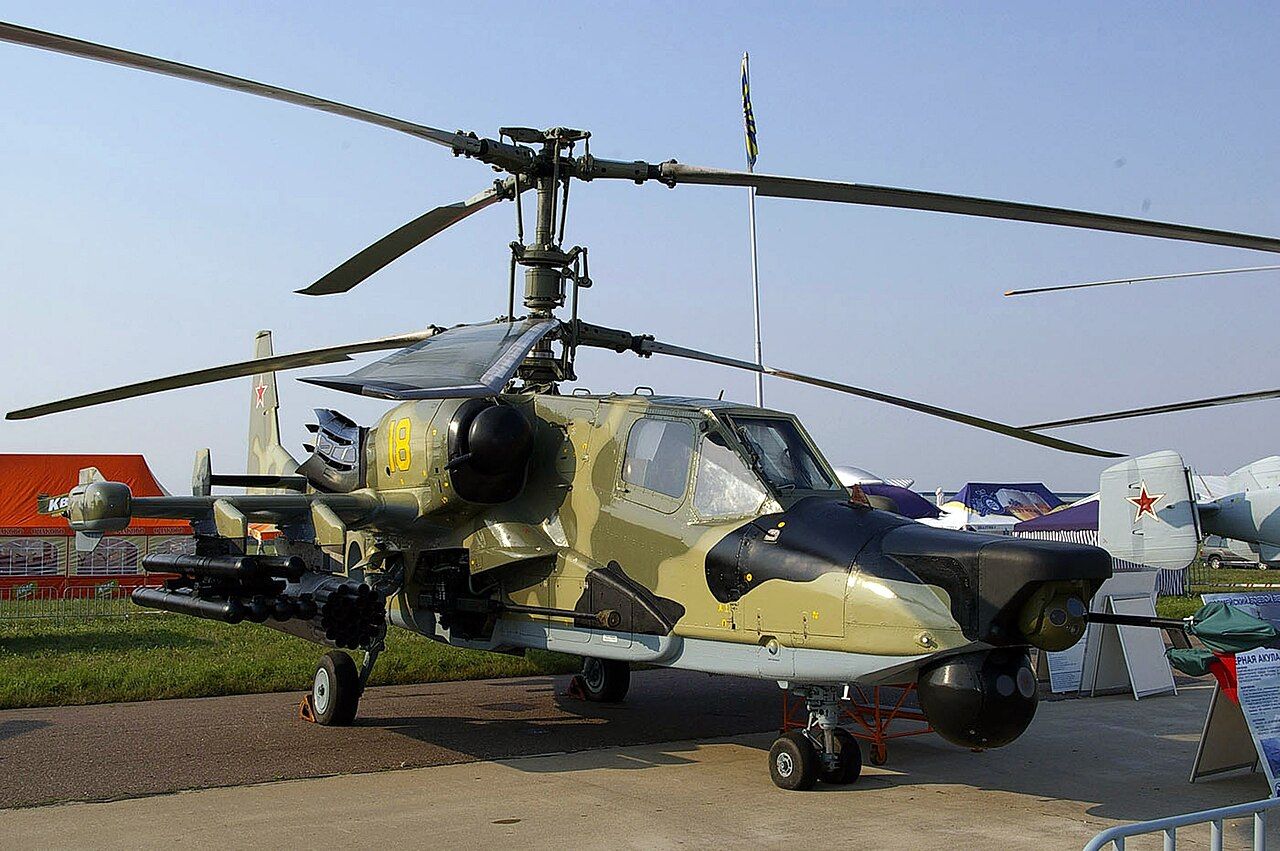
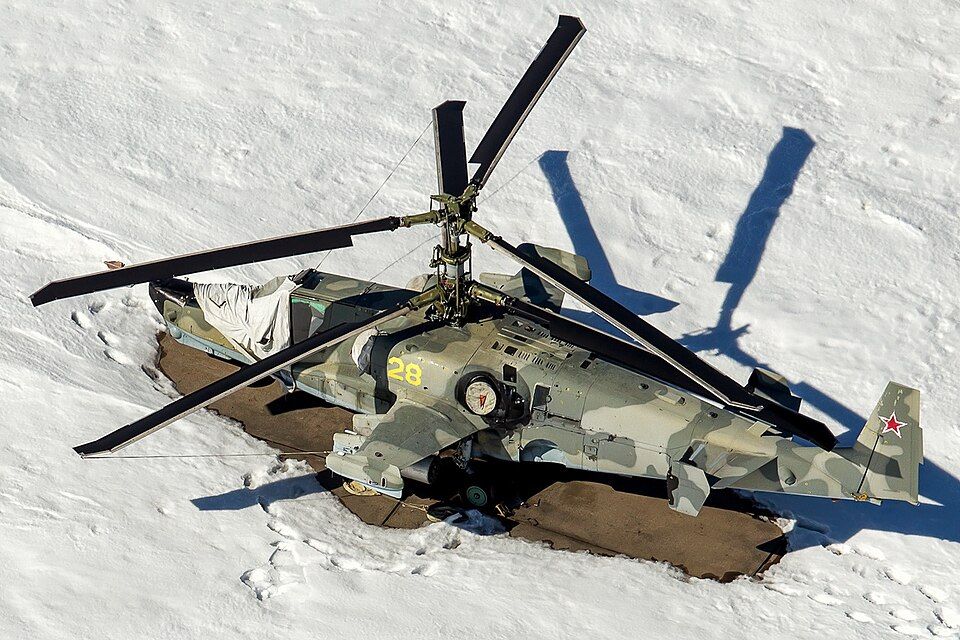
Like other Kamov designs, it has two three-bladed rotors stacked one above the other and turning in opposite directions, with no tail rotor. A tail rotor can absorb up to 30% of a helicopter’s engine power just countering torque, so the coaxial layoutCoaxial rotor GlossaryFlight: A pair of rotors on the same shaft turning in opposite directions. Their torques cancel, so no tail rotor is needed. leaves more for lift, and the helicopter can make flat turns at any speed regardless of the wind. It is fully aerobatic: it can loop, roll and fly “the funnel”, circling a target at changing heights and speeds while keeping its weapons pointed at it. [1] [2] In testing, one Ka-50 lost its tail and still flew back to base, because the tail boom carries no rotor. [1]
Painted windows and a werewolf
Western intelligence first heard of the helicopter in 1984 and saw a photograph only in 1989. The first two prototypes had false windows painted on them, which misled early Western reports so thoroughly that some analysts concluded it was a fighter built to hunt NATO helicopters. [1] At the 1992 Farnborough air show the second production aircraft appeared with a werewolf painted on its rudder, earning it the nickname “Werewolf”. The fifth prototype, painted black, then starred in the Russian film Black Shark, and that name stuck. NATO calls it the Hokum-A. [1]
Built to survive
The pilot sits in an armoured cockpit of layered steel and aluminium plates rated against 12.7 mm armour-piercing bullets and 23 mm fragments, and the rotor blades can take several hits from ground fire. [1] The Ka-50 was the world’s first operational helicopter with an ejection seat that works at any height and speed. Before the K-37-800 rocket seat fires, explosive charges blow the rotor blades away and the canopy is jettisoned. [1]
Its 30 mm cannon, the same weapon as on the BMP-2 infantry fighting vehicle, is fixed almost rigidly to the side of the fuselage near the centre of gravity for accuracy, and the fire-control computer turns the whole helicopter to keep the gun on target. [1] [2] Its main anti-tank weapon is the Vikhr9K121 Vikhr OrdnanceThe Ka-50 and Su-25T's laser beam-riding missile for armour and air targets. laser-guidedLGW GlossaryWeapons: Laser-guided weapon. A weapon that uses a seeker to detect laser energy reflected from a laser marked/designated target and through signal processing provides guidance commands to a control system, which guides the… missile, with a range of about 8 km. [1]
Too few to replace the Hind
The Ka-50 was cleared for service with the Russian army on 28 August 1995, but the collapse of the Soviet Union cut defence spending so sharply that only about a dozen were delivered, instead of the several hundred planned to replace the Mi-24Mi-24P Hind-F AircraftThe Soviet gunship that could also carry eight troops; the Mi-24P has a fixed twin-barrel 30 mm cannon.. [1] Two production Ka-50s went to Chechnya in December 2000 and first used their weapons in combat on 6 January 2001; in one strike that February a pair destroyed a fortified insurgent camp with Vikhr missiles from 3 km away. [1] The Mi-28 became the army’s main gunship, and the Ka-50 was assigned to support special forces. Its lasting legacy is the two-seat Ka-52 “Alligator”, built in far larger numbers and used heavily, with dozens lost, in the Russian invasion of Ukraine. [1]

Sources
- Kamov Ka-50. Wikipedia (secondary source). https://en.wikipedia.org/wiki/Kamov_Ka-50 (accessed 2026-10-25).
- Ka-50 HOKUM. Federation of American Scientists, Military Analysis Network. https://man.fas.org/dod-101/sys/ac/row/ka-50.htm (accessed 2026-10-25).
Wikipedia articles are secondary sources and can change; they are cited with the date they were read. The Federation of American Scientists (FAS) Military Analysis Network pages largely reproduce US service fact sheets of the late 1990s and early 2000s, so later upgrades are not covered there.