
Drafted — not technically validated
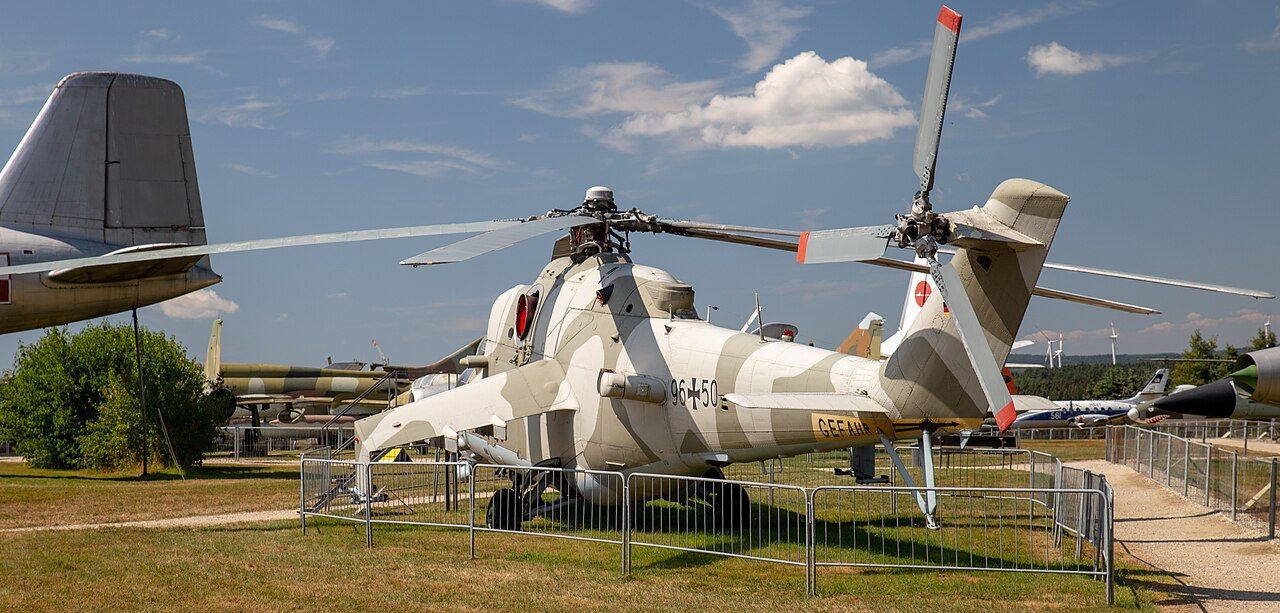
Record revision 1 · The Soviet gunship that could also carry eight troops; the Mi-24P has a fixed twin-barrel 30 mm cannon.
Real-world aircraft as described in public sources. Figures vary between variants, loads and sources; the data plate names the variant its figures describe, and differences are noted beside the number they affect.
Mi-24P Hind-F · Mil Mi-24P
- Origin
- Soviet Union
- Manufacturer
- Mil [1]
- Crew
- 2 pilots, with an optional technician in the cabin [1]
- First flight
- 19 September 1969 (first free flight of the prototype) [1]
- Entered service
- 1972 (Soviet Air Force) [1]
- Status
- In service with Russia and dozens of other countries; 2,648 built [1]
- Powerplant
- Two Isotov TV3-117 turboshafts, 2,200 shp each [1]
- Maximum speed
- 320 km/h (173 kt) [1]
- Service ceiling
- 5,750 m (18,900 ft) [1]
- Range
- 450 km (243 NM) [1]
- Armament
- Purchase
- DCS WorldDCS: Mi-24P Hind by Eagle DynamicsDCS Store
Store pages checked 2026-10-28. Prices and availability change.
A flying infantry fighting vehicle
In the early 1960s Mikhail Mil foresaw that ever-greater battlefield mobility would lead to flying infantry fighting vehicles: helicopters that could carry a squad and support it with their own firepower. Senior officers argued that conventional weapons were a better use of money, but Mil persuaded Marshal Andrei Grechko to convene an expert panel, and America’s use of armed helicopters in Vietnam helped convince the doubters. The design went ahead in 1968, and the prototype made its first free flight on 19 September 1969. Mil did not see it enter service; he died in 1970. [1]
The result was the Mi-24, which NATO called the Hind. It took the engines and rotor system of the Mi-8Mi-8MTV-2 Hip AircraftThe armed transport version of the Mi-8, the most-produced helicopter in the world., wrapped them in a streamlined, armoured airframe with retractable landing gear, and added stub wings that carry weapons and provide up to a quarter of the lift at high speed. Its titanium rotor blades resist 12.7 mm rounds, and the crew sit in an armoured tub behind bulletproof windscreens. [1] It has no direct Western equivalent: a Vietnam-era HueyUH-1H Huey AircraftThe utility helicopter that defined the Vietnam War and served every US armed service; more than 16,000 built. could carry troops or be a gunship, but not both at once. [1]
Flying tank, crocodile, drinking glass
Soviet pilots called the Mi-24 the “flying tank”, the same name given to the wartime Il-2 Shturmovik. Its camouflage earned it the name “Crocodile”, and the flat glass panels around the cockpit of early versions made it the “Drinking Glass”. [1] From the Mi-24D onward the crew sat in tandem under two separate bubble canopies. [1] [2]
Speed was a priority. On 21 September 1978 a stripped Mi-24 known as the A-10 set an absolute helicopter speed record of 368.4 km/h, which stood until a modified Westland Lynx broke it in 1986. [1]
Satan’s chariot
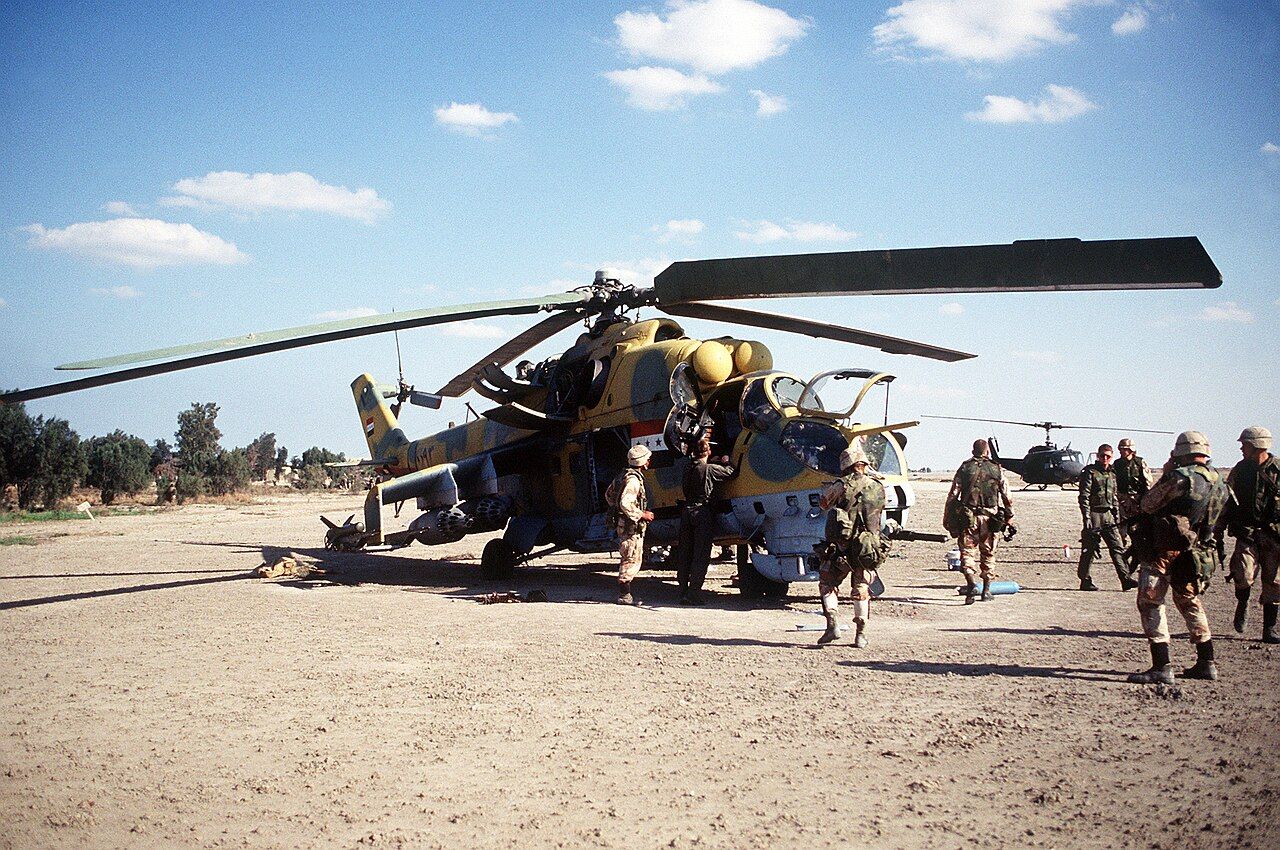
The Mi-24 became the signature weapon of the Soviet war in Afghanistan. [2] Afghan rebels called it Shaitan-Arba, “Satan’s Chariot”. Ground troops loved it because it could stay over the battlefield and keep firing, unlike jets that had to leave to refuel; in one case a pilot who had run out of ammunition saved an infantry company by diving aggressively at the attackers until they fled. [1]
Combat changed how it was used. Gunship crews found passengers a distraction under fire and preferred to fly light at Afghanistan’s high altitudes, so troops rode in Mi-8sMi-8MTV-2 Hip AircraftThe armed transport version of the Mi-8, the most-produced helicopter in the world. while the Mi-24s gave fire support, and the cabin often carried a technician with a machine gun to cover the helicopter’s back as it left a target. An attempt to fit a rear gun, reached through a narrow crawlway, failed: the space was cramped and full of exhaust fumes, and during one demonstration an overweight general got stuck in it. Rear-view mirrors were fitted instead. Once the rebels received American Stinger missilesGuided missile GlossaryWeapons: An unmanned vehicle moving above the surface of the Earth whose trajectory or flight path is capable of being altered by an external or internal mechanism., the Mi-24 and Mi-8Mi-8MTV-2 Hip AircraftThe armed transport version of the Mi-8, the most-produced helicopter in the world. became favourite targets. [1]
The Mi-24P
The Mi-24P replaced the nose turret with a fixed twin-barrel 30 mm GSh-30K cannon on the right side of the nose, for direct fire support, and raised the maximum weight to 12,000 kg. [2] [1] Iraqi Mi-25s, the export version, fought in the only confirmed helicopter-against-helicopter battles in history, against Iranian AH-1J SeaCobras in the 1980s. [1] Russia and Ukraine have both flown Mi-24Ps in the war that began in 2022, and the Hind remains in service with dozens of countries more than 50 years after its first flight. [1]

Sources
- Mil Mi-24. Wikipedia (secondary source). https://en.wikipedia.org/wiki/Mil_Mi-24 (accessed 2026-10-25).
- Mi-24 HIND. Federation of American Scientists, Military Analysis Network. https://man.fas.org/dod-101/sys/ac/row/mi-24.htm (accessed 2026-10-25).
Wikipedia articles are secondary sources and can change; they are cited with the date they were read. The Federation of American Scientists (FAS) Military Analysis Network pages largely reproduce US service fact sheets of the late 1990s and early 2000s, so later upgrades are not covered there.