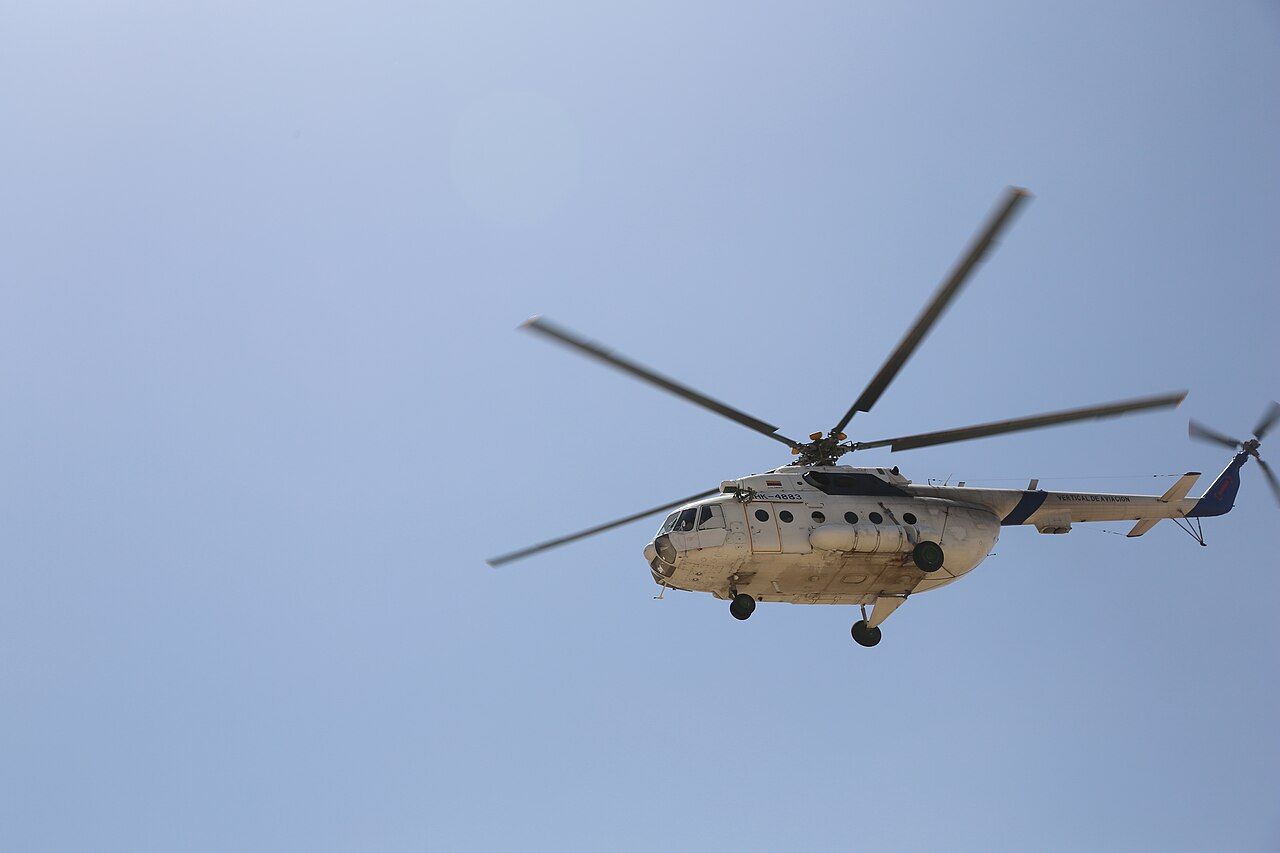

Drafted — not technically validated
Record revision 1 · The armed transport version of the Mi-8, the most-produced helicopter in the world.
Real-world aircraft as described in public sources. Figures vary between variants, loads and sources; the data plate names the variant its figures describe, and differences are noted beside the number they affect.
Mi-8MTV-2 Hip · Mil Mi-8MTV-2
- Variant described
- Mi-8MTV-2, a member of the Mi-8MT/Mi-17 second-generation family; figures are for the Mi-8MT [1]
- Origin
- Soviet Union / Russia
- Crew
- 3: pilot, co-pilot and flight engineer [1]
- Entered service
- 1967 (Soviet Air Force) [1]
- Status
- In production and in service with Russia and about 80 other countries; more than 17,000 built, the world's most-produced helicopter [1]
- Powerplant
- Two Klimov TV3-117MT turboshafts, 1,454 kW (1,950 shp) each [1]
- Maximum speed
- 250 km/h (135 kt) [1]
- Service ceiling
- 5,000 m (16,400 ft) [1]
- Range
- 495 km (267 NM); ferry range 960 km (518 NM) [1]
- Armament
- Six hardpoints for up to 4,000 kg of 57 mm S-5S-5 57 mm rocket OrdnanceThe small Soviet rocket of 1955, derived from a German wartime design and fired from pods of up to 32. rocket pods, bombs or anti-tank missiles [1] [2]
- One or two side-mounted PK machine guns; gunship versions add a 12.7 mm machine gun in the nose [1] [2]
- Cabin for 24 troops, or 12 stretchers, or 4,000 kg of cargo; up to 3 t on an external sling [1] [2]
- Purchase
- DCS WorldDCS: Mi-8MTV2 Magnificent Eight by BelsimtekDCS Store
Store pages checked 2026-10-28. Prices and availability change.
Khrushchev’s helicopter
In September 1959 Nikita Khrushchev visited the United States and took his first ride in the American presidential helicopter. He was so impressed that on his return he ordered a Soviet equivalent ready for the American president’s return visit, to save face. Mil’s bureau hurriedly produced a luxury Mi-4, and during Khrushchev’s inspection flight Mikhail Mil pitched the new turbine helicopter he was developing instead, arguing that it needed a second engine for reliability. In May 1960 Mil received the order to build a twin-engined helicopter, for the first time with purpose-designed Soviet turbine engines and a main gearbox designed in-house. [1]
The Soviet military had argued it did not need a new helicopter at all. Mil had already won approval by describing the project as merely a turbine update of the Mi-4. The single-engined V-8 prototype flew in 1961, and the twin-engined V-8A followed on 2 August 1962. A switch from four to five rotor blades in 1963 reduced vibration, and production began at Kazan in 1965. [1]
Inspired by the Huey
The army showed little interest until the Bell UH-1UH-1H Huey AircraftThe utility helicopter that defined the Vietnam War and served every US armed service; more than 16,000 built.’s role in Vietnam made headlines, showing how helicopters could move troops swiftly in and out of battle. Then a troop-carrying version was rushed into production, and the Mi-8 entered Soviet service in 1967. NATO named it the Hip. [1]
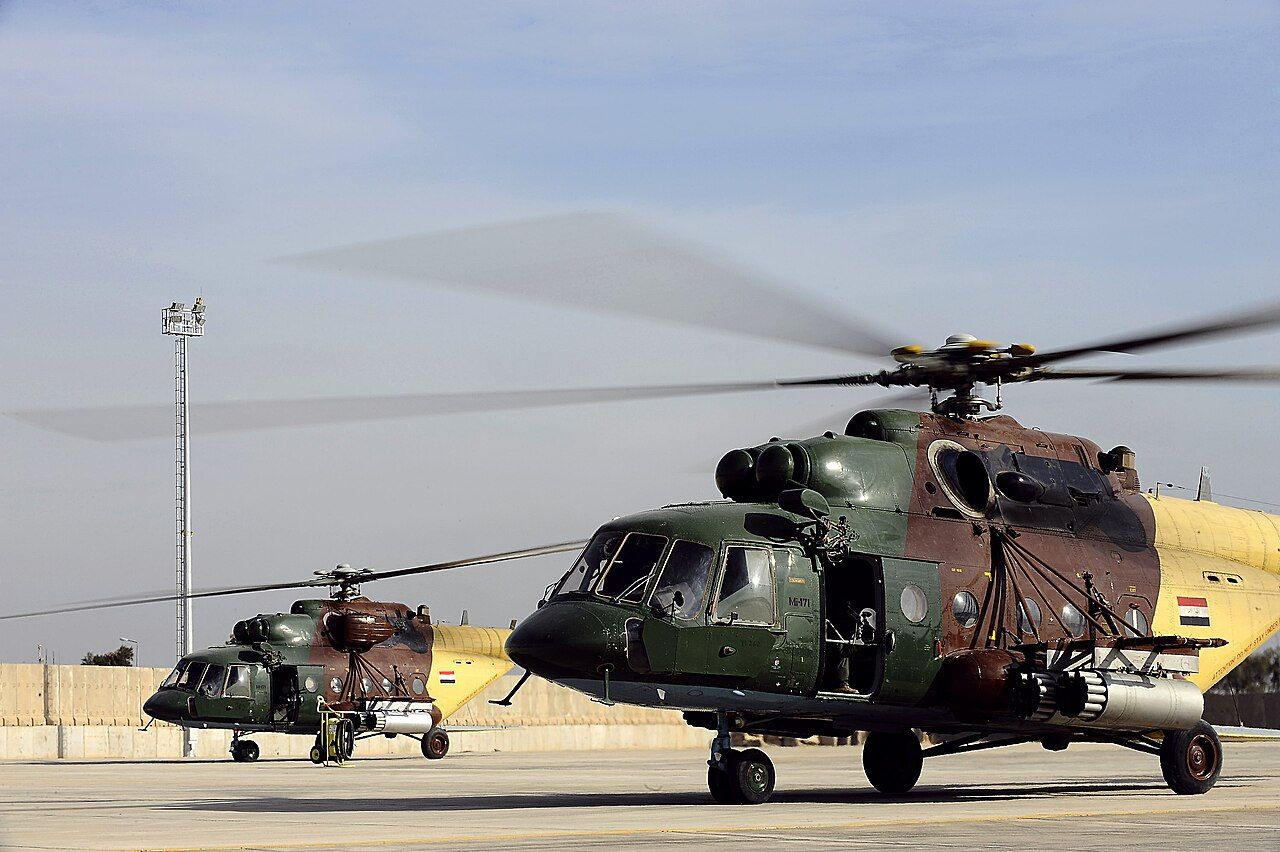
Its long, bus-like fuselage holds 24 troops or 12 stretchers, and a sling under it can carry loads of up to three tonnes. [1] [2] The two engines share the load, and if one fails the other automatically increases its output so the helicopter can keep flying, depending on its weight. [2] Armed versions carry rocket pods, bombs and anti-tank missiles on racks on either side of the fuselage, so the same machine can carry troops and support them with fire. [1] [2]
The second generation
The second-generation Mi-8MT and its export twin, the Mi-17, moved the tail rotor to the left side, where its advancing blades move up into the rotor downwash and give better yaw control. The tail rotor position, oval rather than round exhausts and dust shields on the intakes are the easiest ways to tell the newer helicopters from the original Mi-8. [1] The Mi-8MTV belongs to this generation. Croatia bought 18 Mi-8MTV-1s during its war of independence, and Georgian and Abkhaz Mi-8MTVs fought each other in 1993. [1]
Everywhere at once
Large numbers of Mi-8s served in the Soviet war in Afghanistan, where their rugged construction made them easy to operate and maintain in the field, and the Mi-8 family was the aircraft type the Soviet Union lost most often there. [1] In April and May 1986 Mi-8s flew over the burning Chernobyl reactor, helping drop more than 5,000 tonnes of sand, lead, clay and boron; most were left so irradiated that they were abandoned in a vast scrapyard nearby. [1] In 2001 the CIA and US Special Forces used Mi-8s and Mi-17s to support the Northern Alliance in Afghanistan. [1]
More than 17,000 have been built, used by over 50 countries, and the Mi-8 and Mi-17 together are among the most common military aircraft in the world. Production continues. [1]

Sources
- Mil Mi-8. Wikipedia (secondary source). https://en.wikipedia.org/wiki/Mil_Mi-8 (accessed 2026-10-25).
- Mi-8 HIP. Federation of American Scientists, Military Analysis Network. https://man.fas.org/dod-101/sys/ac/row/mi-8.htm (accessed 2026-10-25).
Wikipedia articles are secondary sources and can change; they are cited with the date they were read. The Federation of American Scientists (FAS) Military Analysis Network pages largely reproduce US service fact sheets of the late 1990s and early 2000s, so later upgrades are not covered there.