
Drafted — not technically validated
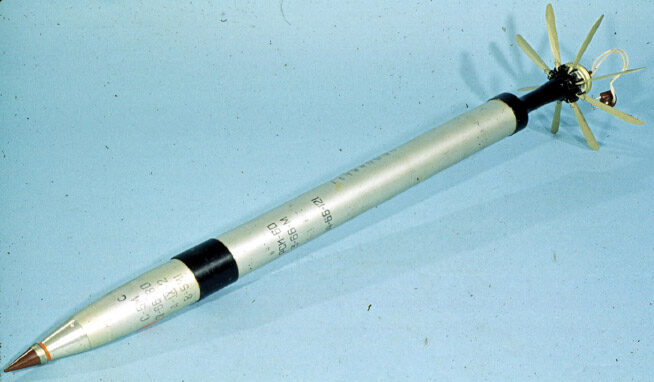
Record revision 1 · The small Soviet rocket of 1955, derived from a German wartime design and fired from pods of up to 32.
Real-world weapon as described in public sources. Weights and dimensions change with the fins, fuzes and variant fitted; the data plate names the variants its figures describe, and differences are noted beside the number they affect. The record describes the weapon; it is not a guide to employing it.
S-5 57 mm rocket · S-5 (ARS-57)
- Type
- 55 mm unguided air-to-ground rocket, fired from 57 mm tubes [1]
- Origin
- Soviet Union; developed by the Nudelman bureau (OKB-16) [1]
- In service
- Accepted into service in April 1955 as the ARS-57, military designation S-5 [1]
- Weight
- About 5 kg (11 lb), depending on warhead and fuze; the 2019 S-5U is 6 kg [1]
- Dimensions
- About 1.4 m (55 in) long; calibre 55 mm [1]
- Warhead or payload
- HEAT anti-armour (S-5K), high-explosive fragmentation (S-5M/MO), smoke and incendiary versions [1]
- Guidance
- None
- Fuzing
- Mechanical impact fuzeFuze GlossaryWeapons: A device that causes the detonation of an explosive charge at the proper time after certain conditions are met. A bomb fuze is mechanical or electrical, and is classed by what sets it off (impact, mechanical time… [1]
- Delivery
- Fired from pods of 4 to 32 rockets; eight folding fins spin the rocket at about 750 rpm, and the motor burns for 1.1 s [1]
- Range
- 3–4 km (1.6–2.2 NM) [1]
- Carried by
A German idea
The S-5 began as a study of a captured weapon. In 1946 the Soviet Nudelman design bureau, then OKB-16, began research on unguided air-to-air rockets, and among the things it examined closely was the German 55 mm R4M “Orkan” air-to-air rocket of the Second World War. [1] The project was only formally funded in 1951, as an air-to-air weapon for the MiG-19MiG-19 AircraftThe first Soviet fighter supersonic in level flight; the MiG-19P added radar for all-weather interception., and tests on MiG-15sMiG-15 AircraftThe Soviet swept-wing jet fighter that shocked UN air forces over Korea, armed with 37 mm and 23 mm cannon. and MiG-17s ran until January 1955. They showed that the rocket did not perform as hoped against aircraft, but it was accepted into service anyway in April 1955 as the ARS-57, designated S-5. [1]
Small and many
In service the S-5 has been used against ground area targets. It is a small steel rocket with a solid motor that burns for 1.1 seconds, covering about 300 m, and eight fins that fold around the body in the tube and spring open as it leaves, spinning it at about 750 rpm. [1] It is only 55 mm across but is fired from 57 mm tubes, which is why its pods carry the number 57. [1]
The S-5 is used in numbers. The first ORO-57 launchers held four, eight or 16 rockets, with the eight-round ORO-57K typical on the MiG-19MiG-19 AircraftThe first Soviet fighter supersonic in level flight; the MiG-19P added radar for all-weather interception.. From the early 1960s the 16-round UB-16-57 became standard on both aircraft and helicopters, its name meaning “universal block” because it fitted ordinary bomb racks, and in the 1970s the 32-round UB-32 followed for heavier aircraft. [1]
Revived
Production ended in 1990, and by 2013 only Belarus and Bulgaria still made the S-5. In 2019 Russia announced it would build it again as the S-5U: longer, heavier, with wrap-around fins and a universal 0.8 kg warhead that combines armour penetration, fragments and incendiary elements, while still fitting the old pods. [1]
Sources
- S-5 rocket. Wikipedia (secondary source). https://en.wikipedia.org/wiki/S-5_rocket (accessed 2026-10-26).
Wikipedia articles are secondary sources and can change; they are cited with the date they were read. NAVEDTRA training manuals and budget justification exhibits are official US publications, but each describes the weapons in service when it was written.