
Drafted — not technically validated
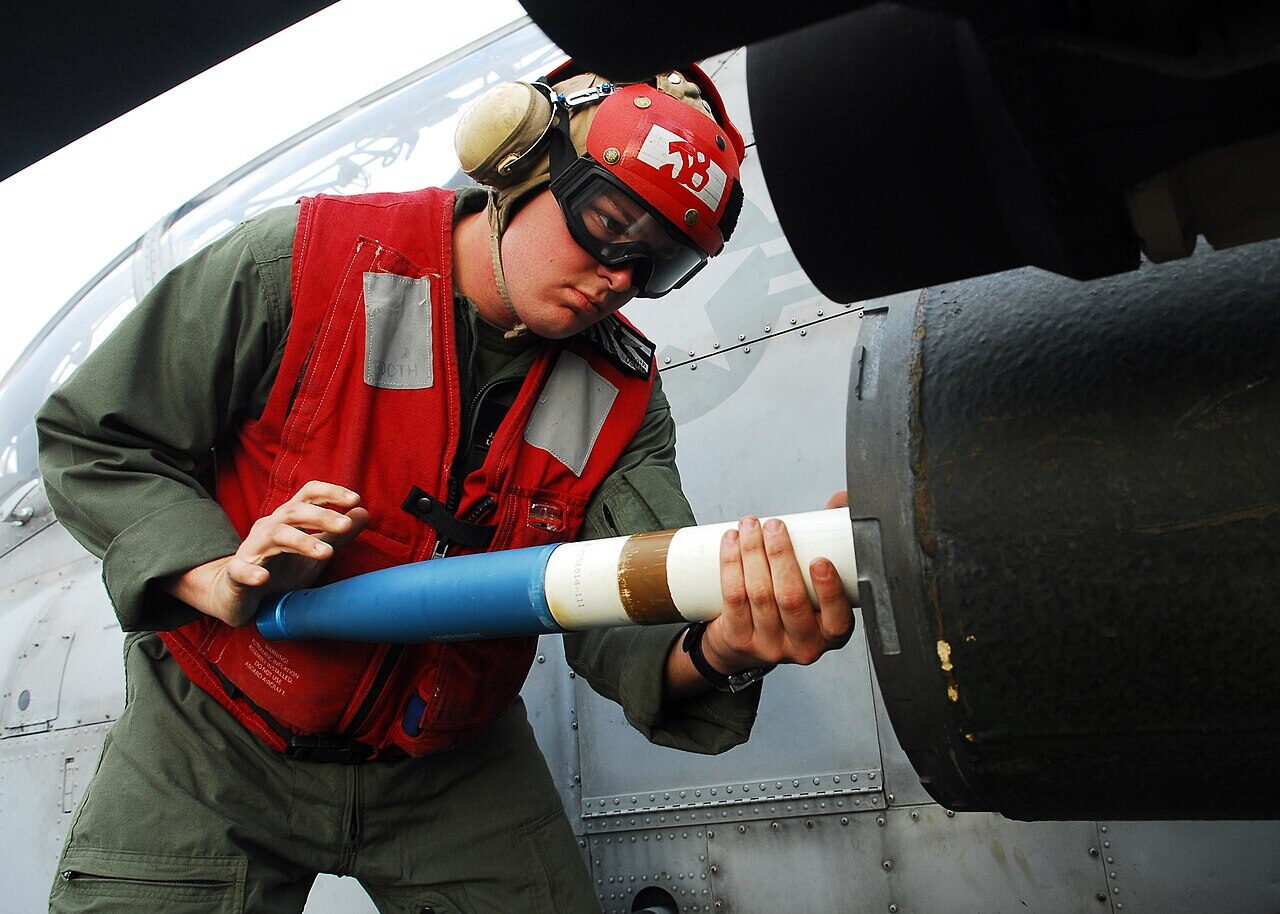
Record revision 1 · The 2.75 in rocket that began as the 'Mighty Mouse' bomber-killer and became the standard rocket of US attack helicopters.
Real-world weapon as described in public sources. Weights and dimensions change with the fins, fuzes and variant fitted; the data plate names the variants its figures describe, and differences are noted beside the number they affect. The record describes the weapon; it is not a guide to employing it.
Hydra 70 (2.75 in) rocket · Mk 66 / Hydra 70
- Type
- 2.75 in (70 mm) unguided, fin-stabilised air-to-ground rocket [1]
- Origin
- United States; developed from the Navy's Mk 4 and Mk 40 Folding-Fin Aerial Rocket of the late 1940s [1] [2]
- Weight
- Mk 66 motor 13.6 lb (6.2 kg); about 25 lb (11 kg) for a complete rocket, depending on the warhead [1]
- Dimensions
- Diameter 2.75 in (70 mm); motor length 41.7 in (1.06 m) [1]
- Warhead or payload
- Interchangeable: the M151 10 lb high-explosive warhead is the most common; also dual-purpose, smoke, illumination, flechette and practice warheads [1] [3]
- Guidance
- None; the APKWS laser guidance kit converts it into a guided rocket [1]
- Fuzing
- Impact-detonating or remote-set multi-option fuzesFuze GlossaryWeapons: A device that causes the detonation of an explosive charge at the proper time after certain conditions are met. A bomb fuze is mechanical or electrical, and is classed by what sets it off (impact, mechanical time… on unitary warheads; settable air-burst fuzesFuze GlossaryWeapons: A device that causes the detonation of an explosive charge at the proper time after certain conditions are met. A bomb fuze is mechanical or electrical, and is classed by what sets it off (impact, mechanical time… on cargo warheads [1]
- Range
- 547–8,749 yd (0.5–8 km) effective, depending on warhead and platform; up to 11,483 yd under optimum conditions [1]
- Carried by
- US Army: AH-64 ApacheAH-64D Apache Longbow AircraftThe US Army's twin-engine attack helicopter, flown from Panama and Desert Storm to Afghanistan; the Longbow adds a mast-mounted radar. (19-tube M261), OH-58D Kiowa WarriorOH-58D Kiowa Warrior AircraftThe US Army's armed scout helicopter, with its ball-shaped sight above the rotor, flown from the Persian Gulf to Afghanistan. (7-tube M260), UH-60 and AH-6 [1]
- US Marine Corps: AH-1W SuperCobra and AH-1Z Viper, UH-1UH-1H Huey AircraftThe utility helicopter that defined the Vietnam War and served every US armed service; more than 16,000 built. [1]
- US Navy: 7-tube LAU-68 and 19-tube LAU-61 launchers [4] [5]
- US Air Force [1]
A bomber-killer that missed
The 2.75 in rocket began as an answer to a Cold War problem. Jet bombers closed so fast that a fighter pilot had only a moment to fire, and wartime experience suggested that machine guns could not reliably bring a bomber down. The Germans had shown that volleys of unguided rockets could. [2] In the late 1940s the US Navy developed the Mk 4 Folding-Fin Aerial Rocket, about 4 ft long and 18.5 lb, whose fins flipped out as it left the tube. Crews called it “Mighty Mouse”, after the cartoon character. [2] In the early 1950s it was the main armament of interceptors such as the F-86DF-86 Sabre AircraftThe swept-wing day fighter that met the MiG-15 over Korea., F-89 and F-94C, carried in large numbers and fired in volleys. [2]
As an air-to-air weapon it was a disappointment. One hit could destroy a bomber, but the rockets scattered so widely that a 24-round volley covered an area the size of a football field. In August 1956 two Air Force F-89s fired 208 rockets at a runaway Navy target drone and failed to bring it down. By the end of the decade guided missilesGuided missile GlossaryWeapons: An unmanned vehicle moving above the surface of the Earth whose trajectory or flight path is capable of being altered by an external or internal mechanism. had replaced it. [2]
A second career
Against the ground, where a volley’s spread mattered less, the rocket found its true role, above all on the new armed helicopters. Fitted with the more powerful Mk 40 motor and a range of warheads, it served in Korea and Vietnam from about 20 different aircraft, fixed-wing and rotary. [1] [2] The Navy’s ordnance manual still notes that rockets began in aircraft armament in the Second World War because they gave a heavy blow without recoil, and that the Navy’s two rockets are the 2.75 in “Mighty Mouse” and the 5 in ZuniZuni 5 in rocket OrdnanceThe Navy's 5 in rocket of 1957, fired from four-tube LAU-10 pods and credited with an A-4 Skyhawk's only MiG kill.. [6] It describes FFARsFFAR GlossaryWeapons: Folding-fin aircraft rocket. The Navy's 2.75-inch rocket, known as the Mighty Mouse; the 5.0-inch folding-fin rocket is the Zuni. fired in large numbers to make a shotgun pattern, and a low-spin version for helicopters and low-speed aircraft which, because it spins, is fired one at a time rather than rippled. [4]
Hydra 70
The modern Hydra 70 is the same 2.75 in rocket with the Mk 66 motor. Its propellant gives considerably more thrust, its fins wrap around the body and flick sideways to open, and its slightly angled nozzles start it spinning while it is still in the tube. [1] The motor burns for just over a second and the rocket leaves the tube at 148 ft/s, reaching 2,425 ft/s at burnout. [1] The commonest warhead, the M151 “10-pounder”, is high-explosive fragmentation, the kind the Navy manual describes for use against troops and light targets such as trucks and parked aircraft. [1] [3]
Today it is carried by every US service. The Army fires it from ApachesAH-64D Apache Longbow AircraftThe US Army's twin-engine attack helicopter, flown from Panama and Desert Storm to Afghanistan; the Longbow adds a mast-mounted radar. in 19-tube M261 launchers and from KiowaOH-58D Kiowa Warrior AircraftThe US Army's armed scout helicopter, with its ball-shaped sight above the rotor, flown from the Persian Gulf to Afghanistan. Warriors in seven-tube M260s; the Marine Corps carries it on the AH-1W and AH-1Z and on the UH-1UH-1H Huey AircraftThe utility helicopter that defined the Vietnam War and served every US armed service; more than 16,000 built.; and the Navy and Air Force use it too. [1] The Navy’s launchers are the seven-tube LAU-68 and the 19-tube LAU-61, both reusable and able to fire singly or in ripple. [5]
Sources
- Hydra 70. Wikipedia (secondary source). https://en.wikipedia.org/wiki/Hydra_70 (accessed 2026-10-26).
- Folding-Fin Aerial Rocket. Wikipedia (secondary source). https://en.wikipedia.org/wiki/Folding-Fin_Aerial_Rocket (accessed 2026-10-26).
- Aviation Ordnanceman, NAVEDTRA 14313, p. 2-6. US Navy, Naval Education and Training Command; copy hosted by Integrated Publishing. https://navyaviation.tpub.com/14313/css/He-Frag-Warheads-58.htm (accessed 2026-10-26).
- Aviation Ordnanceman, NAVEDTRA 14313, p. 2-13. US Navy, Naval Education and Training Command; copy hosted by Integrated Publishing. https://navyaviation.tpub.com/14313/css/2-75-Inch-Ffar-And-Lsffar-65.htm (accessed 2026-10-26).
- Aviation Ordnanceman, NAVEDTRA 14313, p. 2-14. US Navy, Naval Education and Training Command; copy hosted by Integrated Publishing. https://navyaviation.tpub.com/14313/css/Table-2-4-2-75-Inch-Rocket-Launchers-66.htm (accessed 2026-10-26).
- Aviation Ordnanceman, NAVEDTRA 14313, p. 2-1. US Navy, Naval Education and Training Command; copy hosted by Integrated Publishing. https://navyaviation.tpub.com/14313/css/Chapter-2-Aircraft-Rockets-And-Rocket-Launchers-53.htm (accessed 2026-10-26).
Wikipedia articles are secondary sources and can change; they are cited with the date they were read. NAVEDTRA training manuals and budget justification exhibits are official US publications, but each describes the weapons in service when it was written.