
Drafted — not technically validated
Record revision 1 · The 5 in 'Holy Moses' rocket of the Second World War and Korea, fired from Thunderbolts, Corsairs and Skyraiders.
Real-world weapon as described in public sources. Weights and dimensions change with the fins, fuzes and variant fitted; the data plate names the variants its figures describe, and differences are noted beside the number they affect. The record describes the weapon; it is not a guide to employing it.
High Velocity Aircraft Rocket (HVAR) · HVAR
- Type
- 5 in (127 mm) unguided air-to-ground rocket, nicknamed 'Holy Moses' [1]
- Origin
- United States; designed at Caltech [1]
- In service
- 1944 to the mid-1960s; produced 1944–1955 [1]
- Weight
- 134 lb (61 kg) [1]
- Dimensions
- Length 68 in (1.73 m); diameter 5 in (127 mm) [1]
- Warhead or payload
- Mk 4 general-purpose head with 7.5–7.6 lb of TNT or Composition B, or Mk 2 armour-piercing head; post-war proximity-fuzed, smoke, anti-submarine and shaped-charge heads [1]
- Guidance
- None
- Fuzing
- Base fuzeFuze GlossaryWeapons: A device that causes the detonation of an explosive charge at the proper time after certain conditions are met. A bomb fuze is mechanical or electrical, and is classed by what sets it off (impact, mechanical time…, with an optional nose fuzeFuze GlossaryWeapons: A device that causes the detonation of an explosive charge at the proper time after certain conditions are met. A bomb fuze is mechanical or electrical, and is classed by what sets it off (impact, mechanical time…; later a proximity fuzeProximity fuze GlossaryWeapons: A fuze that detonates before impact when any substantial object is detected at a predetermined distance from it. [1]
- Delivery
- Fired singly, in pairs or in a rapid salvo; 1,375 ft/s plus the speed of the launching aircraft [1]
- Carried by
- Second World War: P-47D ThunderboltP-47D Thunderbolt AircraftThe heaviest single-engined fighter of the war: eight .50 calibre guns, a turbosupercharged radial, and a fearsome fighter-bomber., F4U CorsairF4U-1D Corsair AircraftThe bent-wing Navy and Marine fighter of the Pacific war, with a kill ratio better than 11 to 1., F6F Hellcat, TBF/TBM Avenger, SB2C Helldiver, P-38 Lightning, PBJ Mitchell, PV-2 Harpoon [1]
- Korean War: AD Skyraider, F-51D MustangP-51D Mustang AircraftThe long-range escort fighter that took US bombers to Berlin and back; Merlin-powered, with six .50 calibre guns., F9F Panther [1]
- Variants
- RAM: an oversized 6.5 in shaped-charge head on the HVAR motor [1]
A faster rocket
RocketsRocket GlossaryWeapons: A weapon propelled by the sustained reaction of a discharging jet of gas against the container of gas. Rockets answered the need for a large weapon that could be fired from an aircraft without recoil. entered aircraft armament in the Second World War because they offered a heavy blow with no recoil, and because a rocket fired at close range was more accurate than a bomb dropped from high altitude. [2] The first American 5 in aircraft rocket had a 5 in warhead on an underpowered motor only 3.25 in across. Engineers at Caltech wanted a faster rocket with a flatter trajectory, which would be easier to aim, and designed the HVAR with a full 5 in motor. It carried almost three times the propellant, and its speed gain roughly doubled. [1]
From Normandy to Okinawa
Testing finished by D-Day, and Navy HVARs were soon airlifted to France and loaded on Ninth Air Force P-47DP-47D Thunderbolt AircraftThe heaviest single-engined fighter of the war: eight .50 calibre guns, a turbosupercharged radial, and a fearsome fighter-bomber. Thunderbolts supporting the break-out from Normandy. [1] An HVAR could penetrate 4 ft of reinforced concrete, and it was used against shipping, pillboxes, gun positions, fuel and ammunition dumps, tanks, locomotives and bunkers. After victory in Europe, Navy CorsairsF4U-1D Corsair AircraftThe bent-wing Navy and Marine fighter of the Pacific war, with a kill ratio better than 11 to 1. and Avengers made the heaviest use of it in the Pacific. [1] More than a million were made during the war. [1]
Korea
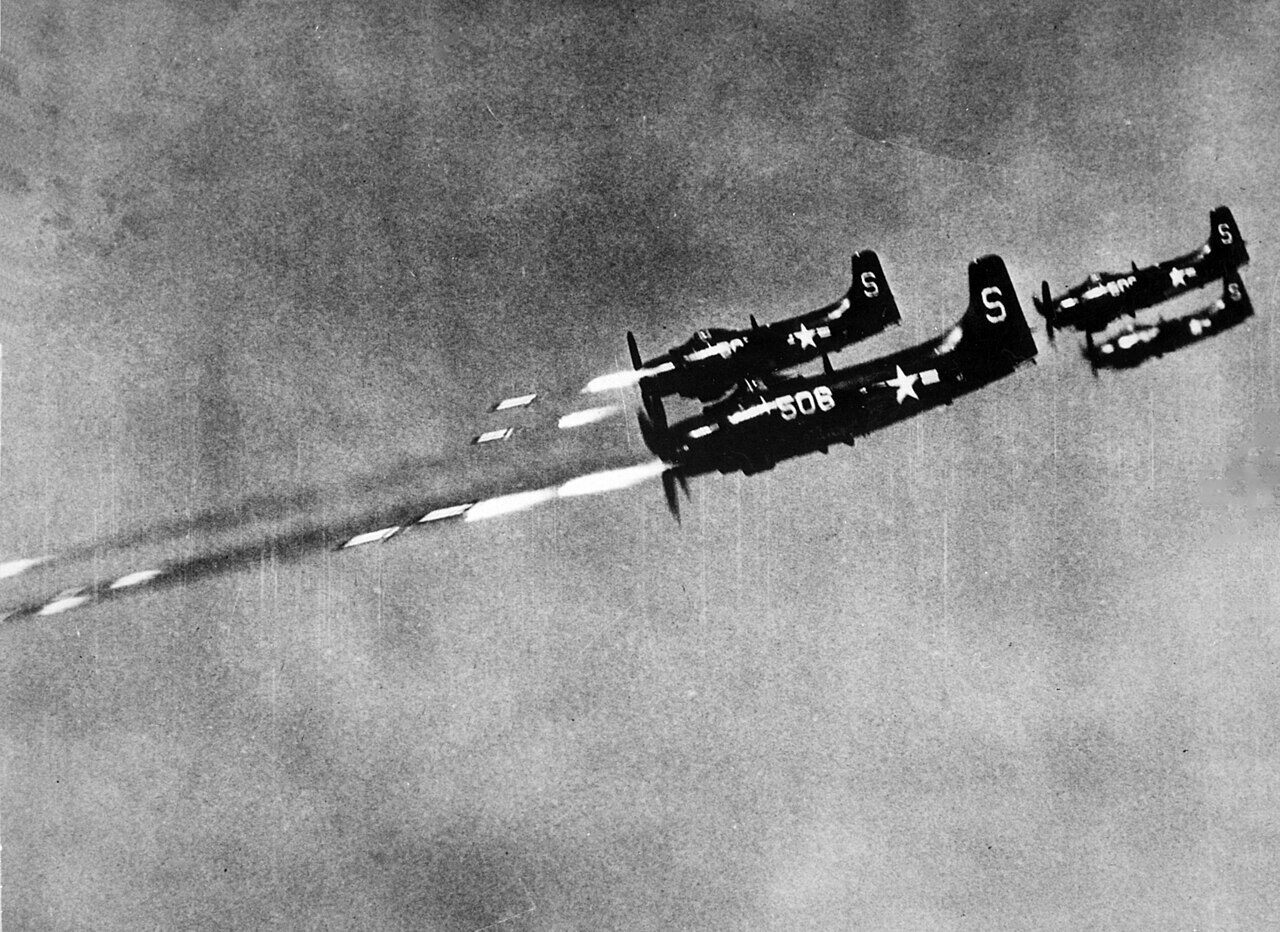
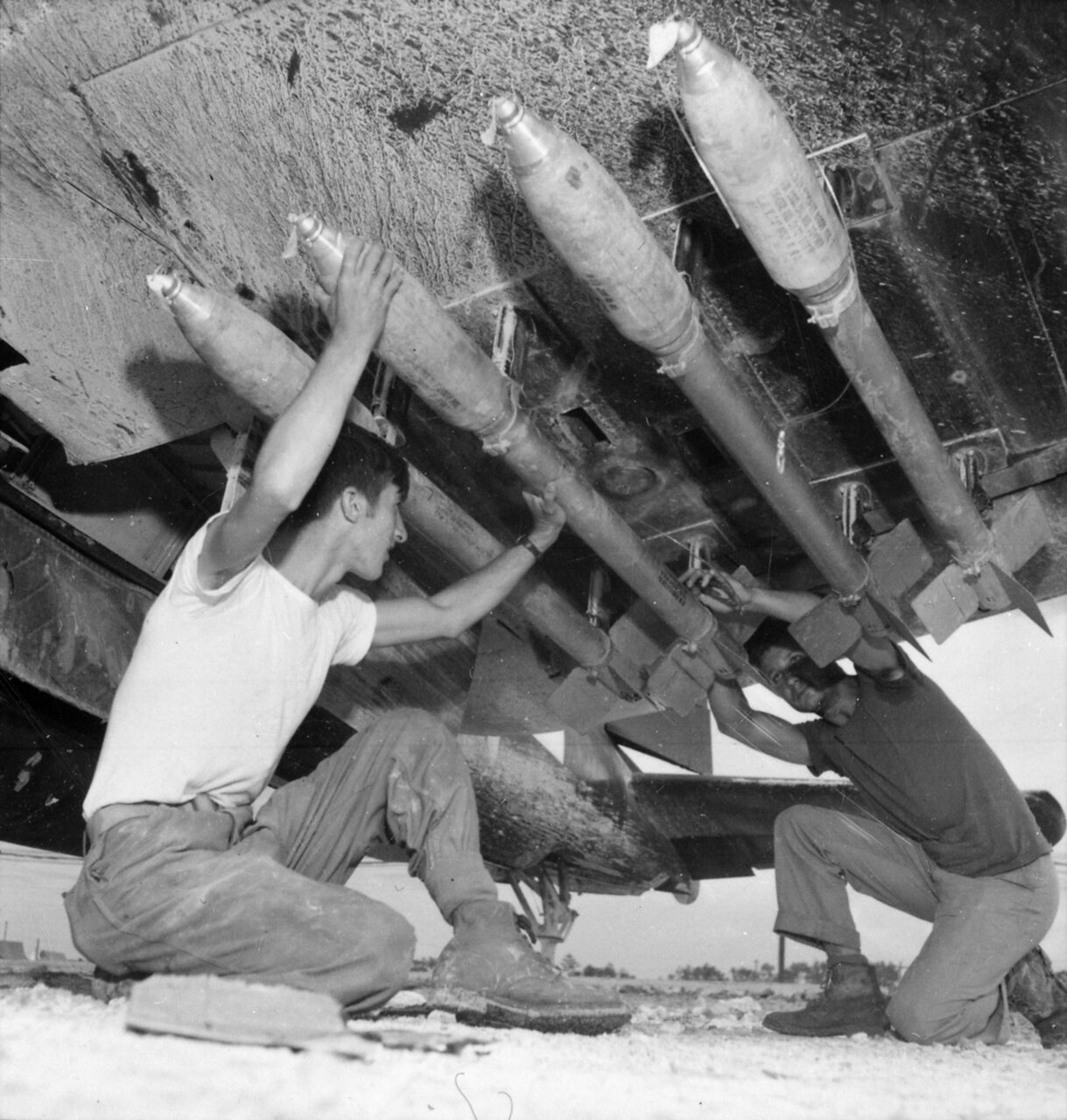
The HVAR stayed in production until 1955 and saw wide use in Korea. Navy AD Skyraiders often carried a dozen, Air Force F-51D MustangsP-51D Mustang AircraftThe long-range escort fighter that took US bombers to Berlin and back; Merlin-powered, with six .50 calibre guns. carried six or ten, and Navy F9F Panther jets carried six alongside their cannon. [1] Its targets ranged from bunkers and coastal guns to ships, bridges and even destroyers. [1]
The HVAR demanded skill. It rewarded experienced pilots and disappointed those used to aiming roughly and walking their gunfire onto a target: it needed accurate alignment before firing and a good judgement of range. [1] It remained in the Navy’s inventory until the mid-1960s. [1]

Sources
- High Velocity Aircraft Rocket. Wikipedia (secondary source). https://en.wikipedia.org/wiki/High_Velocity_Aircraft_Rocket (accessed 2026-10-26).
- Aviation Ordnanceman, NAVEDTRA 14313, p. 2-1. US Navy, Naval Education and Training Command; copy hosted by Integrated Publishing. https://navyaviation.tpub.com/14313/css/Chapter-2-Aircraft-Rockets-And-Rocket-Launchers-53.htm (accessed 2026-10-26).
Wikipedia articles are secondary sources and can change; they are cited with the date they were read. NAVEDTRA training manuals and budget justification exhibits are official US publications, but each describes the weapons in service when it was written.