
Drafted — not technically validated
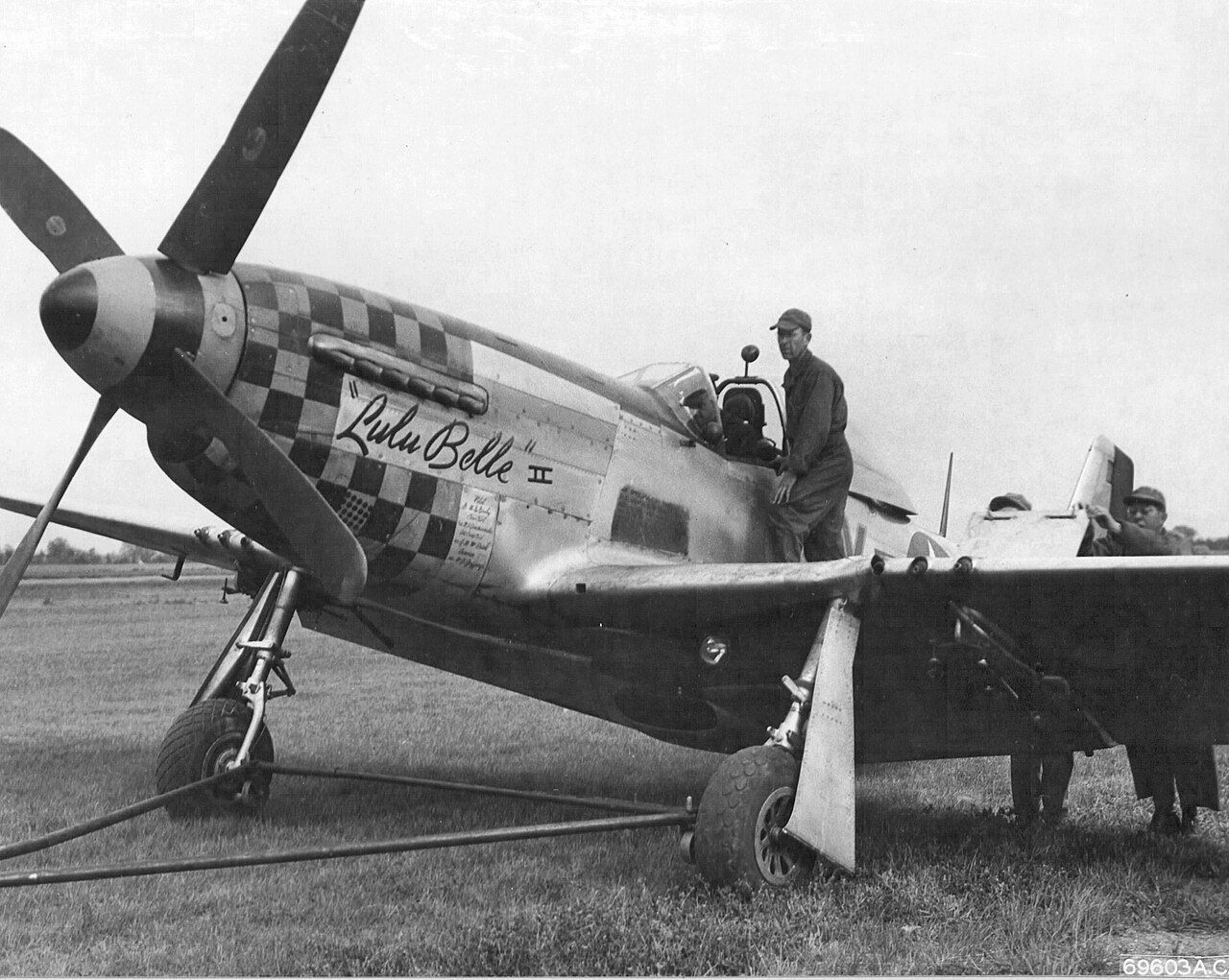
Record revision 1 · The long-range escort fighter that took US bombers to Berlin and back; Merlin-powered, with six .50 calibre guns.
Real-world aircraft as described in public sources. Figures vary between variants, loads and sources; the data plate names the variant its figures describe, and differences are noted beside the number they affect.
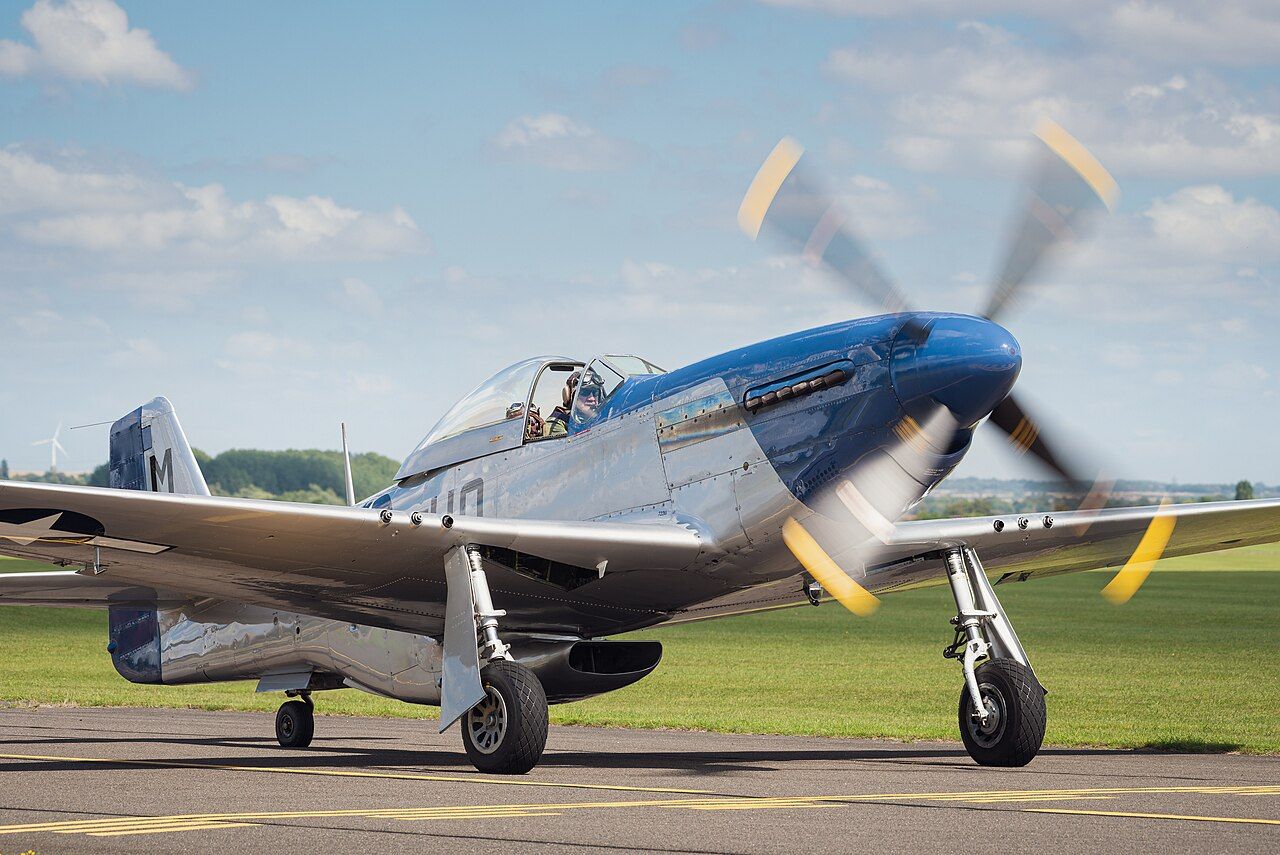
P-51D Mustang · North American P-51D Mustang
- Origin
- United States
- Crew
- 1 [1]
- Entered service
- 5 January 1942 (Royal Air Force); P-51B with the US Eighth and Ninth Air Forces from winter 1943–44 [1]
- Status
- Retired; the US Air Force withdrew its last in 1957 [2] and the Dominican Air Force in 1984 [1]. 15,686 built, 8,302 of them P-51Ds [1] [2]; many still fly as warbirds [1]
- Powerplant
- One Packard V-1650-7 Merlin V-12, liquid-cooled, two-stage supercharged: 1,490 hp, 1,720 hp at war emergency power [1]
- Maximum speed
- 440 mph (383 kt) [1]
- Service ceiling
- 41,900 ft [1]
- Range
- 1,650 miles (1,434 NM) with external tanks [1]
- Armament
- Six .50 calibre (12.7 mm) M2 Browning machine guns, 1,840 rounds [1] [2]
- Two bombs of 100, 250 or 500 lb, or six to ten 5 in HVARHigh Velocity Aircraft Rocket (HVAR) OrdnanceThe 5 in 'Holy Moses' rocket of the Second World War and Korea, fired from Thunderbolts, Corsairs and Skyraiders. rockets on later aircraft [1]
- Sensors and avionics
- K-14 gyro gunsight from late 1944 [1]
- Purchase
- DCS WorldDCS: P-51D Mustang by Eagle DynamicsDCS Store
- DCS WorldTF-51D Mustang (two-seat trainer) by Eagle DynamicsFree: comes with the free DCS World downloadDCS World
- Microsoft Flight SimulatorP-51D Mustang by Aeroplane HeavenOrbx
Store pages checked 2026-10-28. Prices and availability change.
Built for the British, in a hurry
In 1940 Britain was desperate for fighters and asked North American Aviation, a company that had never built one, to make Curtiss P-40s under licence. North American’s president, “Dutch” Kindelberger, said his company could design something better, with the same Allison engine, in less time than it would take to set up a P-40 line. [1] The British agreed. A team under engineer Edgar Schmued drew a clean, mass-producible fighter with two new ideas: a laminar-flow wing, developed with NACA for low drag at high speed, and a radiator mounted behind the pilot whose ducting turned waste heat into a little extra thrust. The prototype was rolled out about 100 days after the order and first flew in October 1940. [1] [2] The RAF named it the Mustang. [2]
A Merlin transforms it
The first Mustangs were fast and handled well low down, but their single-stage Allison engine ran out of breath above about 15,000 ft, where the air war over Europe was being fought. In 1942 a Rolls-Royce test pilot, Ronald Harker, suggested fitting the two-stage supercharged Merlin from the SpitfireSpitfire LF Mk IX AircraftThe elliptical-winged British fighter; the Merlin 66-powered Mark IX answered the Fw 190. IX. [1] The result was about 50 mph faster, and as the US-built Packard Merlin it became the P-51B. With an extra fuel tank behind the pilot and drop tanks under the wings, it could escort bombersFighter escort GlossaryJoint terms: An offensive counterair operation providing dedicated protection sorties by air-to-air capable fighters in support of other offensive air and air support missions over enemy territory, or in a defensive counterair role… from England to Germany and back. [1] [2] The P-51D followed with a cut-down rear fuselage, a bubble canopy that gave the pilot an all-round view, and six .50 calibre guns instead of four. More D models were built, 8,302, than all other versions combined. [2]
Over Berlin
In 1943 American heavy bombers were suffering terrible losses over Germany, because no Allied fighter could stay with them all the way to the target. The Mustang could. [1] [2] At the start of 1944 Major General James Doolittle, the new Eighth Air Force commander, freed his fighters from flying close escort and sent them out ahead to hunt the Luftwaffe wherever it could be found; bomber crews complained, but by June the Allies had air supremacy. By the end of 1944, 14 of the Eighth’s 15 fighter groups flew Mustangs. [1] Hermann Göring, head of the Luftwaffe, was quoted as saying: “When I saw Mustangs over Berlin, I knew the jig was up.” [1]
By May 1945, P-51 groups in Europe had claimed about 4,950 aircraft shot down, roughly half of all US claims in the theatre and more than any other Allied fighter, and 4,131 destroyed on the ground, for about 2,520 losses. The top Mustang ace, George Preddy, scored 23 of his 26.83 victories in the P-51 before he was killed by friendly fire on Christmas Day 1944. [1] Mustangs even caught Germany’s new jets: Chuck Yeager of the 357th Fighter Group shot down an Me 262 on its landing approach, and on 7 October 1944 Urban Drew of the 361st downed two as they took off. [1] Among the units flying them were the Tuskegee Airmen of the 332nd Fighter Group in Italy. [1]
The Mustang had one weakness. Its liquid-cooled engine depended on a radiator and coolant lines, and a single bullet through either could bring it down, which made strafing far more dangerous for it than for the air-cooled P-47P-47D Thunderbolt AircraftThe heaviest single-engined fighter of the war: eight .50 calibre guns, a turbosupercharged radial, and a fearsome fighter-bomber.. [1] [2]
Iwo Jima to Korea
From March 1945 Mustangs flew from Iwo Jima to escort B-29s over Japan: round trips of 1,500 miles, mostly over water with little navigation equipment, lasting seven or eight hours. [1] After the war the newly independent US Air Force kept the Mustang, renamed the F-51 in 1948, and sent it back into combat in Korea, where its long range let it reach targets that early jets based in Japan could not. It flew ground attack there with the US, South African, South Korean and Australian air forces, and its cooling system again made it vulnerable to ground fire. [1] [2] The US Air Force retired its last P-51s in 1957, and the Dominican Air Force flew them until 1984. [1] [2]

Sources
- North American P-51 Mustang. Wikipedia (secondary source). https://en.wikipedia.org/wiki/North_American_P-51_Mustang (accessed 2026-10-25).
- North American P-51D Mustang. Smithsonian National Air and Space Museum. https://airandspace.si.edu/collection-objects/north-american-p-51d-30-na-mustang/nasm_A19600300000 (accessed 2026-10-25).
Wikipedia articles are secondary sources and can change; they are cited with the date they were read. The Federation of American Scientists (FAS) Military Analysis Network pages largely reproduce US service fact sheets of the late 1990s and early 2000s, so later upgrades are not covered there.