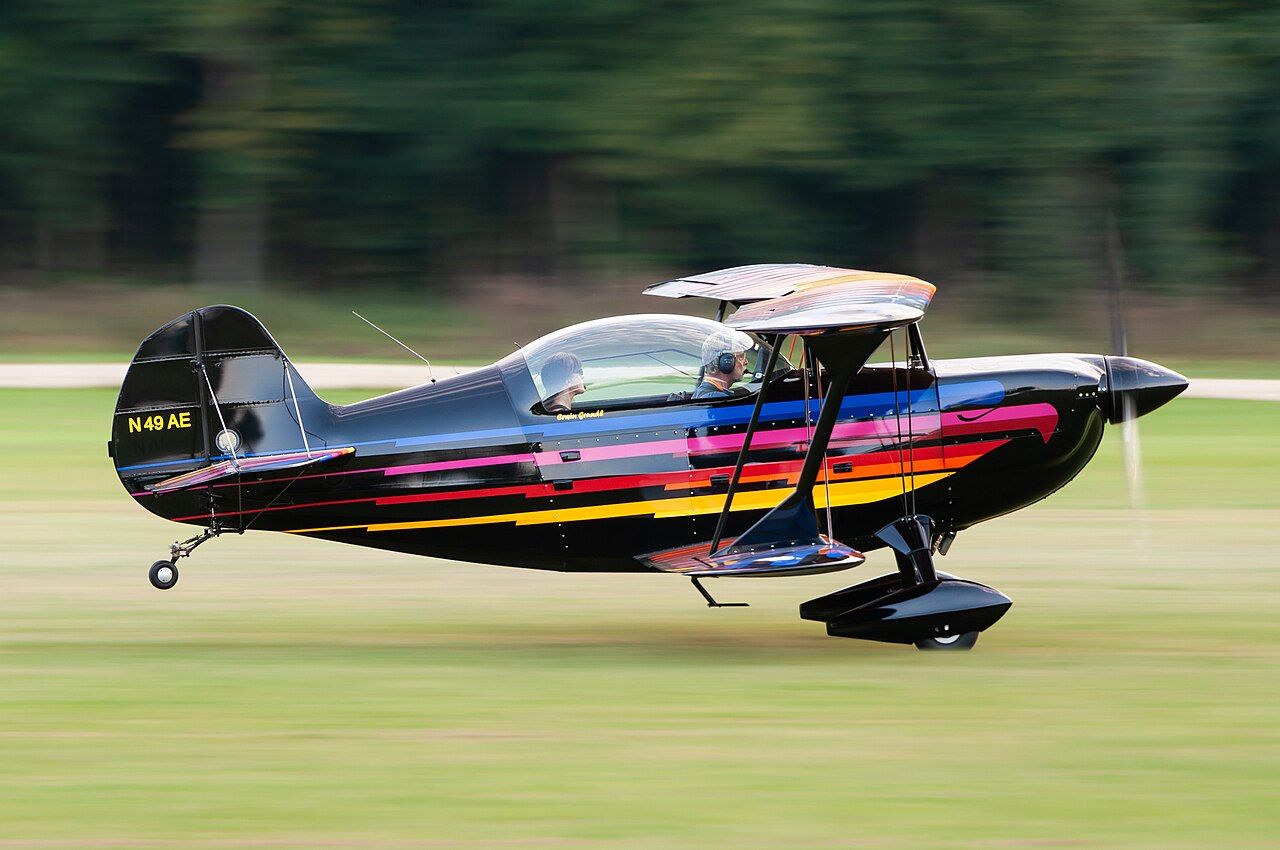

Drafted — not technically validated
Record revision 1 · A two-seat kit-built aerobatic biplane, flown by the Eagles Aerobatic Team.
Real-world aircraft as described in public sources. Figures vary between variants, loads and sources; the data plate names the variant its figures describe, and differences are noted beside the number they affect.
Christen Eagle II · Christen Eagle II
- Variant described
- Eagle II, two-seat homebuilt kit version [1]
- Role
- Aerobatic sport biplane (civilian) [1]
- Origin
- United States
- Manufacturer
- Christen Industries; Aviat Aircraft from the 1990s; a new Christen Industries from 2025 [1]
- Crew
- 2, in tandem, with dual controls [1]
- First flight
- February 1977 [1]
- Entered service
- Late 1970s; over 350 flying by 2011 [1]
- Status
- In production again as the Christen Eagle [1]
- Powerplant
- One Lycoming AEIO-360-A1D air-cooled flat-four, 200 hp, with a two-bladed constant-speed propeller [1]
- Maximum speed
- 184 mph (160 kt); never-exceed speed 210 mph; cruise 165 mph [1]
- Service ceiling
- 17,000 ft [1]
- Range
- 437 miles (380 NM) [1]
- Armament
- None [1]
- Purchase
- DCS WorldDCS: Christen Eagle II by Magnitude 3DCS Store
Store pages checked 2026-10-28. Prices and availability change.
A kit-built rival to the Pitts
The Eagle is not a warplane. It is a small aerobatic biplane designed by Frank Christensen to compete with the famous Pitts Special, and the Eagle II is marketed as a kit for owners to build themselves. [1]
Its construction is traditional. The fuselage and tail are a welded frame of chrome-molybdenum steel tube, skinned in aluminium at the front and fabric at the back; the wings are Sitka spruce covered in fabric, braced with streamlined wires and joined by a single I-shaped strut on each side. Pilot and passenger sit one behind the other under a large bubble canopy, and the wheels are fixed, on sprung aluminium legs with streamlined spats. [1]
Small, light and strong
The two-seat Eagle II weighs about 1,025 lb empty and has a 200 hp Lycoming engine driving a constant-speed propeller. It is stressed to +9 and −6 g and rolls at 187 degrees a second. [1]
The Eagles Aerobatic Team
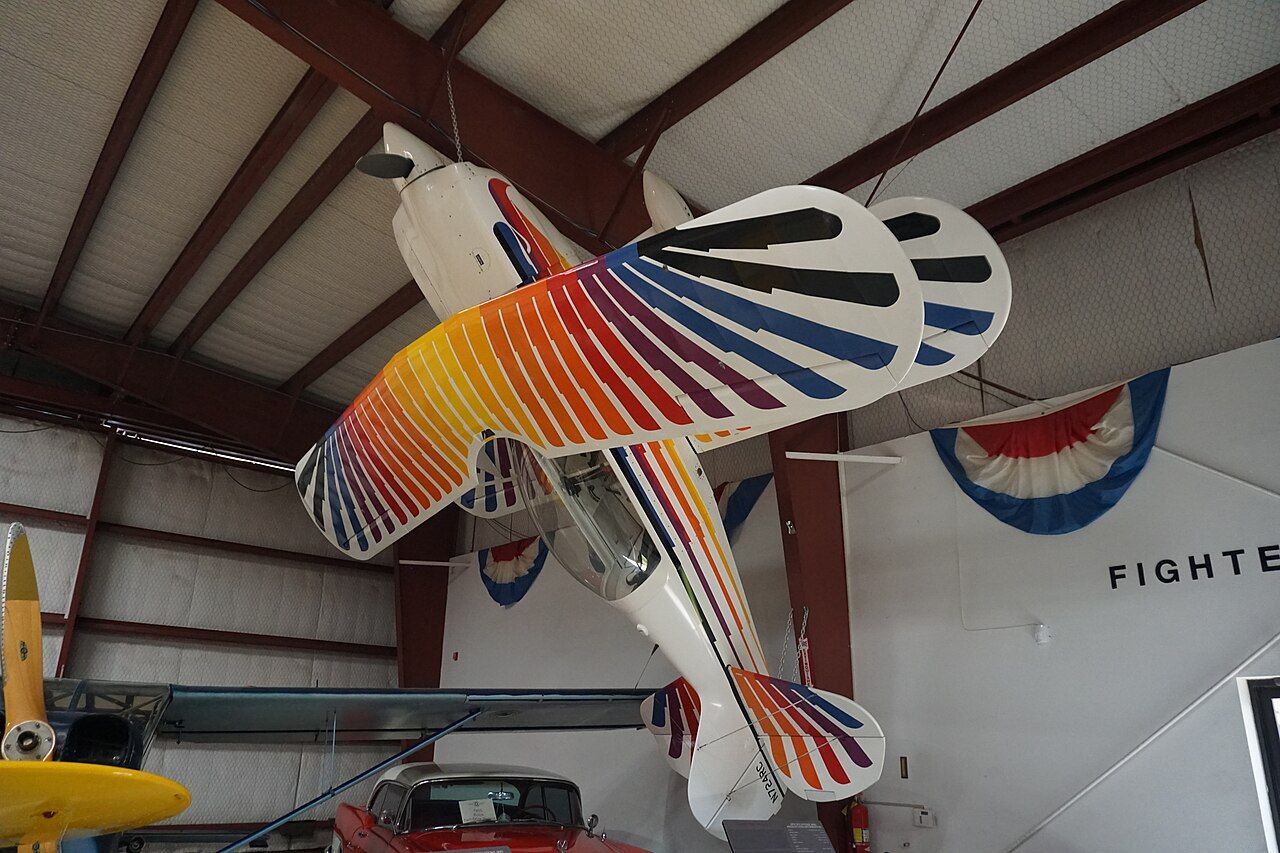
In 1979 three well-known display pilots, Charlie Hillard, Tom Poberezny and Gene Soucy, replaced the Pitts Specials of their “Red Devils” act with single-seat Christen Eagles. As the Eagles Aerobatic Team they flew close-formation aerobatics at air shows until 1995. All three of their aircraft now hang in the lobby of the EAA AirVenture Museum in Oshkosh, Wisconsin. [1]

Sources
- Aviat Eagle (Christen Eagle). Wikipedia (secondary source). https://en.wikipedia.org/wiki/Aviat_Eagle (accessed 2026-10-25).
Wikipedia articles are secondary sources and can change; they are cited with the date they were read. The Federation of American Scientists (FAS) Military Analysis Network pages largely reproduce US service fact sheets of the late 1990s and early 2000s, so later upgrades are not covered there.