
Drafted — not technically validated
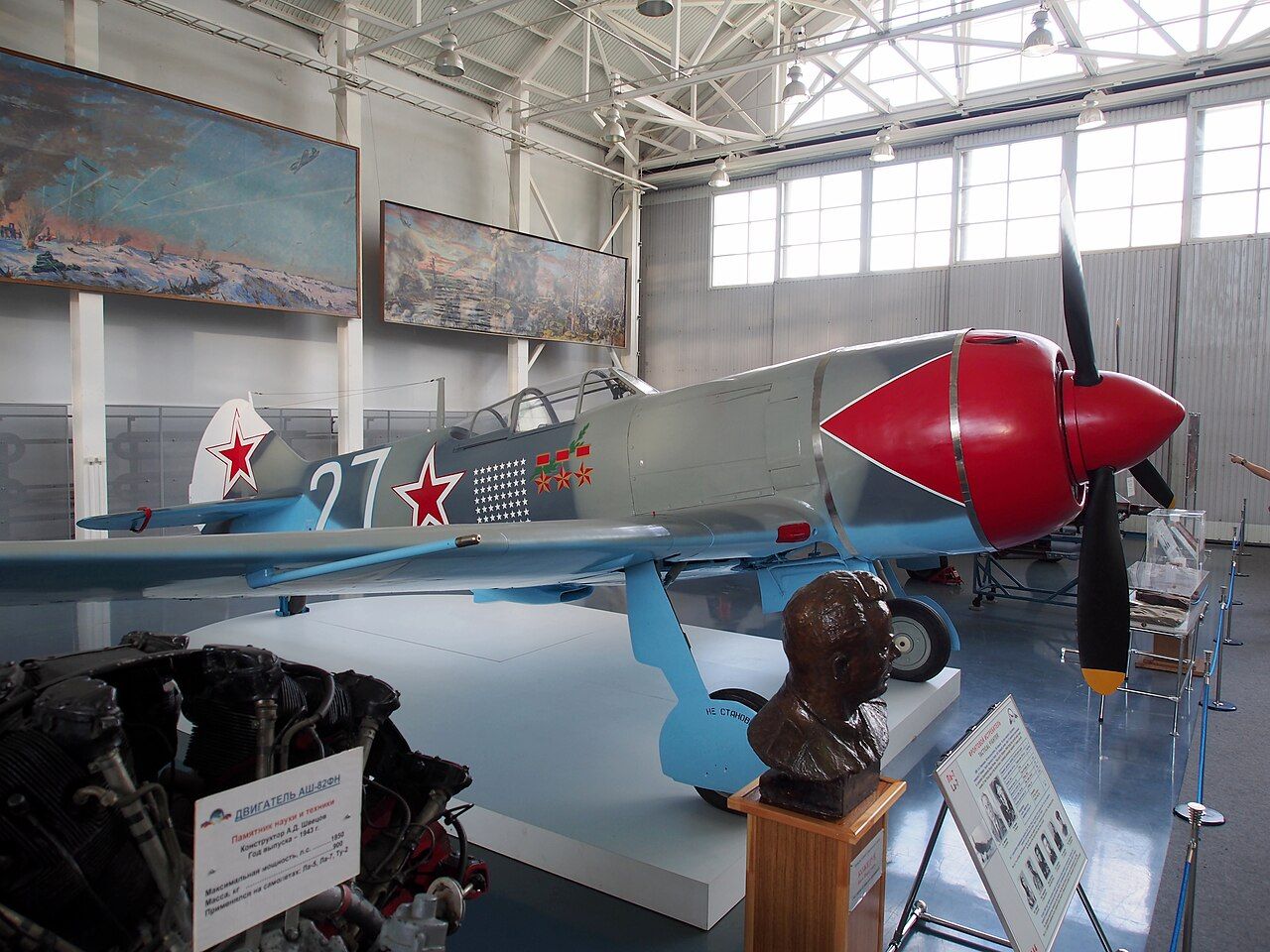
Record revision 1 · The refined Soviet radial-engined fighter of 1944–45, flown by the top Soviet ace Ivan Kozhedub.
Real-world aircraft as described in public sources. Figures vary between variants, loads and sources; the data plate names the variant its figures describe, and differences are noted beside the number they affect.
La-7 · Lavochkin La-7
- Variant described
- La-7, 1945 production [1]
- Role
- Fighter [1]
- Origin
- Soviet Union
- Manufacturer
- Lavochkin design bureau; built at Factories 21 (Gorky), 381 (Moscow) and 99 (Ulan-Ude) [1]
- Crew
- 1 [1]
- First flight
- 1 February 1944 (La-5 mod. 1944) [1]
- Entered service
- June 1944; combat trials from mid-September 1944 [1]
- Status
- Retired; phased out of Soviet service in 1947 (the infobox gives 1952) and by Czechoslovakia in 1950 [1]. 5,753 built, plus 584 two-seat trainers [1]
- Powerplant
- One Shvetsov ASh-82FN 14-cylinder two-row air-cooled radial, 1,380 kW (1,850 hp) [1]
- Maximum speed
- 661 km/h (357 kt) at 6,000 m [1]
- Service ceiling
- 10,450 m (34,300 ft) [1]
- Range
- 665 km (359 NM) (1944 model) [1]
- Armament
- Two 20 mm ShVAK cannon; three 20 mm B-20 cannon on aircraft built from January 1945 [1]
- Purchase
- DCS WorldDCS: La-7 by OctopusGDCS Store
Store pages checked 2026-10-28. Prices and availability change.
Refining a wooden fighter
The La-7 was the last of a family that began in 1938 with the LaGG-1. Its predecessor, the La-5, was a mainstay of the Soviet air force by 1943, but designer Semyon Lavochkin and the engineers of the Central Aerohydrodynamic Institute (TsAGI) believed it could be better. [1] TsAGI took a standard La-5FN and sealed every gap in the engine cowling, moved the oil cooler into the wing and the air intake under the nose. With the same engine it was 64 km/h faster. [1]
Lavochkin went further. The La-5 had been built mostly of wood to save scarce aluminium, and now that supplies were secure he replaced parts of the structure with light alloy, moved the air intakes to the wing roots and gave each engine cylinder its own exhaust pipe. The prototype was 180 kg lighter and climbed to 5,000 m in under four and a half minutes. It went into production as the La-7 in spring 1944. [1] Early aircraft had troubles: low-mounted intakes let the engine swallow sand and dust, and a batch of faulty wing spars caused six accidents, four of them fatal, before the fleet was grounded and the fault found. [1]
Kozhedub’s fighter
The 63rd Guards Fighter Regiment took 30 La-7s into combat trials in September 1944 and claimed 55 victories in a month for four aircraft lost in combat. Its commander, Colonel Yevgeny Gorbatyuk, reported “unquestionable advantages over German aircraft”, but asked for heavier guns and an urgent fix for the engine, because two 20 mm cannon were no longer enough to bring down an armoured Fw 190 in one burst. Three-cannon aircraft followed from January 1945. [1]
The top Soviet ace of the war, Ivan Kozhedub, a three-time Hero of the Soviet Union, scored his last 17 victories in an La-7, numbered 27, including one of the few Me 262 jets ever shot down. His aircraft is preserved at the Central Air Force Museum at Monino. [1] The La-7 ended the Bf 109G’s advantage in climbing fights and was fast enough at low level to catch Fw 190 fighter-bombers running for home. [1] By the end of the war 967 were in front-line service, and 313 took part in the invasion of Japanese-held Manchuria in August 1945. [1]
British test pilot Eric Brown flew one in Germany in May 1945. He found the handling and performance “quite superb”, but the guns and sights “below par”, the instruments “appallingly basic”, and thought its wooden structure “would have withstood little combat punishment”. [1]
Sources
- Lavochkin La-7. Wikipedia (secondary source). https://en.wikipedia.org/wiki/Lavochkin_La-7 (accessed 2026-10-25).
Wikipedia articles are secondary sources and can change; they are cited with the date they were read. The Federation of American Scientists (FAS) Military Analysis Network pages largely reproduce US service fact sheets of the late 1990s and early 2000s, so later upgrades are not covered there.