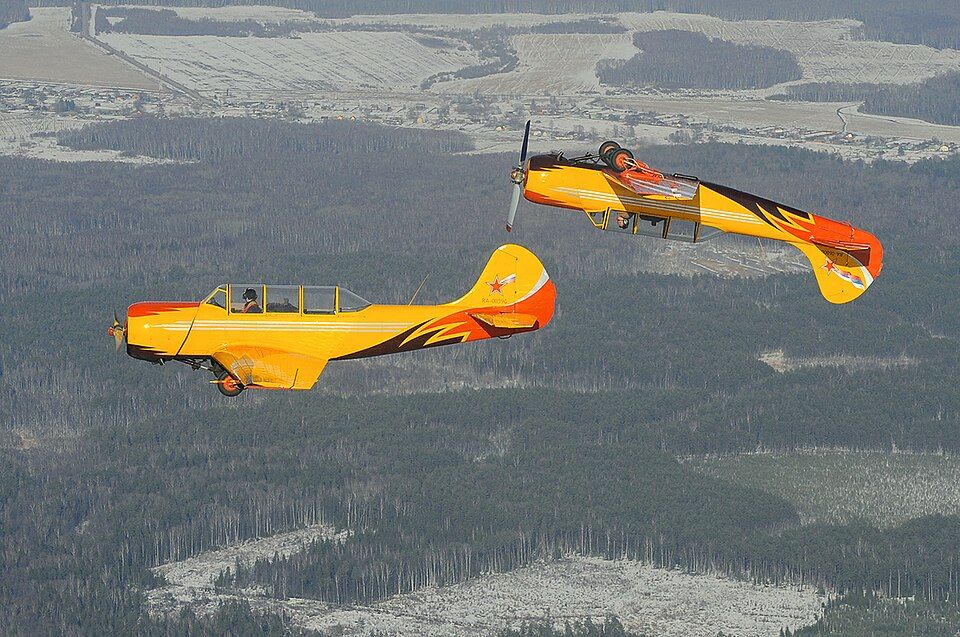

Drafted — not technically validated
Record revision 1 · A Soviet aerobatic primary trainer, built in Romania, that has also hunted drones over Ukraine.
Real-world aircraft as described in public sources. Figures vary between variants, loads and sources; the data plate names the variant its figures describe, and differences are noted beside the number they affect.
Yak-52 · Yakovlev Yak-52
- Variant described
- Yak-52 [1]
- Role
- Primary and aerobatic trainer [1]
- Origin
- Soviet Union; built in Romania
- Manufacturer
- Yakovlev design; produced by Aerostar in Romania from 1977 to 1998 as the Iak-52 [1]
- Crew
- 2, in tandem [1]
- First flight
- 1976 [1]
- Entered service
- 1979 [1]
- Status
- In service; the Romanian Air Force is listed as an operator in 2026, and Ukrainian and Russian forces have used it against drones [1]. Widely flown by civilian aerobatic pilots [1]
- Powerplant
- One Vedeneyev M-14P nine-cylinder radial, 360 hp (268 kW) [1]
- Maximum speed
- 285 km/h (154 kt) at sea level; cruise 190 km/h [1]
- Service ceiling
- 4,000 m (13,100 ft) [1]
- Range
- 550 km (297 NM) at 500 m [1]
- Armament
- None on the trainer; the Yak-52B light attack version carries two UB-32-57 pods of S-5S-5 57 mm rocket OrdnanceThe small Soviet rocket of 1955, derived from a German wartime design and fired from pods of up to 32. rockets [1]
- In Ukraine, a gunner in the rear seat has engaged drones at close range [1]
- Purchase
- DCS WorldDCS: Yak-52 by Eagle DynamicsDCS Store
Store pages checked 2026-10-28. Prices and availability change.
A trainer that thinks it is a fighter
The Yak-52 was built to start pilots on the way to jets. It was designed for DOSAAF, the Soviet organisation that trained sport pilots and future military pilots, and it descends from the single-seat Yak-50 aerobatic competition aircraft. [1] Much of it deliberately copies early postwar jet fighters: the tandem cockpits, the instrument panel and seats, the tail, the tricycle undercarriage and even the overall dimensions match the Yak-17 jet trainer. A student who learned on a Yak-52 would feel at home when stepping up to a jet. [1]
It is all metal and was built, like most Soviet military aircraft, to work in rough conditions with little maintenance. Compressed air does the work that electrics and hydraulics do in Western aircraft: engine starting, undercarriage, flaps and brakes all run from air bottles behind the rear cockpit, topped up by a compressor on the engine. [1] Even when retracted the wheels stay partly exposed, adding useful drag in a dive and offering some protection if the pilot has to land with the gear up. [1]
Every manoeuvre in the book
The Yak-52’s nine-cylinder radial engine and fuel system can keep running upside down for up to two minutes. It is stressed for +7 and −5 g, rolls to the right at up to 352 degrees a second, and can fly every manoeuvre in the Aresti catalogue, the international dictionary of aerobatic figures. [1] It is flown in its own FAI World Aerobatic Yak-52 Competition, and Western owners have fitted many with new instruments, three-bladed propellers and tailwheels. [1]
An unarmed drone hunter
Production moved to Romania under a COMECON agreement, and Aerostar built the Iak-52 there from 1977 to 1998. [1] Nearly half a century after its first flight the Yak-52 found an unexpected military role. In the Russian invasion of Ukraine, Ukrainian Yak-52s have hunted Russian reconnaissanceReconnaissance GlossaryJoint terms: A mission undertaken to obtain, by visual observation or other detection methods, information about the activities and resources of an enemy or adversary, or to secure data concerning the meteorological, hydrographic, or… drones, shooting down an Orlan-10 over Odesa in April 2024. Its slow stall speed lets it follow a drone closely while a gunner in the rear seat fires at it, and images suggest at least one has downed as many as eight. [1]

Sources
- Yakovlev Yak-52. Wikipedia (secondary source). https://en.wikipedia.org/wiki/Yakovlev_Yak-52 (accessed 2026-10-25).
Wikipedia articles are secondary sources and can change; they are cited with the date they were read. The Federation of American Scientists (FAS) Military Analysis Network pages largely reproduce US service fact sheets of the late 1990s and early 2000s, so later upgrades are not covered there.