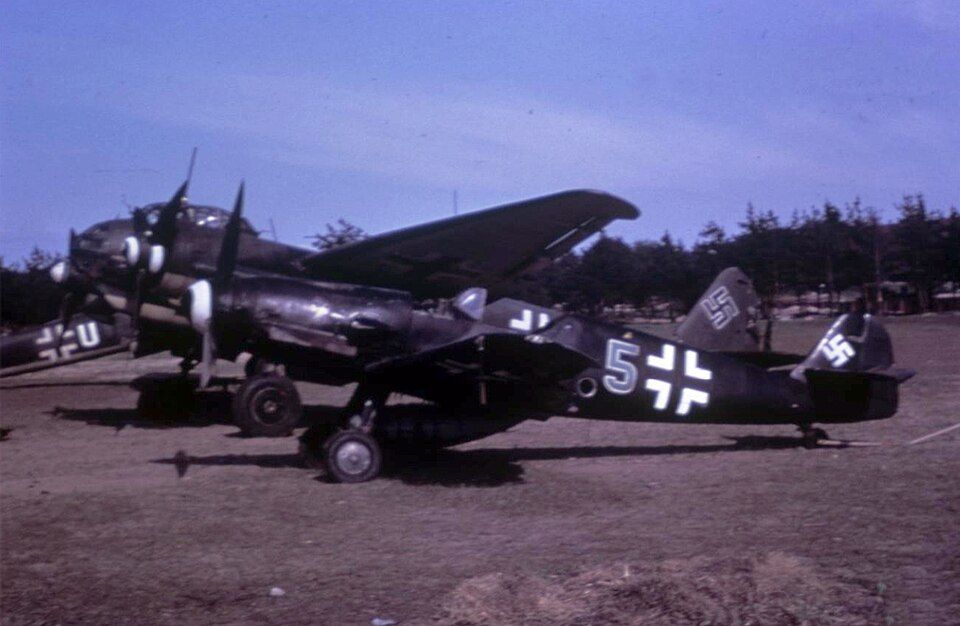

Drafted — not technically validated
Record revision 1 · The final production version of the most-produced fighter in history, Germany's standard fighter throughout the war.
Real-world aircraft as described in public sources. Figures vary between variants, loads and sources; the data plate names the variant its figures describe, and differences are noted beside the number they affect.
Bf 109 K-4 · Messerschmitt Bf 109 K-4
- Variant described
- Bf 109 K-4, the last production version; ceiling and range are for the Bf 109 G-6 [1] [2]
- Origin
- Germany
- Manufacturer
- Bayerische Flugzeugwerke, renamed Messerschmitt AG in 1938; K-4 built at Regensburg [1] [2] [3]
- Crew
- 1 [1]
- Status
- Retired; Luftwaffe service ended 9 May 1945, and Spanish-built versions served until 27 December 1965 [1]. 34,248 built, the most-produced fighter in history [1]; at least 1,593 K-4s [2]
- Powerplant
- One Daimler-Benz DB 605 DB/DC inverted V-12, liquid-cooled: 1,850 PS for take-off, up to 2,000 PS with MW 50 methanol-water injection (DC) [2]
- Maximum speed
- 710 km/h (383 kt) at 7,500 m with MW 50, the fastest Bf 109 of the war; 670 km/h at 9,000 m without [2]
- Service ceiling
- 12,000 m (39,400 ft) (G-6) [1]
- Range
- 880–1,144 km; 1,994 km with a drop tank (G-6) [1]
- Armament
- Sensors and avionics
- Purchase
- DCS WorldDCS: Bf 109 K-4 Kurfürst by Eagle DynamicsDCS Store
Store pages checked 2026-10-28. Prices and availability change.
Flown first with a British engine
The most-produced fighter in history first flew with a Rolls-Royce engine. When Willy Messerschmitt and Robert Lusser’s prototype was ready in 1935, no suitable German engine existed, so the German air ministry traded Rolls-Royce a Heinkel He 70 for four Kestrel engines, and the Bf 109 V1 took off on a British V-12. [1] [3] It was built on Messerschmitt’s “lightweight construction” principle: a small airframe with few separate parts, a single main spar, and leading-edge slats that opened automatically to help it turn. The landing gear was attached to the fuselage, so the wings could be removed for servicing. [1]
Luftwaffe pilots used to open-cockpit biplanes were critical of it at first, and the Heinkel He 112 was the favourite of the service’s leaders. But the Bf 109 was faster and climbed and dived better, and when Messerschmitt’s test pilot flew spins, dives, flick rolls and tight turns in full control, the commission chose it. News that Britain had ordered the SpitfireSpitfire LF Mk IX AircraftThe elliptical-winged British fighter; the Merlin 66-powered Mark IX answered the Fw 190. into production hurried the decision. [1] In 1937 a special Bf 109 set a world speed record for landplanes of 610.95 km/h. [1]
Messer
The Bf 109 first fought in the Spanish Civil War and was the Luftwaffe’s main fighter when the Second World War began. [1] [3] Over Britain in 1940 it met the SpitfireSpitfire LF Mk IX AircraftThe elliptical-winged British fighter; the Merlin 66-powered Mark IX answered the Fw 190., which was slightly faster and more manoeuvrable but weaker at altitude; its limited fuel gave it only about 20 minutes over England, and many pilots ran dry and crashed into the Channel. [3] Its narrow undercarriage made it tricky on the ground: at least 10% of all Bf 109s were lost in take-off and landing accidents. [1]
The Allies called it the Me 109. German crews and their opponents called it Messer, short for Messerschmitt and also the German word for “knife”; Soviet pilots called it “the skinny one”. [1] It was flown by the three highest-scoring fighter pilots in history, all of Jagdgeschwader 52 on the Eastern Front, led by Erich Hartmann with 352 victories, and by Hans-Joachim Marseille, who claimed 158 in North Africa. [1] More aircraft were shot down by the Bf 109 than by any other aircraft of the war. [1]
Kurfürst: the last 109
By 1943 the Bf 109 came in a bewildering range of versions, kits and conversions that Germany could no longer afford to build and maintain. The air ministry ordered one standard model with interchangeable parts, the K series, or Kurfürst. The K-4 was the only version mass-produced. [2] Deliveries began in mid-October 1944; by the end of January 1945 about one in four Bf 109s in front-line units was a K-4. [2] With methanol-water injection it reached 710 km/h, the fastest Bf 109 of the war. Its 30 mm cannon fired through the propeller hub, though it often jammed when the pilot manoeuvred hard, leaving only the two machine guns. [2]
Some Bf 109s were built by slave labour in Nazi concentration camps. [1] After the war the type flew on: it was the first aircraft of the Israeli Air Force, Finland kept its Bf 109Gs until 1954, and Spanish-built versions served into the late 1960s. [1]
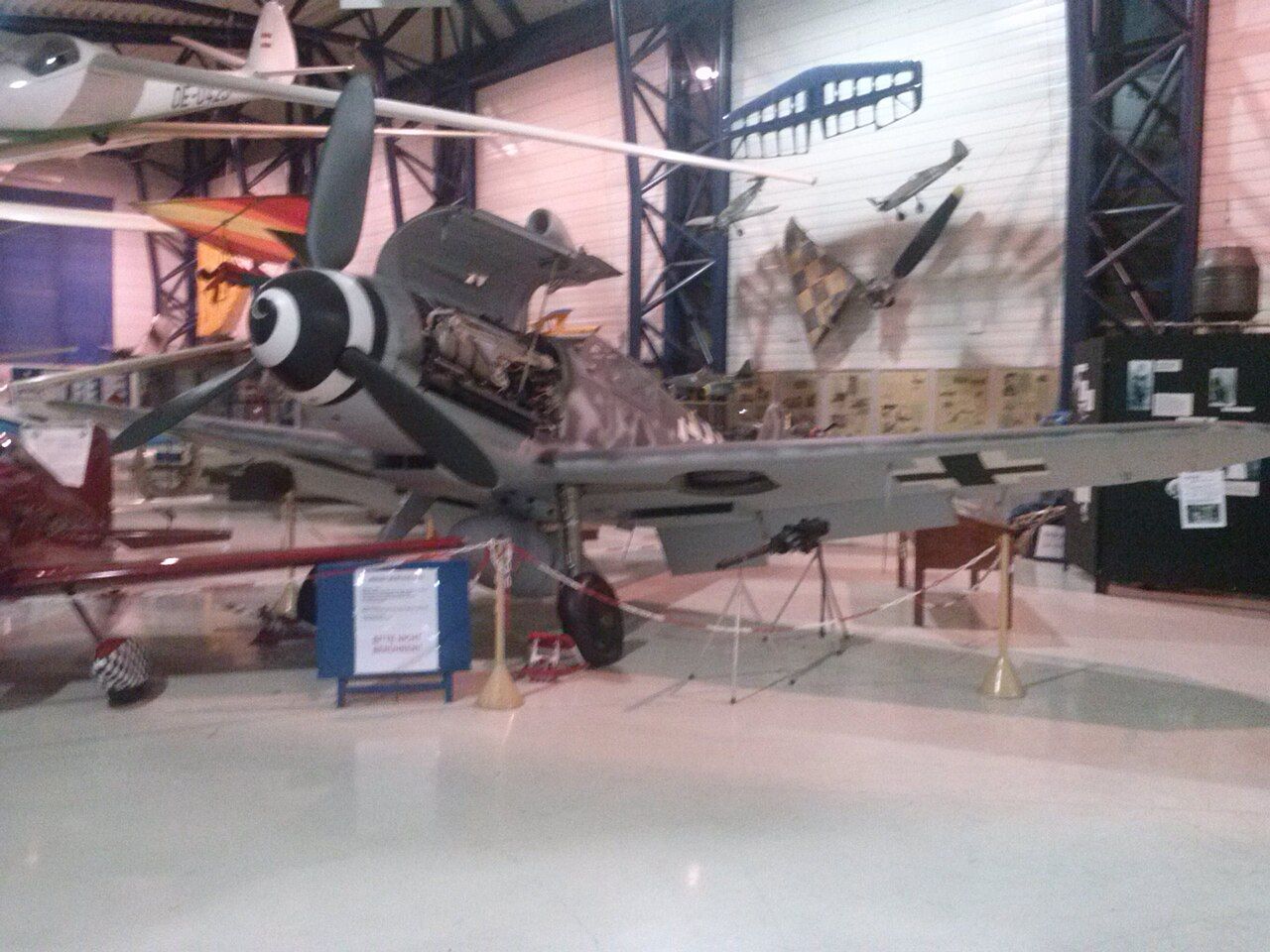

Sources
- Messerschmitt Bf 109. Wikipedia (secondary source). https://en.wikipedia.org/wiki/Messerschmitt_Bf_109 (accessed 2026-10-25).
- Messerschmitt Bf 109 variants. Wikipedia (secondary source). https://en.wikipedia.org/wiki/Messerschmitt_Bf_109_variants (accessed 2026-10-25).
- Messerschmitt Bf 109 G-6/R3. Smithsonian National Air and Space Museum. https://airandspace.si.edu/collection-objects/messerschmitt-bf-109-g-6r3/nasm_A19600327000 (accessed 2026-10-25).
Wikipedia articles are secondary sources and can change; they are cited with the date they were read. The Federation of American Scientists (FAS) Military Analysis Network pages largely reproduce US service fact sheets of the late 1990s and early 2000s, so later upgrades are not covered there.