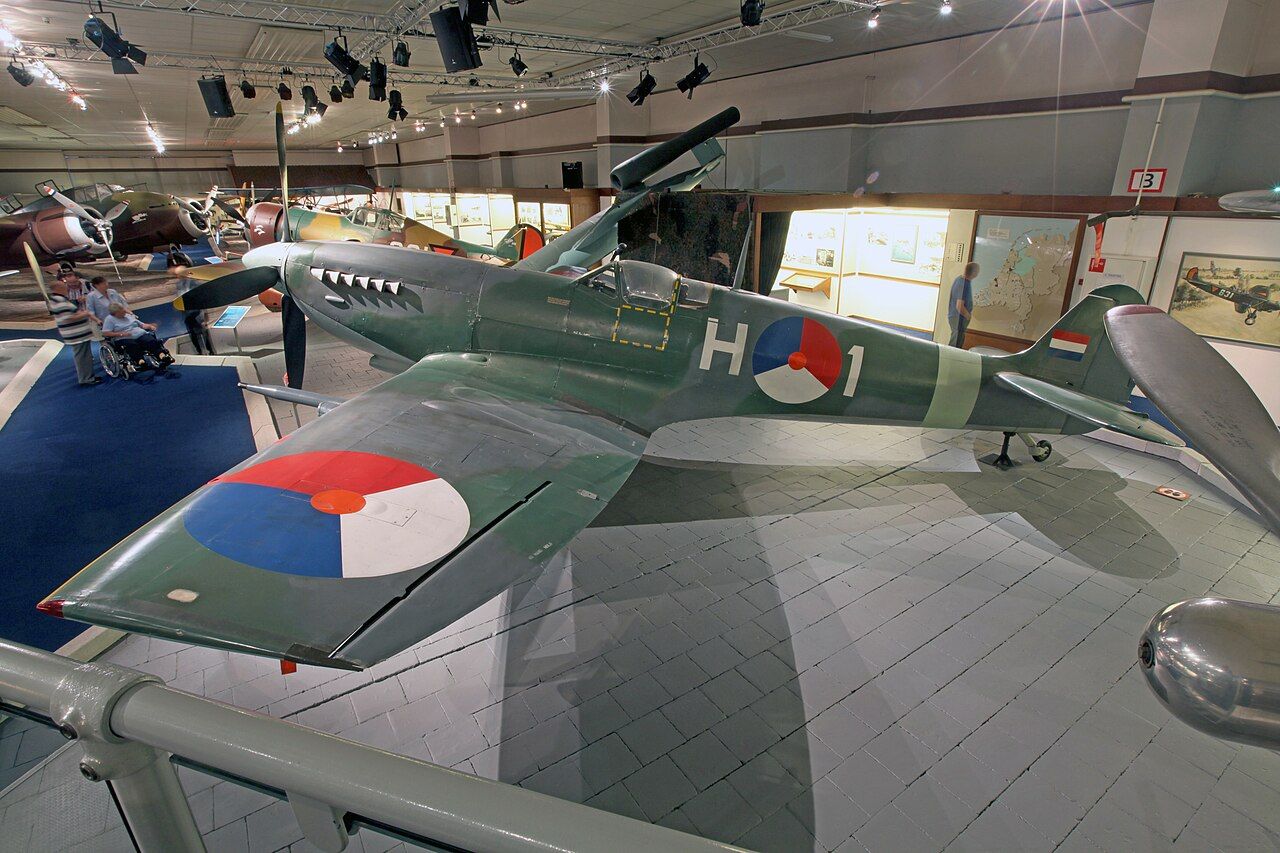

Drafted — not technically validated
Record revision 1 · The elliptical-winged British fighter; the Merlin 66-powered Mark IX answered the Fw 190.
Real-world aircraft as described in public sources. Figures vary between variants, loads and sources; the data plate names the variant its figures describe, and differences are noted beside the number they affect.
Spitfire LF Mk IX · Supermarine Spitfire LF Mk IX
- Variant described
- Spitfire LF Mk IX, with the low-altitude-rated Merlin 66 [2]
- Origin
- United Kingdom
- Crew
- 1 [1]
- Status
- Retired by the RAF in 1955 [2]. 20,351 Spitfires of all marks built [1] [3], over 4,000 of them LF Mk IXs [2]; many still fly
- Powerplant
- One Rolls-Royce Merlin 66 V-12, liquid-cooled, two-stage two-speed supercharger: 1,720 hp at 5,750 ft [2]
- Maximum speed
- 404 mph (351 kt) at 21,000 ft [2]
- Service ceiling
- Not given for the LF Mk IX; trials of the first Mk IX reported an easy climb to 38,000 ft and above 40,000 ft in stages [2]
- Range
- 85 gal internal fuel plus slipper tanks of 30, 45 or 90 gal; late aircraft with rear fuselage tanks had a ferry range of over 1,200 miles [2]
- Armament
- Sensors and avionics
- Mark II gyro gunsight from early 1944, which doubled the effectiveness of RAF gunnery [2]
- Purchase
- DCS WorldDCS: Spitfire LF Mk. IX by Eagle DynamicsDCS Store
- Microsoft Flight SimulatorSpitfire L.F Mk IXc by FlyingIron SimulationsFlyingIron
Store pages checked 2026-10-28. Prices and availability change.
From racing seaplanes
Reginald Mitchell designed every British winner of the Schneider Trophy seaplane races after the First World War, and in 1931 his S.6B won the trophy outright for Britain. [3] His first attempt at a fighter, the Type 224, was a disappointment: an open-cockpit monoplane with gull wings and fixed wheels that lost to a biplane. Mitchell’s team started again from what they had learned on the racers, adding a retractable undercarriage, an enclosed cockpit, thin wings and Rolls-Royce’s new PV XII engine, soon to be named the Merlin. When the Air Ministry asked for eight guns instead of four, the design was ready. [1] [3]
Its famous wing solved two conflicting needs. It had to be thin for low drag, yet thick enough to hold the undercarriage, guns and ammunition, and Mitchell’s team chose a near-elliptical shape, the most efficient for producing lift with the least drag. [1] On 5 March 1936 test pilot “Mutt” Summers took the prototype up for eight minutes from Eastleigh and, on landing, is quoted as saying: “Don’t touch anything.” [1] Mitchell never saw it enter production. He died of cancer in June 1937, aged 42. [3]
The Battle of Britain
The first Spitfire reached No. 19 Squadron at Duxford on 4 August 1938, and 400 were in service when war broke out. [1] [3] In the Battle of Britain in 1940 the more numerous Hurricane did most of the fighting against the bombers, while Spitfires, with their higher performance, were sent where possible against the German escort fighters; Spitfire squadronsSquadron GlossaryJoint terms: 1. An organization consisting of two or more divisions of ships, or two or more divisions (Navy) or flights of aircraft. 2. The basic administrative aviation unit of the Army, Navy, Marine Corps, and Air Force. 3… lost fewer aircraft and scored more victories for each loss. The legend grew all the same, helped by a “Spitfire Fund” that let the public buy fighters. [1]
The Mark IX answers the Fw 190
In 1941 the Focke-Wulf Fw 190 appeared over France and was clearly better than the Spitfire V. The answer was the Merlin 61, with a two-stage supercharger, which test pilot Jeffrey Quill called a “quantum leap”. Rather than wait a year for a redesigned airframe, the Air Ministry had existing Spitfire V airframes fitted with the new engine, creating the Mark IX. [2] Trials in April 1942 found it “outstandingly better than the Spitfire V especially at heights above 20,000 feet”: at 38,000 ft it could still fly at 368 mph and manoeuvre well enough to fight. [2] A stripped Mark IX later caught a high-flying Junkers Ju 86R bomber at over 40,000 ft. [2]
The LF Mk IX, with the Merlin 66 rated for lower altitudes, became the most numerous Mark IX, with more than 4,000 built; it first went into action with the Biggin Hill Wing in March 1943, including the Free French of 341 Squadron. [2] From early 1944 it carried the Mark II gyro gunsight, which worked out how far to aim ahead of a turning target; it doubled the effectiveness of RAF gunnery. [2]
Everywhere, for everyone
Spitfires defended Malta, served with the Soviet air defenceAir defense GlossaryJoint terms: Defensive measures designed to destroy attacking enemy aircraft or missiles in the atmosphere, or to nullify or reduce the effectiveness of such attack. forces, and fought the Japanese over Burma and northern Australia. [1] Americans flew them too: the 4th Fighter Group, formed from the RAF’s Eagle Squadrons of American volunteers, kept its Spitfires until March 1943. [1] Famous Spitfire pilots included “Johnnie” Johnson, with 34 victories, Douglas Bader, “Paddy” Finucane, Canada’s George Beurling and South Africa’s “Sailor” Malan. [1] Unarmed photo-reconnaissanceReconnaissance GlossaryJoint terms: A mission undertaken to obtain, by visual observation or other detection methods, information about the activities and resources of an enemy or adversary, or to secure data concerning the meteorological, hydrographic, or… Spitfires photographed German radar sites and the V-weapon base at Peenemünde, and one, in a test dive in 1944, reached MachMach number GlossaryFlight: The ratio of the true airspeed to the speed of sound. All compressibility effects depend on it. 0.92, the fastest ever recorded for a piston-engined aircraft. [1]
When the last one rolled out in February 1948, 20,351 Spitfires had been built. It was the only British fighter built continuously before, during and after the war. [1] [3]
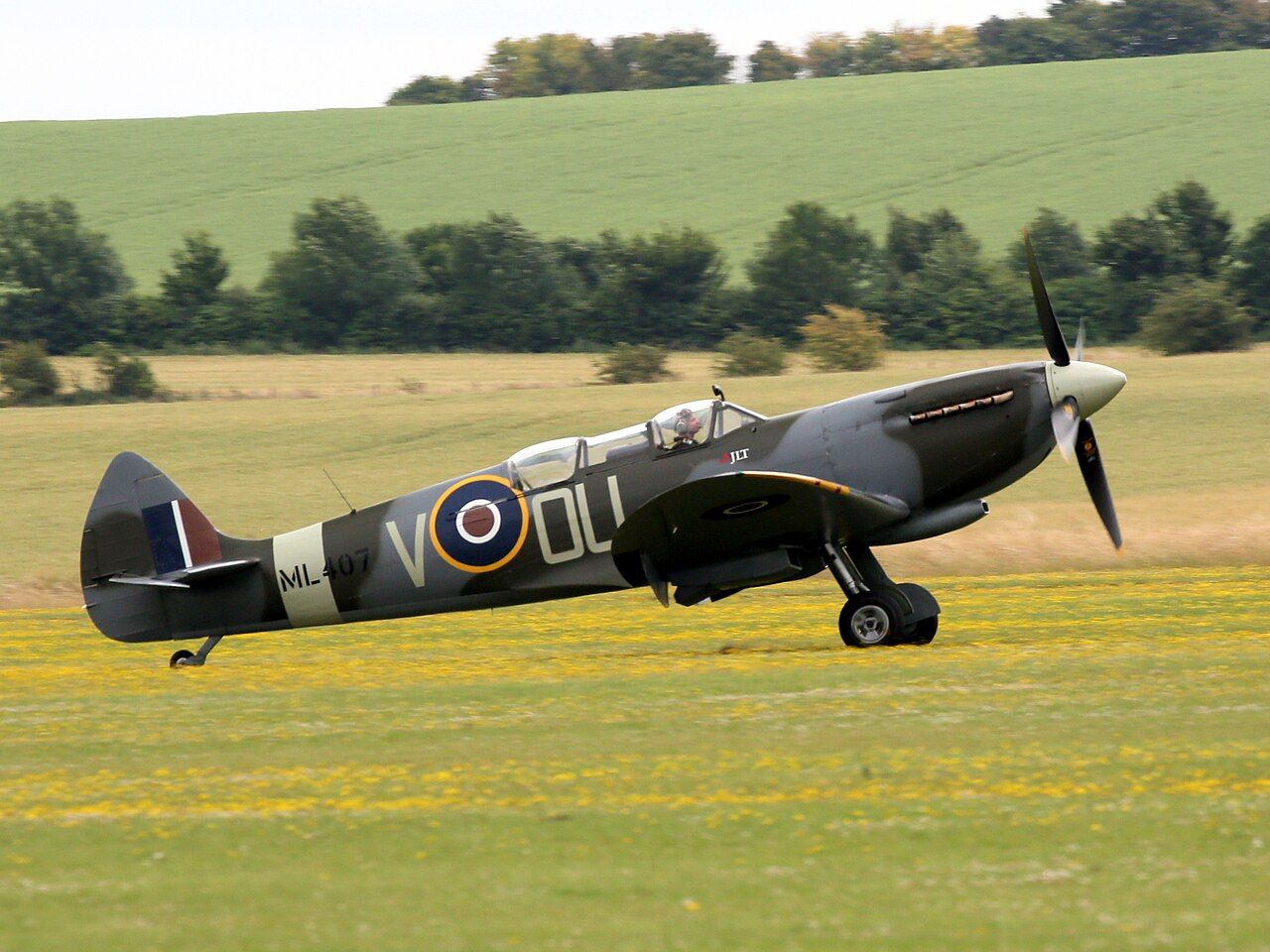

Sources
- Supermarine Spitfire. Wikipedia (secondary source). https://en.wikipedia.org/wiki/Supermarine_Spitfire (accessed 2026-10-25).
- Supermarine Spitfire (late Merlin-powered variants). Wikipedia (secondary source). https://en.wikipedia.org/wiki/Supermarine_Spitfire_(late_Merlin-powered_variants) (accessed 2026-10-25).
- Supermarine Spitfire HF. Mk. VIIc. Smithsonian National Air and Space Museum. https://airandspace.si.edu/collection-objects/supermarine-spitfire-hf-mk-viic/nasm_A19600331000 (accessed 2026-10-25).
Wikipedia articles are secondary sources and can change; they are cited with the date they were read. The Federation of American Scientists (FAS) Military Analysis Network pages largely reproduce US service fact sheets of the late 1990s and early 2000s, so later upgrades are not covered there.