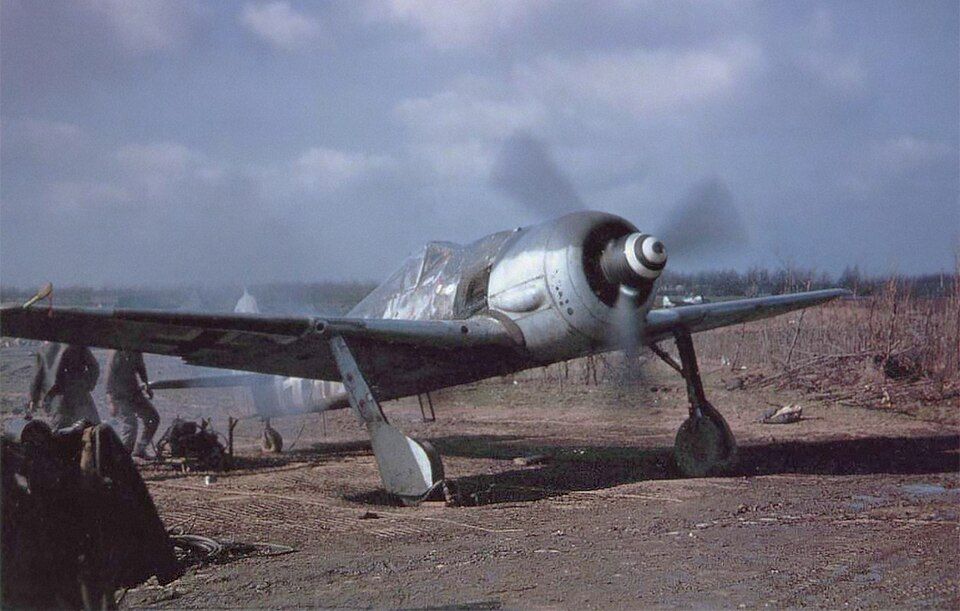

Drafted — not technically validated
Record revision 1 · Kurt Tank's radial-engined fighter, armoured and up-gunned in the A-8 to attack American heavy bombers.
Real-world aircraft as described in public sources. Figures vary between variants, loads and sources; the data plate names the variant its figures describe, and differences are noted beside the number they affect.
Fw 190 A-8 Würger · Focke-Wulf Fw 190 A-8
- Origin
- Germany
- Crew
- 1 [1]
- Status
- Retired. Over 20,000 Fw 190s built [1]; the museum record gives about 13,250 fighters and 6,250 fighter-bombers [3]
- Powerplant
- One BMW 801 D-2 14-cylinder air-cooled radial, 1,700 PS; 1,980 PS for up to 10 minutes with C3 fuel injection boost [1]
- Maximum speed
- 652 km/h (352 kt) at 19,420 ft [1]
- Service ceiling
- 10,350 m (34,000 ft) [1]
- Range
- 900–1,000 km; about 1,800–2,000 km with a drop tank [1]
- Armament
- Purchase
- DCS WorldDCS: Fw 190 A-8 by Eagle DynamicsDCS Store
- Microsoft Flight SimulatorFw 190 A-8 by FlyingIron SimulationsFlyingIron
Store pages checked 2026-10-28. Prices and availability change.
Kurt Tank’s cavalry horse
In 1937 the German air ministry wanted a second fighter alongside the Bf 109Bf 109 K-4 AircraftThe final production version of the most-produced fighter in history, Germany's standard fighter throughout the war., in case foreign designs overtook it. Kurt Tank of Focke-Wulf offered a design built around an air-cooled radial engine. Most Europeans thought a radial too bulky for a small, fast fighter, but Tank had seen the US Navy make radials work, and his choice had a practical advantage: it would not compete with the Bf 109Bf 109 K-4 AircraftThe final production version of the most-produced fighter in history, Germany's standard fighter throughout the war. and Bf 110 for scarce Daimler-Benz engines. [1] [3] Tank, who had served in the cavalry and infantry in the First World War, compared the Bf 109Bf 109 K-4 AircraftThe final production version of the most-produced fighter in history, Germany's standard fighter throughout the war. and the SpitfireSpitfire LF Mk IX AircraftThe elliptical-winged British fighter; the Merlin 66-powered Mark IX answered the Fw 190. to racehorses that could outrun anything with enough pampering but faltered “the moment the going became tough”. He wanted a fighter that could fly from rough front-line airfields, be flown and maintained by men with little training, and take battle damage and still get home: “not a racehorse, but a Dienstpferd, a cavalry horse.” [1]
It was full of new ideas. A wide-track landing gear retracted inwards, built to take twice the usual landing loads, so the Fw 190 had far fewer ground accidents than the Bf 109Bf 109 K-4 AircraftThe final production version of the most-produced fighter in history, Germany's standard fighter throughout the war.. Rigid push-rods instead of cables made the controls light and crisp, and the landing gear, flaps and guns were worked electrically, making it the only fighter of the war with electric landing gear and flaps. [1] [3] A single lever, the Kommandogerät, automatically set the engine’s revolutions, mixture, timing and supercharger. [2] Hans Sander flew the first prototype on 1 June 1939; it handled beautifully, but the tight cowling cooked the engine and the pilot, and overheating nearly cancelled the programme. [3]
The shock over the Channel
The Fw 190 reached JG 26 in France in August 1941. RAF pilots reported a new radial-engined fighter, and at first intelligence officers assumed they had met captured French Curtiss Hawks. [2] It outclassed the SpitfireSpitfire LF Mk IX AircraftThe elliptical-winged British fighter; the Merlin 66-powered Mark IX answered the Fw 190. V in everything except turning circle: it rolled faster, hit harder and was faster at low level. Until the SpitfireSpitfire LF Mk IX AircraftThe elliptical-winged British fighter; the Merlin 66-powered Mark IX answered the Fw 190. IX arrived in late 1942, the Allies had nothing to match it. [2] [3] Plans were drawn up for a commando raid to steal one, but in June 1942 Oberleutnant Armin Faber of JG 2, lost and disoriented, landed his Fw 190 at a British airfield by mistake and handed the RAF an intact example. [2] German crews called it the Würger, the shrike or “butcher bird”. [3]
Storming the bombers
When American heavy bombers began raiding Germany in daylight, their massed .50 calibre guns made them very hard to bring down. The Fw 190, rugged and a steady gun platform, became the Luftwaffe’s bomber destroyer. [1] The A-8, in production from February 1944 and built in greater numbers than any other Fw 190 fighter, carried two machine guns and four 20 mm cannon, and armoured Sturmböcke (“battering rams”) versions swapped two cannon for heavy 30 mm guns and added armour around the cockpit. [1] [3]
The Sturmgruppen attacked from directly behind the bombers, often closing to within 100 yards. When the tactic worked the results were devastating, but the extra weight made the A-8 sluggish, so Bf 109sBf 109 K-4 AircraftThe final production version of the most-produced fighter in history, Germany's standard fighter throughout the war. had to fly escort to keep the American P-47sP-47D Thunderbolt AircraftThe heaviest single-engined fighter of the war: eight .50 calibre guns, a turbosupercharged radial, and a fearsome fighter-bomber. and P-51sP-51D Mustang AircraftThe long-range escort fighter that took US bombers to Berlin and back; Merlin-powered, with six .50 calibre guns. away. [1] [3] On the Eastern Front, its reliable air-cooled engine and wide landing gear suited rough airfields and harsh winters, and ground-attack versions served there until the end of the war. [3]
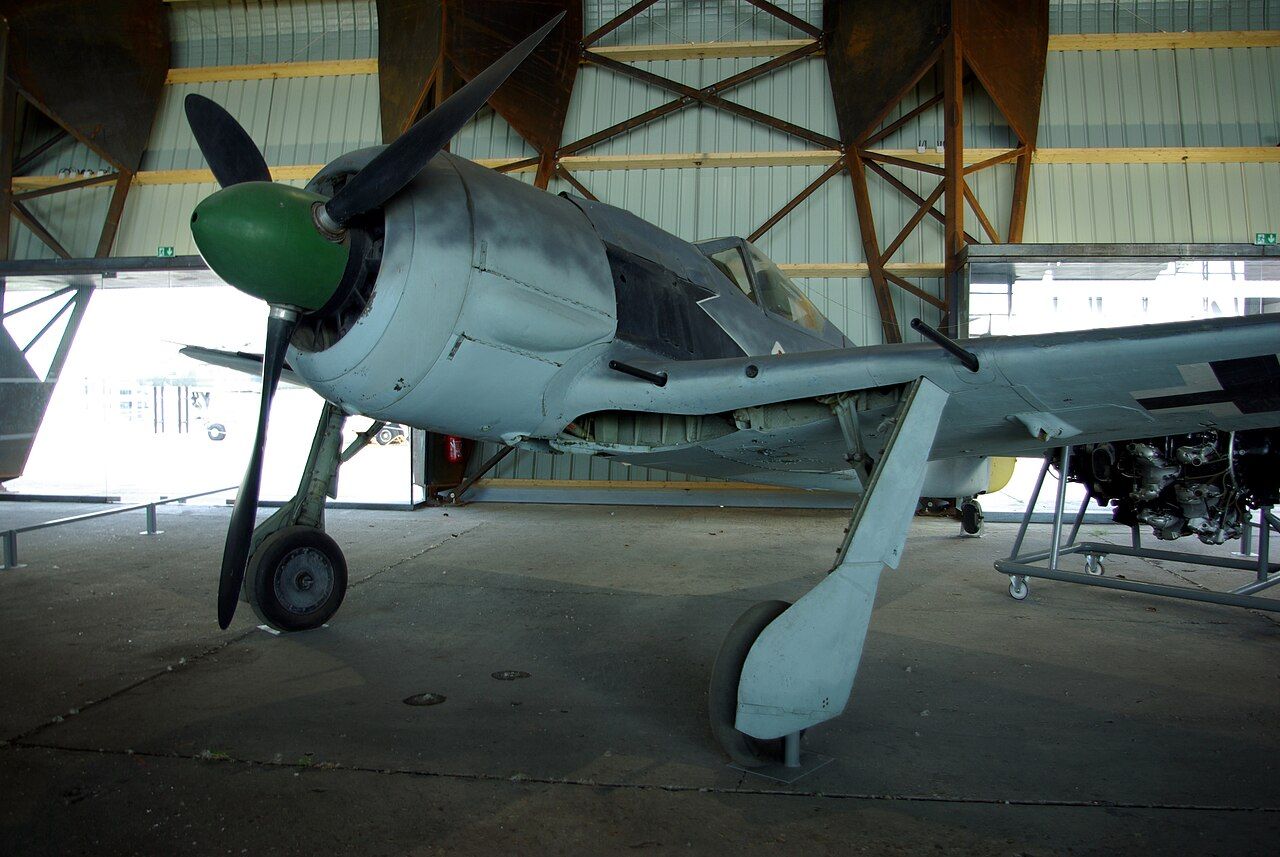

Sources
- Focke-Wulf Fw 190. Wikipedia (secondary source). https://en.wikipedia.org/wiki/Focke-Wulf_Fw_190 (accessed 2026-10-25).
- Focke-Wulf Fw 190 operational history. Wikipedia (secondary source). https://en.wikipedia.org/wiki/Focke-Wulf_Fw_190_operational_history (accessed 2026-10-25).
- Focke-Wulf Fw 190 F-8/R1. Smithsonian National Air and Space Museum. https://airandspace.si.edu/collection-objects/focke-wulf-fw-190-f-8r1/nasm_A19600318000 (accessed 2026-10-25).
Wikipedia articles are secondary sources and can change; they are cited with the date they were read. The Federation of American Scientists (FAS) Military Analysis Network pages largely reproduce US service fact sheets of the late 1990s and early 2000s, so later upgrades are not covered there.