
Drafted — not technically validated
Record revision 1 · The long-nosed, Jumo-powered Fw 190 that entered service in late 1944.
Real-world aircraft as described in public sources. Figures vary between variants, loads and sources; the data plate names the variant its figures describe, and differences are noted beside the number they affect.
Fw 190 D-9 "Dora" · Focke-Wulf Fw 190 D-9
- Role
- Interceptor and fighter; some D-9s carried bombs or radar [2]
- Origin
- Germany
- Manufacturer
- Focke-Wulf, with production at several plants [2]
- Crew
- 1 [1]
- Entered service
- October 1944 (III./JG 54) [2]
- Status
- Retired; 650 to 700 Fw 190 Ds completed by 1945 [2]
- Powerplant
- One Junkers Jumo 213A inverted V-12, liquid-cooled: 1,776 hp, boosted to 2,240 hp with methanol-water injection [2]
- Maximum speed
- 709 km/h (440 mph, 383 kt) [2]
- Service ceiling
- Not given in the cited sources
- Range
- Not given in the cited sources
- Armament
- Purchase
- DCS WorldDCS: Fw 190 D-9 Dora by Eagle DynamicsDCS Store
Store pages checked 2026-10-28. Prices and availability change.
A bomber engine in a fighter
The Fw 190’s BMW radial had proved unreliable, and the Luftwaffe wanted a version that performed better at high altitude. Kurt Tank’s answer, which he saw only as a stopgap until his Ta 152 was ready, was to replace the radial with a liquid-cooled Junkers Jumo 213, a V-12 until then used only in bombers. [1] [2] Prototypes began testing in 1942 with a longer nose and a redesigned tail, and small pre-production batches went to units for evaluation in 1943, just as the American Eighth Air Force began large daylight raids. [2]
Long-Nose Dora
The first production version was called the D-9, because the last production Fw 190 fighter had been the A-8. German radio used “Dora” for the letter D, so it was the Dora-9, and Allied and Luftwaffe pilots alike soon called it the “long-nose” (Langnasen) Fw 190. [2] Pilots liked it. It was more reliable than the radial-engined A-8 and much better in climb, dive and level speed, reaching 709 km/h, and many considered it more than a match for the P-51D MustangP-51D Mustang AircraftThe long-range escort fighter that took US bombers to Berlin and back; Merlin-powered, with six .50 calibre guns.. [2]
Too late
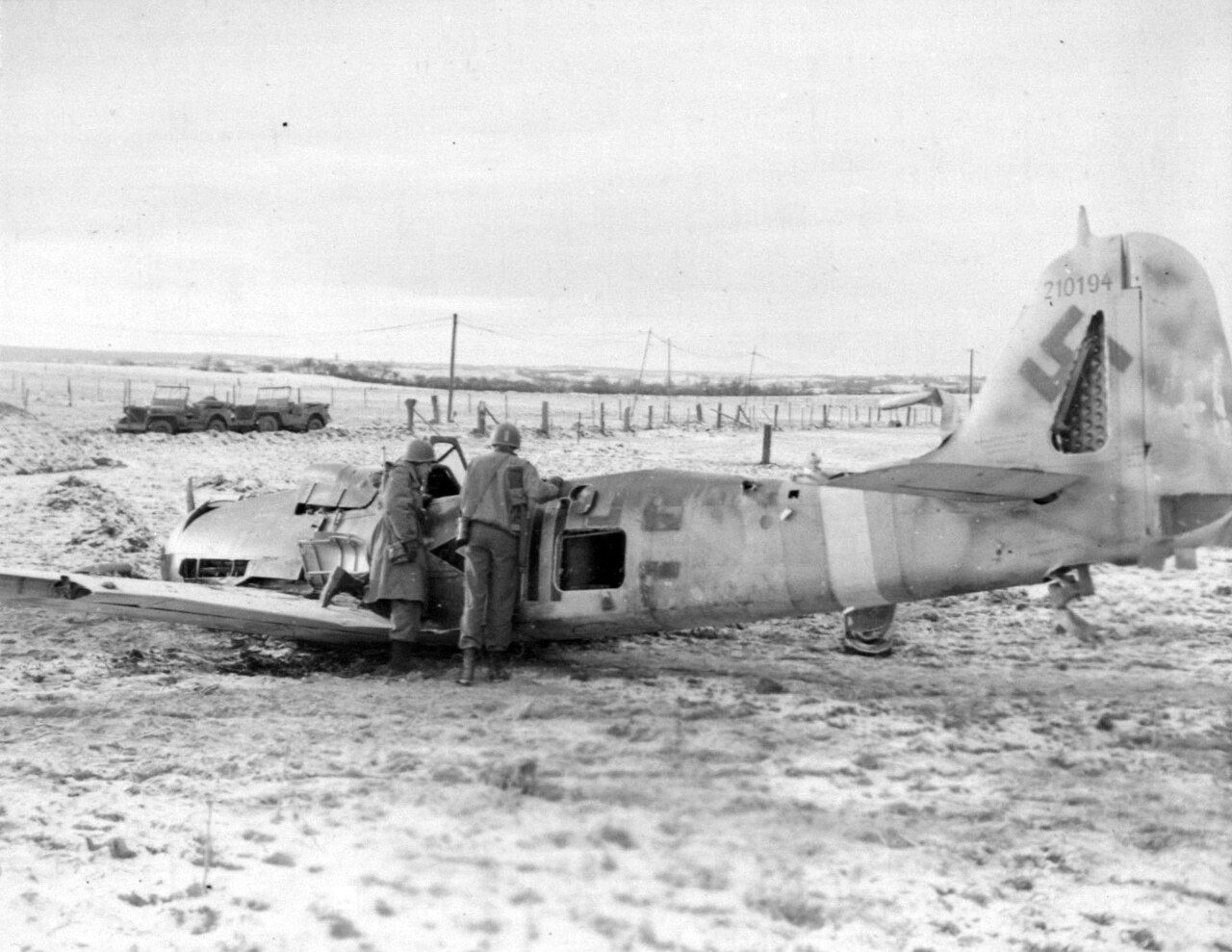
The D-9 entered service in October 1944 with III./JG 54. On its first mission with the new fighter, II./JG 26 shot down four Lancaster bombers and a MosquitoMosquito FB Mk VI AircraftThe fast wooden twin-engined fighter-bomber that needed no defensive guns. for the loss of one Dora. [2] But by late 1944 Germany’s war had changed. Doras flew more often against Allied fighters and in ground attack than against the heavy bombers they had been built to stop. [1] [2] On 1 January 1945 Dora units joined Operation Bodenplatte, an attack by nearly 1,000 German aircraft on Allied airfields that cost about 250 fighters; JG 2 lost 40% of its aircraft. [2] By April 1945 bombing had so starved the Luftwaffe of fuel that when JG 6 received 150 D-9s, only four could fly at a time. [2]
Only 650 to 700 Fw 190 Ds were built. The design led directly to the Ta 152 high-altitude fighter. [1] [2]
Sources
- Focke-Wulf Fw 190. Wikipedia (secondary source). https://en.wikipedia.org/wiki/Focke-Wulf_Fw_190 (accessed 2026-10-25).
- Focke-Wulf Fw 190 D-9. Smithsonian National Air and Space Museum. https://airandspace.si.edu/collection-objects/focke-wulf-fw-190-d-9/nasm_A19600319000 (accessed 2026-10-25).
Wikipedia articles are secondary sources and can change; they are cited with the date they were read. The Federation of American Scientists (FAS) Military Analysis Network pages largely reproduce US service fact sheets of the late 1990s and early 2000s, so later upgrades are not covered there.