
Drafted — not technically validated
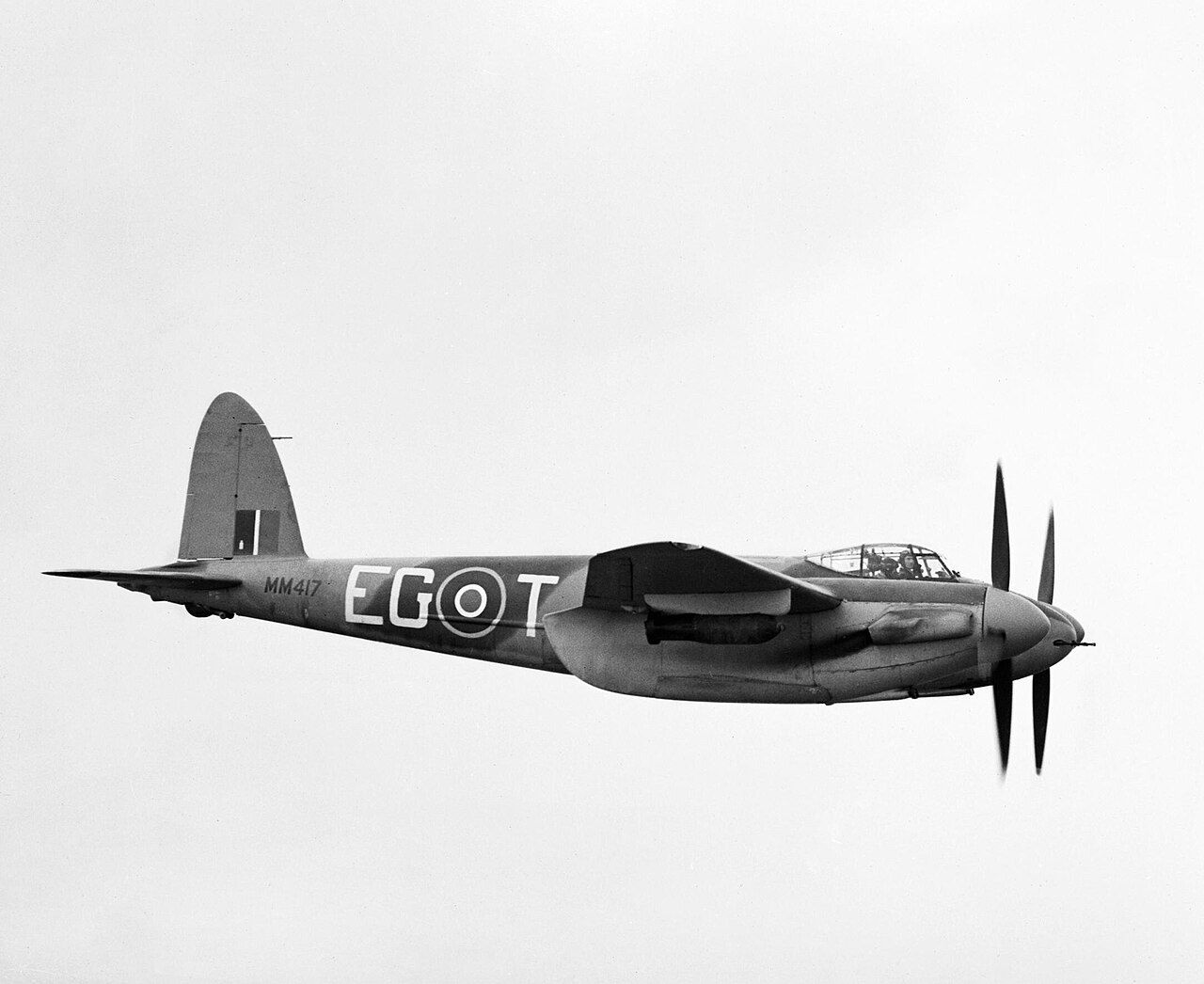
Record revision 1 · The fast wooden twin-engined fighter-bomber that needed no defensive guns.
Real-world aircraft as described in public sources. Figures vary between variants, loads and sources; the data plate names the variant its figures describe, and differences are noted beside the number they affect.
Mosquito FB Mk VI · de Havilland Mosquito FB Mk VI
- Variant described
- FB Mk VI fighter-bomber; ceiling and range are for the B Mk XVI bomber [1]
- Role
- Fighter-bomber and strike aircraft; the family also flew as bomber, night fighter and reconnaissance aircraft [1] [2]
- Origin
- United Kingdom; also built in Canada and Australia
- Crew
- 2: pilot and navigator [1]
- First flight
- 25 November 1940 (prototype); FB Mk VI on 1 June 1942 [1]
- Entered service
- 17 November 1941 [1]
- Status
- Retired; the last RAF Mosquitoes, TT.35 target tugs, left service in May 1963 [1]. 7,781 built, 2,298 of them FB Mk VIs [1]
- Powerplant
- Two Rolls-Royce Merlin V-12s: Merlin 21 (1,460 hp) or Merlin 25 (1,635 hp) [1]
- Maximum speed
- 384 mph (334 kt) in tests with stub exhausts; often given as 368 mph, a figure for aircraft with shrouded exhausts [1]
- Service ceiling
- 37,000 ft (B Mk XVI) [1]
- Range
- 1,300 miles (1,130 NM) (B Mk XVI) [1]
- Armament
A bomber with no guns, made of wood
Geoffrey de Havilland had an idea the Air Ministry hated. In 1938 he argued that a war would bring shortages of aluminium and steel but not of wood, and that a clean, wooden bomber with two Merlin engines could be so fast that it would need no defensive guns at all. Turrets add drag and weight, he reasoned; leave them off and speed becomes the defence. [1] Officials “vehemently resisted” it and wanted turrets and a third crew member. Air Marshal Wilfrid Freeman backed the design, and when the minister of aircraft production told him in 1940 to stop work on it, Freeman ignored the request. [1] [2] The minister, Lord Beaverbrook, nicknamed it “Freeman’s Folly”. [1]
The fuselage was built in two halves, each a sandwich of birch plywood around a core of Ecuadorian balsa, moulded over forms of mahogany or concrete and then glued together. Spruce, ash, birch and fir went into the rest. [1] [2] Furniture factories and skilled carpenters who had little other war work built the parts. [1]
Faster than a Spitfire
Geoffrey de Havilland Jr. first flew the prototype from Hatfield on 25 November 1940. In tests in early 1941 it outpaced a SpitfireSpitfire LF Mk IX AircraftThe elliptical-winged British fighter; the Merlin 66-powered Mark IX answered the Fw 190., reaching 392 mph against the fighter’s 360. [1] It was nicknamed the Wooden Wonder or simply the Mossie, and in 1941 it was one of the fastest operational aircraft in the world. [1]
Göring off the air
The Mosquito became famous for daring precision raids. On 30 January 1943, the tenth anniversary of the Nazis taking power, Mosquitoes knocked out the main Berlin broadcasting station in the morning while Hermann Göring was speaking, taking his speech off the air; a second raid in the afternoon disrupted a speech by Joseph Goebbels. [1] Göring ordered special fighter units formed to stop the Mosquito; they failed. [1] Later, Mosquito bombers dropped 4,000 lb “cookie” bombs on Berlin in fast, high raids that German night fighters could hardly intercept, and they ended the war with the lowest losses of any aircraft in Bomber Command. [1]
The fighter-bomber
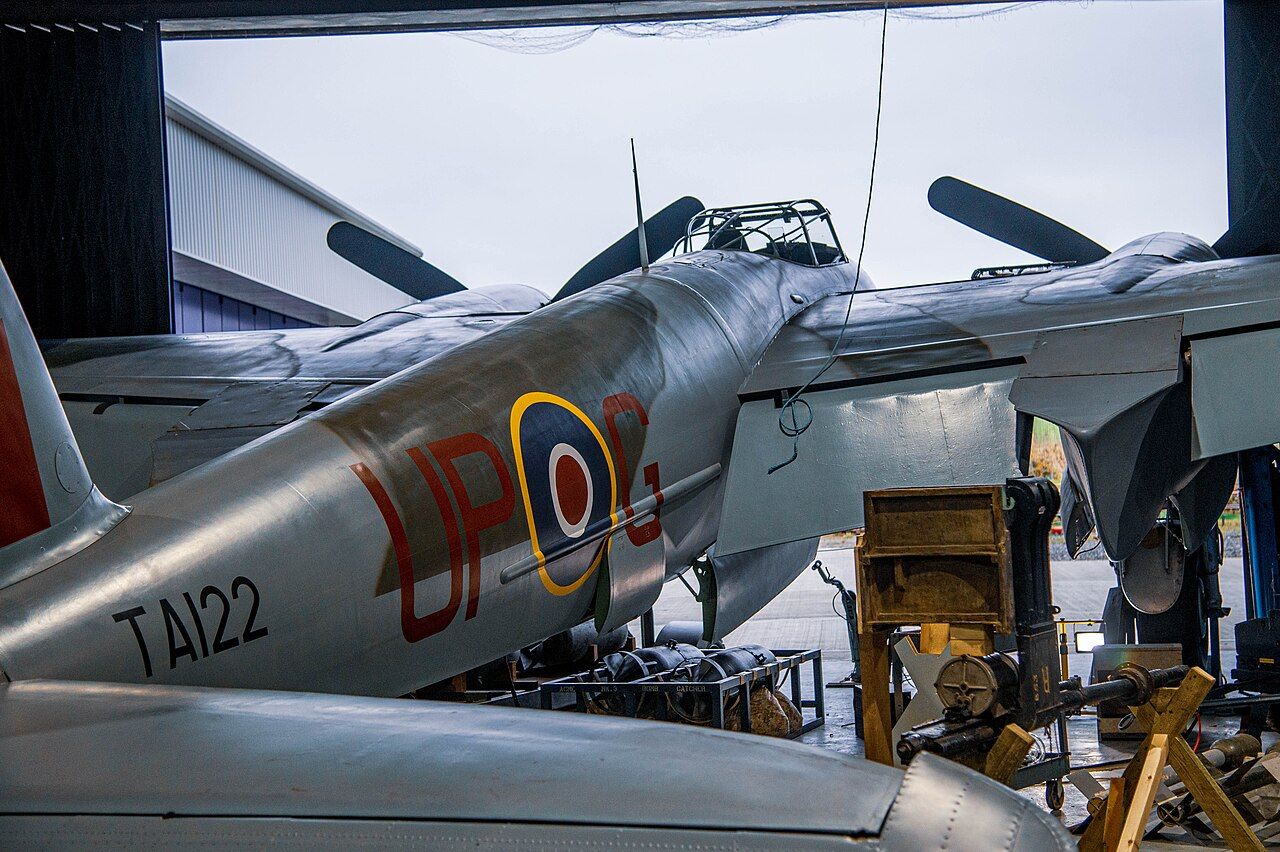
The FB Mk VI, first flown on 1 June 1942, was the most-produced version, with 2,298 built, nearly a third of all Mosquitoes. It combined the fighter’s nose battery of four 20 mm cannon and four machine guns with bombs in the bay and under the wings, or eight rockets. [1] FB VIs flew low-level raids such as Operation Jericho, the attack on Amiens prison in early 1944, and precision strikes on Gestapo headquarters. [1] Three wings of them supported the Allied armies in the Normandy invasion. [1] They could fight back, too: on 15 January 1945 Mosquitoes of 143 Squadron were attacked by 30 Fw 190s while striking ships off Norway, sank three vessels and shot down five fighters for five Mosquitoes lost. [1]
As a night fighter and intruder the Mosquito shot down 487 German aircraft, and German crews came to speak of Moskitoschreck, “Mosquito terror”, the fear of being caught as they landed at night. [1] No fewer than 42 versions entered service, and the Royal Air Force never had as many as it wanted. [2] After the war Mosquitoes flew for Nationalist China, among others, and the RAF’s last ones, towing targets, retired in 1963. [1]

Sources
- de Havilland Mosquito. Wikipedia (secondary source). https://en.wikipedia.org/wiki/De_Havilland_Mosquito (accessed 2026-10-25).
- De Havilland DH-98 B/TT Mk. 35 Mosquito. Smithsonian National Air and Space Museum. https://airandspace.si.edu/collection-objects/de-havilland-dh-98-btt-mk-35-mosquito/nasm_A19640023000 (accessed 2026-10-25).
Wikipedia articles are secondary sources and can change; they are cited with the date they were read. The Federation of American Scientists (FAS) Military Analysis Network pages largely reproduce US service fact sheets of the late 1990s and early 2000s, so later upgrades are not covered there.