
Drafted — not technically validated
Record revision 1 · The bent-wing Navy and Marine fighter of the Pacific war, with a kill ratio better than 11 to 1.
Real-world aircraft as described in public sources. Figures vary between variants, loads and sources; the data plate names the variant its figures describe, and differences are noted beside the number they affect.
F4U-1D Corsair · Vought F4U-1D Corsair
- Origin
- United States
- Crew
- 1 [1]
- Entered service
- 28 December 1942; F4U-1D from April 1944 [1]
- Status
- Retired; last combat in the 1969 "Football War" between Honduras and El Salvador [1]. 12,571 to 12,582 built, in production longer than any other US fighter of the war [1] [2]
- Powerplant
- One Pratt & Whitney R-2800-8W Double Wasp 18-cylinder radial with water injection, up to 250 hp more than the F4U-1's [1]; the museum's F4U-1D record gives 1,850 hp [2]
- Maximum speed
- 425 mph (369 kt), up from 417 mph for the F4U-1 [1]
- Service ceiling
- 41,500 ft (F4U-4) [1]
- Range
- 1,005 miles (873 NM) (F4U-4) [1]
- Armament
- Purchase
- DCS WorldDCS: F4U-1D Corsair by Magnitude 3DCS Store
Store pages checked 2026-10-28. Prices and availability change.
The biggest engine, the biggest propeller
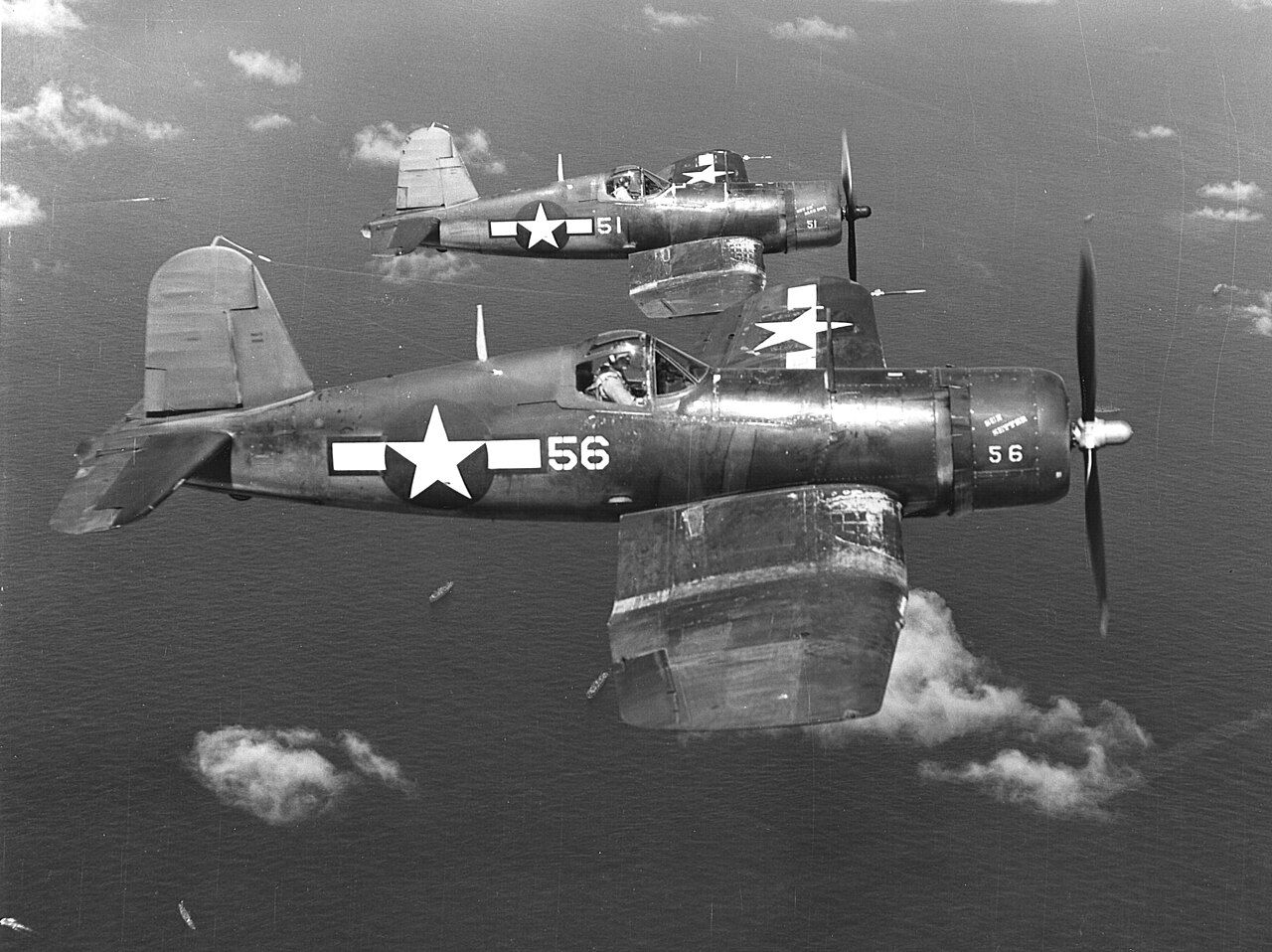
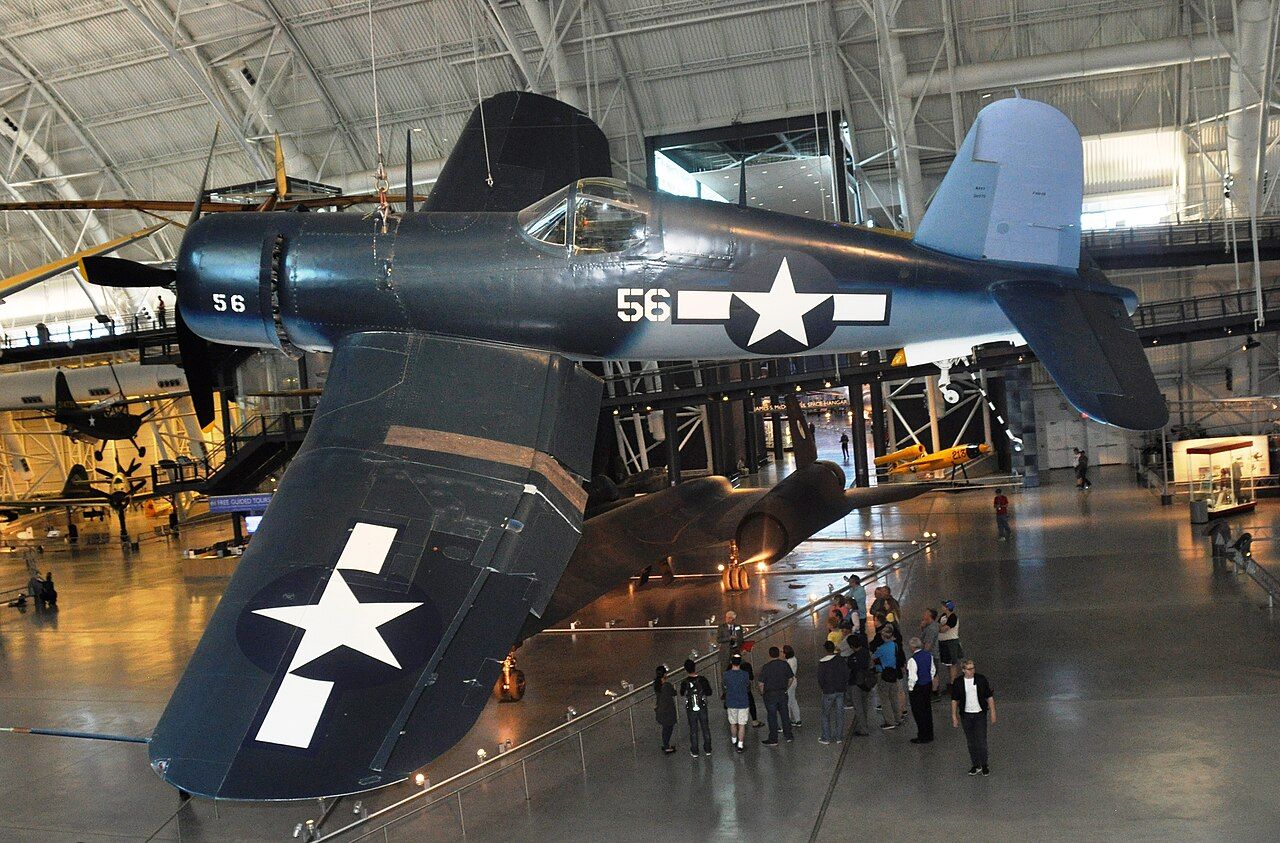
In 1938 the US Navy asked for a carrier fighter with one overriding quality: speed. Vought’s team under Rex Beisel built it around the most powerful air-cooled engine available, the 18-cylinder Pratt & Whitney Double Wasp, turning a three-bladed propeller more than 13 ft across. [1] [2] A propeller that big needed long landing-gear legs to clear the deck, so Beisel bent the wings down and then up again in an “inverted gull” shape. The short legs at the bottom of the bend could fold back into the wing, and the wing met the fuselage at the angle that gave least drag. [1] [2]
Lyman Bullard first flew the prototype on 29 May 1940. On 1 October it averaged 405 mph between Stratford and Hartford, Connecticut, the first US single-engined fighter to fly faster than 400 mph. [1] [2]
The ensign eliminator
The production fighter paid for its heavier armament. Six .50 calibre guns in the wings pushed the fuel into a big tank ahead of the pilot, so the cockpit moved nearly three feet back, behind a very long nose. On approach to a carrier the pilot could not see the deck. The early Corsair also had a vicious stall, strong torque at low speed and landing gear that bounced it down the deck, and Navy pilots nicknamed it the “ensign eliminator”. [1] [2] The Navy gave its carriers the easier F6F Hellcat instead, and the Corsair went to the Marines to fly from land. It was not cleared for US carriers until late 1944, by which time the British had solved the last of the landing problems caused by its long nose. [1] [2] The F4U-1D, from April 1944, added water injection for more power, a clear bubble canopy and rails for rockets and bombs. [1]
Black Sheep
Marine Corsairs went into action from Guadalcanal in February 1943. [1] [2] The most famous unit was VMF-214, the Black Sheep, under Major Gregory “Pappy” Boyington, who was credited with 22 victories in the Corsair before he was shot down over Rabaul in January 1944 and spent the rest of the war as a prisoner. He was awarded the Medal of Honor, as were Corsair pilots Kenneth Walsh and Robert Hanson. [1] [2] Over Okinawa, Marine Lieutenant R. R. Klingman’s guns froze at high altitude, so he flew into a Japanese aircraft and chopped off its tail with his propeller, then landed safely with 5 inches missing from his blades. [1]
Grateful infantrymen called it “the Sweetheart of the Marianas” and “the Angel of Okinawa”. Allied wartime accounts often claimed the Japanese called it “Whistling Death”, but Japanese sources do not support this; to them it was mainly “the Sikorsky”. [1]
By the end of the war Navy and Marine Corsairs had flown 64,051 operational sortiesSortie GlossaryJoint terms: In air operations, an operational flight by one aircraft. and claimed 2,140 aircraft for 189 lost in air combat, a ratio better than 11 to 1. [1] [2] It was also a fighter-bomber: Charles Lindbergh, flying with Marine Air Group 31 in 1944, carried a 2,000 lb bomb and two 1,000 lb bombs on one Corsair against Wotje Atoll, knowing he would almost certainly be executed if he were captured. [2]
Korea and the last dogfights
Corsairs returned to war in Korea, mostly supporting troops on the ground. On 10 September 1952 a MiG-15MiG-15 AircraftThe Soviet swept-wing jet fighter that shocked UN air forces over Korea, armed with 37 mm and 23 mm cannon. made the mistake of turning with Marine Captain Jesse Folmar’s Corsair and was shot down. [1] [2] Navy Lieutenant Guy Bordelon, flying a Corsair night fighter, became the Navy’s only ace of the war and the only American ace in Korea in a piston-engined aircraft. [1] Lieutenant Thomas Hudner earned the Medal of Honor by deliberately crash-landing his Corsair beside the downed aircraft of his squadronSquadron GlossaryJoint terms: 1. An organization consisting of two or more divisions of ships, or two or more divisions (Navy) or flights of aircraft. 2. The basic administrative aviation unit of the Army, Navy, Marine Corps, and Air Force. 3… mate, Ensign Jesse Brown, one of the Navy’s first African American aviators, in an attempt to rescue him; Brown did not survive. [1]
The French Navy flew Corsairs in Indochina, Suez and Algeria. [1] [2] The last combat came in 1969, when Honduran Captain Fernando Soto shot down three Salvadoran aircraft in a single day: the last air battles between piston-engined fighters in history. [1]

Sources
- Vought F4U Corsair. Wikipedia (secondary source). https://en.wikipedia.org/wiki/Vought_F4U_Corsair (accessed 2026-10-25).
- Vought F4U-1D Corsair. Smithsonian National Air and Space Museum. https://airandspace.si.edu/collection-objects/vought-f4u-1d-corsair/nasm_A19610124000 (accessed 2026-10-25).
Wikipedia articles are secondary sources and can change; they are cited with the date they were read. The Federation of American Scientists (FAS) Military Analysis Network pages largely reproduce US service fact sheets of the late 1990s and early 2000s, so later upgrades are not covered there.