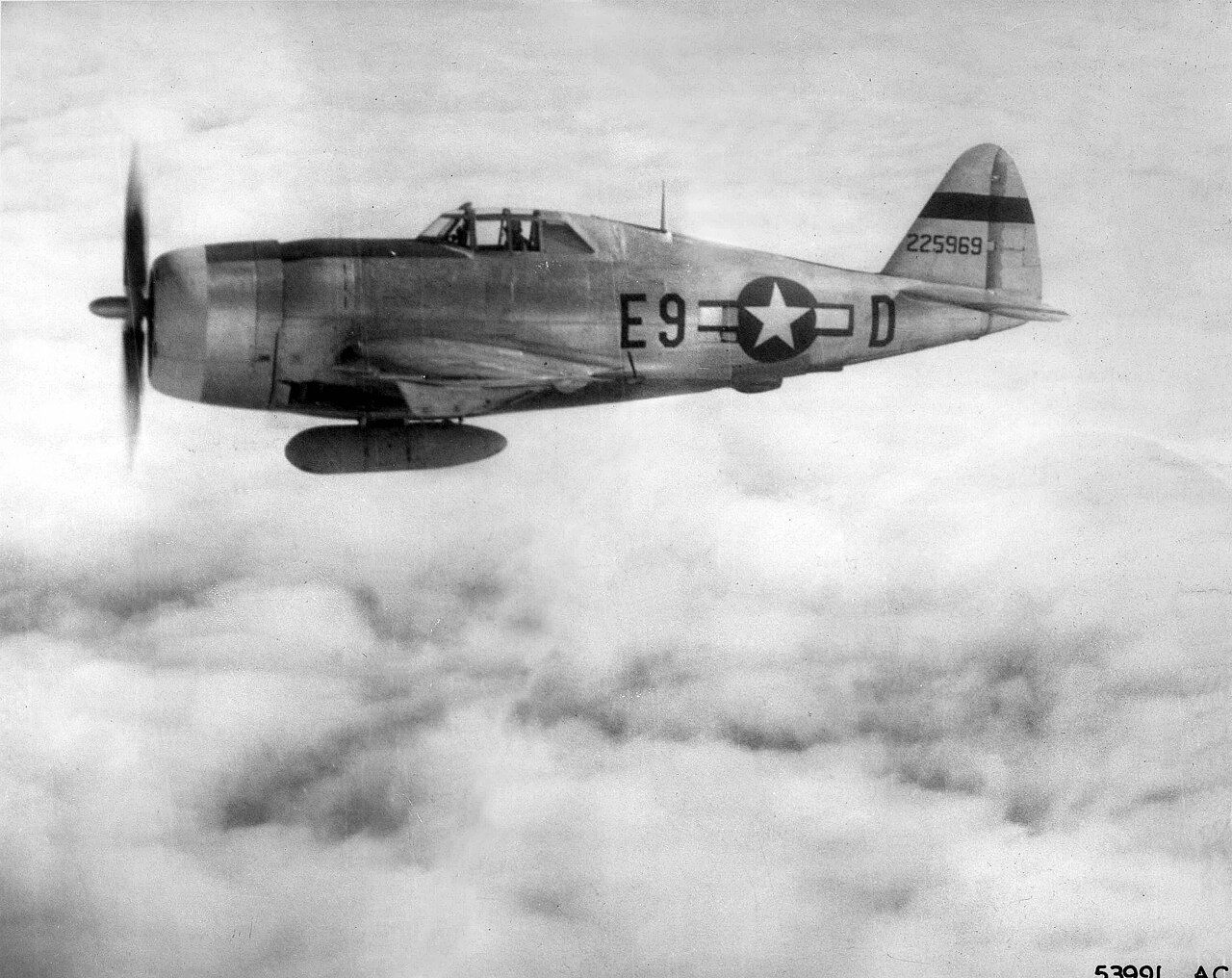

Drafted — not technically validated
Record revision 1 · The heaviest single-engined fighter of the war: eight .50 calibre guns, a turbosupercharged radial, and a fearsome fighter-bomber.
Real-world aircraft as described in public sources. Figures vary between variants, loads and sources; the data plate names the variant its figures describe, and differences are noted beside the number they affect.
P-47D Thunderbolt · Republic P-47D Thunderbolt
- Origin
- United States
- Crew
- 1 [1]
- Entered service
- November 1942 [1]
- Status
- Retired; US Air National Guard until 1953, Peruvian Air Force until 1966 [1]. 15,636 built, more than any other US fighter [1] [2]
- Powerplant
- One Pratt & Whitney R-2800-59 Double Wasp 18-cylinder air-cooled radial with turbosupercharger, 2,000 hp; 2,300 hp with water injection [1] [2]
- Maximum speed
- 444 mph (386 kt) at 23,200 ft with water injection; 430 mph without [1]
- Service ceiling
- 42,000 ft [1]
- Range
- 1,030 miles (895 NM); up to 1,800 miles at 10,000 ft with external tanks [1]
- Armament
- Eight .50 calibre (12.7 mm) M2 Browning machine guns, 425 rounds each [1] [2]
- Up to 2,500 lb of bombs; ten 5 in HVARHigh Velocity Aircraft Rocket (HVAR) OrdnanceThe 5 in 'Holy Moses' rocket of the Second World War and Korea, fired from Thunderbolts, Corsairs and Skyraiders. rockets on late P-47Ds [1]
“A dinosaur with good proportions”
The Thunderbolt was huge. Its designer, Alexander Kartveli, had fled his native Georgia after the Bolshevik revolution, and when combat reports from Europe in 1940 showed that his company’s lightweight fighter designs were outclassed, he drew something nobody had imagined: the largest single-engined fighter of the war, built around the most powerful air-cooled radial engine available and armed with eight .50 calibre machine guns. [1] [2] Empty, the prototype weighed 65% more than Republic’s previous fighter. “It will be a dinosaur,” Kartveli said, “but it will be a dinosaur with good proportions.” [1]
To make it fast at high altitude, Kartveli fitted a turbosupercharger in the rear fuselage, driven by exhaust pipes that ran past the cockpit and glowed red at full power. The ductwork was so important that it was designed first and the rest of the aircraft built around it; it filled nearly the whole belly. After the fighter entered service, crash investigators found that those ducts formed a cushion between the pilot and the ground. [1] [2] The cockpit was roomy and air-conditioned, with a seat one pilot compared to a lounge chair. [1] The XP-47B first flew on 6 May 1941 and later reached 412 mph in level flight. [1]
The Jug
P-47s reached England at the end of 1942, and pilots soon called it the Jug, because its profile looked like a milk jug. Major Don Blakeslee scored its first air victory, over an Fw 190, on 15 April 1943. [1] The 56th Fighter Group became the Eighth Air Force’s top-scoring group and the only one that kept its Thunderbolts, by choice, when the others switched to MustangsP-51D Mustang AircraftThe long-range escort fighter that took US bombers to Berlin and back; Merlin-powered, with six .50 calibre guns.. Its pilots claimed 677½ aircraft in the air; among them Francis Gabreski scored 28 victories and Robert S. Johnson 27. [1] Luftwaffe ace Heinz Bär said the P-47 “could absorb an astounding amount of lead and had to be handled very carefully”. [1]
In the Pacific, Colonel Neel Kearby of the 348th Fighter Group led four P-47s into 40 Japanese aircraft over Wewak, New Guinea, on 11 October 1943 and shot down six himself, earning the Medal of Honor. [1]
The fighter-bomber
Its greatest work was close to the ground. Pilots returning from escort missions shot up targets of opportunity, and the Thunderbolt’s tough airframe and air-cooled engine could take damage that would have brought down a liquid-cooled fighter. It became the Army Air Forces’ main fighter-bomber, carrying bombs of up to 1,000 lb and, from 1944, 5 in rockets nicknamed “Holy Moses”. [1] [2] Between D-Day and the end of the war in Europe, P-47 pilots claimed 86,000 railway cars, 9,000 locomotives, 6,000 armoured vehicles and 68,000 trucks. On 29 July 1944, during the Normandy breakout, the 405th Fighter Group spent more than six hours attacking a trapped German column near Roncey; investigators on the ground later counted 66 tanks, 204 vehicles and 11 guns destroyed. [1] Across the war the Thunderbolt flew more than 746,000 sortiesSortie GlossaryJoint terms: In air operations, an operational flight by one aircraft. with an air-to-air kill ratio of 4.6 to 1. [1]
Many flags
Other nations flew the Jug too. RAF Thunderbolts attacked the Japanese in Burma; Brazil’s 1st Fighter Squadron flew 445 missions over Italy; and Mexico’s 201st Fighter Squadron flew 791 sortiesSortie GlossaryJoint terms: In air operations, an operational flight by one aircraft. in the Philippines without losing a pilot or aircraft to the enemy. [1] The Free French received 446, and the Soviet Union tested and used about 200 for high-altitude air defenceAir defense GlossaryJoint terms: Defensive measures designed to destroy attacking enemy aircraft or missiles in the atmosphere, or to nullify or reduce the effectiveness of such attack.. [1] After the war the Air Force renamed it the F-47 and kept it with the Air National Guard until 1953, while Latin American air forces flew it into the 1960s. [1]
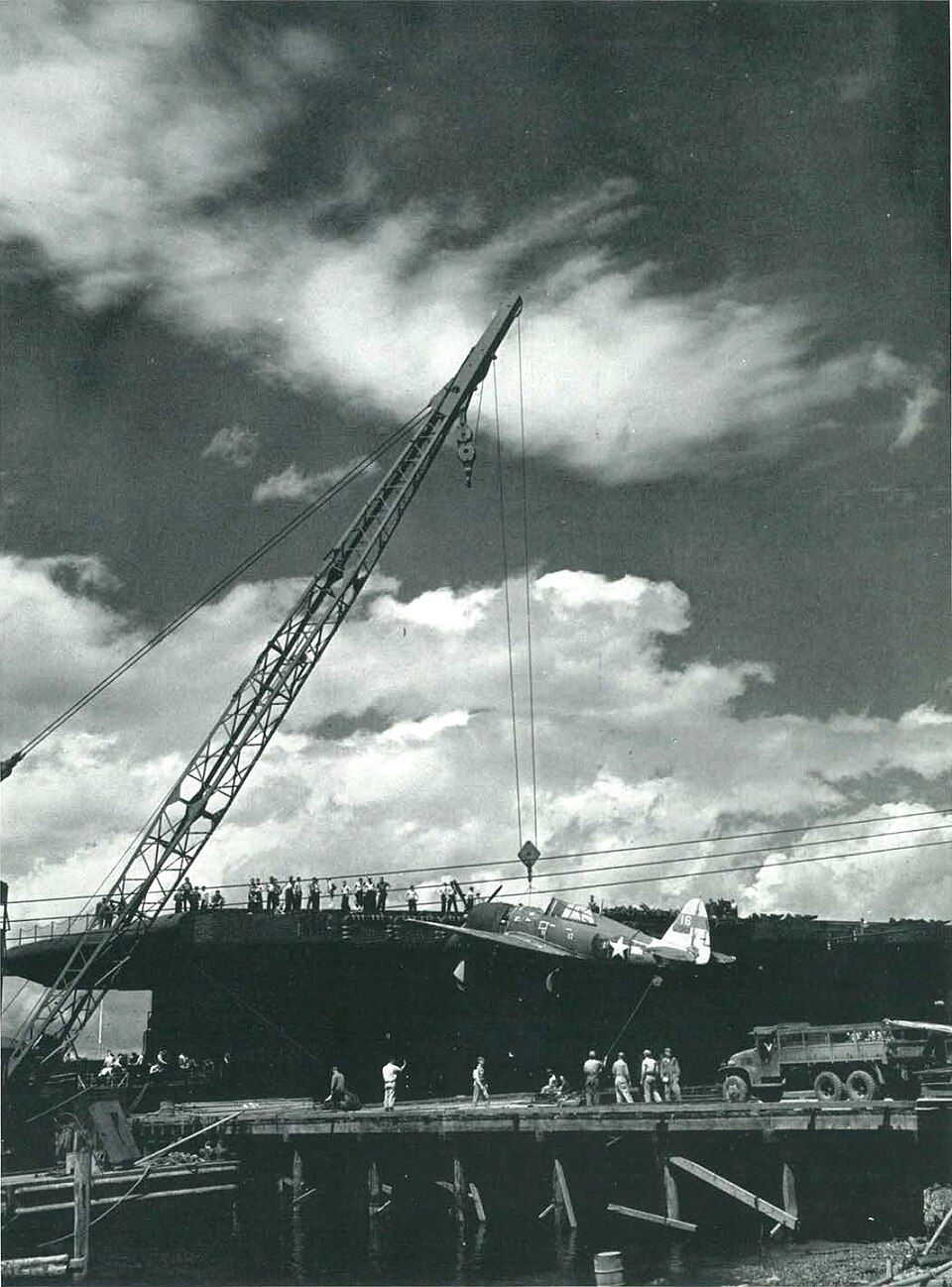

Sources
- Republic P-47 Thunderbolt. Wikipedia (secondary source). https://en.wikipedia.org/wiki/Republic_P-47_Thunderbolt (accessed 2026-10-25).
- Republic P-47D-30-RA Thunderbolt. Smithsonian National Air and Space Museum. https://airandspace.si.edu/collection-objects/republic-p-47d-30-ra-thunderbolt/nasm_A19600306000 (accessed 2026-10-25).
Wikipedia articles are secondary sources and can change; they are cited with the date they were read. The Federation of American Scientists (FAS) Military Analysis Network pages largely reproduce US service fact sheets of the late 1990s and early 2000s, so later upgrades are not covered there.