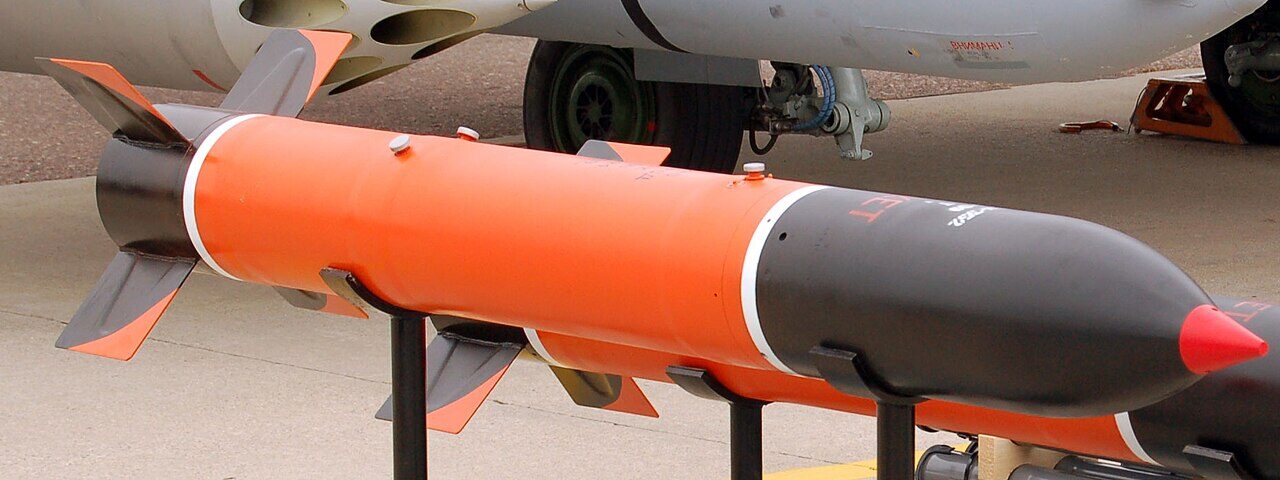

Drafted — not technically validated
Record revision 1 · A heavy Soviet rocket with a 123 kg warhead, carried singly on pylons.
Real-world weapon as described in public sources. Weights and dimensions change with the fins, fuzes and variant fitted; the data plate names the variants its figures describe, and differences are noted beside the number they affect. The record describes the weapon; it is not a guide to employing it.
S-24 240 mm rocket · S-24
- Type
- 240 mm heavy unguided air-to-ground rocket [1]
- Origin
- Soviet Union
- In service
- Not given in the cited source; still used by the Russian and Ukrainian air forces [1]
- Weight
- 235 kg (518 lb) at launch [1]
- Dimensions
- Length 2.33 m (7 ft 8 in); diameter 240 mm (9.4 in) [1]
- Warhead or payload
- 123 kg (271 lb) blast-fragmentation warhead [1]
- Guidance
- None
- Fuzing
- The RV-24 proximity fuzeProximity fuze GlossaryWeapons: A fuze that detonates before impact when any substantial object is detected at a predetermined distance from it. is available for an air burst about 3 m above the ground [1]
- Delivery
- Carried singly on weapon pylons, not in pods [1]
- Range
- About 2–3 km (1.1–1.6 NM) [1]
- Carried by
- Soviet, Russian, Ukrainian and export strike aircraft; the cited source does not list types [1]
The heavy end of the scale
The Soviet Union used aircraft rockets from as early as the 1930s, and the S-24 sits at the heavy end of that tradition. It is named for its diameter, 24 cm, and it is one of a handful of successors to the BETAB-750DS rockets of the Second World War. [1] At 2.33 m long and 235 kg at launch, it is carried singly on weapon pylons rather than in pods. [1]
One big warhead
Where the smaller rockets rely on numbers, the S-24 relies on a single 123 kg blast-fragmentation warhead. [1] With the RV-24 proximity fuzeProximity fuze GlossaryWeapons: A fuze that detonates before impact when any substantial object is detected at a predetermined distance from it. it bursts about 3 m above the ground, and its scored body breaks into some 4,000 fragments able to penetrate up to 30 mm of armour (some sources say 25 mm), over a casualty radius of 300 to 400 m. [1] Its range is short, about 2 to 3 km. [1]
The S-24B version uses a low-smoke propellant, so that its flight leaves less of a trail. [1] The rocket remains in service with the Russian Aerospace Forces, the Ukrainian Air Force and many export customers, and Iran builds it under licence as the Shafaq. [1]
Sources
- S-24 rocket. Wikipedia (secondary source). https://en.wikipedia.org/wiki/S-24_rocket (accessed 2026-10-26).
Wikipedia articles are secondary sources and can change; they are cited with the date they were read. NAVEDTRA training manuals and budget justification exhibits are official US publications, but each describes the weapons in service when it was written.