
Drafted — not technically validated
Record revision 1 · The Soviet 80 mm rocket of 1984, with anti-armour, runway-attack and fuel-air warheads, fired from B-8 pods.
Real-world weapon as described in public sources. Weights and dimensions change with the fins, fuzes and variant fitted; the data plate names the variants its figures describe, and differences are noted beside the number they affect. The record describes the weapon; it is not a guide to employing it.
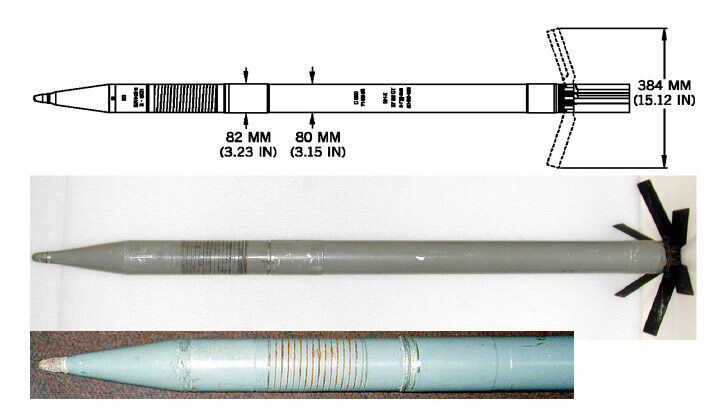
S-8 80 mm rocket · S-8
- Type
- 80 mm unguided air-to-ground rocket [1]
- Origin
- Soviet Union
- In service
- Developed in the 1970s; entered service in 1984 [1]
- Weight
- 11.3–15.2 kg (25–33.5 lb), depending on warhead and fuze; 11.3 kg for the S-8KOM [1]
- Dimensions
- Length 1.5–1.7 m (59–67 in); 1.57 m for the S-8KOM; calibre 80 mm [1]
- Warhead or payload
- Shaped-charge anti-armour (S-8KO, S-8KOM, 3.6 kg), penetrating runway-attack (S-8B, S-8BM), fuel-air explosive (S-8D, S-8DM), illumination, chaffChaff GlossaryWeapons: Radar confusion reflectors, consisting of thin, narrow metallic strips of various lengths and frequency responses, which are used to reflect echoes for confusion purposes., flechette and smoke versions [1]
- Guidance
- None
- Fuzing
- Varies by warhead; the S-8OFP successor has a digital fuzeFuze GlossaryWeapons: A device that causes the detonation of an explosive charge at the proper time after certain conditions are met. A bomb fuze is mechanical or electrical, and is classed by what sets it off (impact, mechanical time… [1]
- Delivery
- Fired from B-series pods of 7 or 20 rockets [1]
- Range
- 2–4 km (1.1–2.2 NM); 1.3–4 km for the S-8KOM [1]
- Carried by
- Soviet and Russian fighter-bombers and helicopters, among them the Su-25Su-25 Frogfoot AircraftAn armoured Soviet close air support jet; the Su-25T adds Vikhr anti-tank missiles., Mi-8Mi-8MTV-2 Hip AircraftThe armed transport version of the Mi-8, the most-produced helicopter in the world. and Mi-24/35 [1]
Eighty millimetres
The S-8 is an 80 mm rocket developed in the 1970s for fighter-bombers and helicopters, and it entered service in 1984. [1] It is roughly one and a half metres long and weighs between 11 and 15 kg depending on the warhead, and it is carried in the B series of pods, which hold either seven or 20 rockets. [1]
A warhead for every target
The S-8 comes with a wide range of warheads. The S-8KO and S-8KOM carry a 3.6 kg shaped charge able to penetrate about 400 mm of armour; the S-8KOM’s improved low-smoke motor burns twice as long and pushes the rocket to about 700 m/s. [1] The S-8B and S-8BM are penetrating rockets for attacking runways, and the S-8D and S-8DM carry fuel-air explosive. Others carry illumination flares, radar-reflecting chaffChaff GlossaryWeapons: Radar confusion reflectors, consisting of thin, narrow metallic strips of various lengths and frequency responses, which are used to reflect echoes for confusion purposes. or flechettes. [1] The rockets reach between 2 and 4 km. [1]
Still developing
In 2018 the Russian Aerospace Forces tested the S-8OFP Broneboishchik, a successor with longer range, a heavier warhead and a digital fuzeFuze GlossaryWeapons: A device that causes the detonation of an explosive charge at the proper time after certain conditions are met. A bomb fuze is mechanical or electrical, and is classed by what sets it off (impact, mechanical time… that can be set to burst in front of an obstacle or behind it. It is meant for Su-25Su-25 Frogfoot AircraftAn armoured Soviet close air support jet; the Su-25T adds Vikhr anti-tank missiles. attack aircraft and Mi-8Mi-8MTV-2 Hip AircraftThe armed transport version of the Mi-8, the most-produced helicopter in the world. helicopters, and has been seen fired from the Mi-35M; it entered series production in May 2023. [1]
Sources
- S-8 (rocket). Wikipedia (secondary source). https://en.wikipedia.org/wiki/S-8_(rocket) (accessed 2026-10-26).
Wikipedia articles are secondary sources and can change; they are cited with the date they were read. NAVEDTRA training manuals and budget justification exhibits are official US publications, but each describes the weapons in service when it was written.