
Drafted — not technically validated
Record revision 1 · A Soviet 122 mm rocket built to penetrate runways, shelters and bunkers, fired from five-tube launchers.
Real-world weapon as described in public sources. Weights and dimensions change with the fins, fuzes and variant fitted; the data plate names the variants its figures describe, and differences are noted beside the number they affect. The record describes the weapon; it is not a guide to employing it.
S-13 122 mm rocket · S-13
- Type
- 122 mm unguided air-to-ground rocket for hardened targets [1]
- Origin
- Soviet Union
- In service
- First trials 1973; introduced 1983 [1]
- Weight
- 57 kg (126 lb) for the basic S-13; up to 75 kg for the S-13T [1]
- Dimensions
- Length 2.54 m (100 in) for the S-13, up to 3.12 m for other versions; calibre 122 mm [1]
- Warhead or payload
- S-13: 21 kg penetrating warhead with 1.82 kg of explosive; S-13T tandem penetrator; S-13OF fragmentation (33 kg, 450 fragments); S-13D fuel-air explosive [1]
- Guidance
- None
- Fuzing
- Not given in the cited source
- Delivery
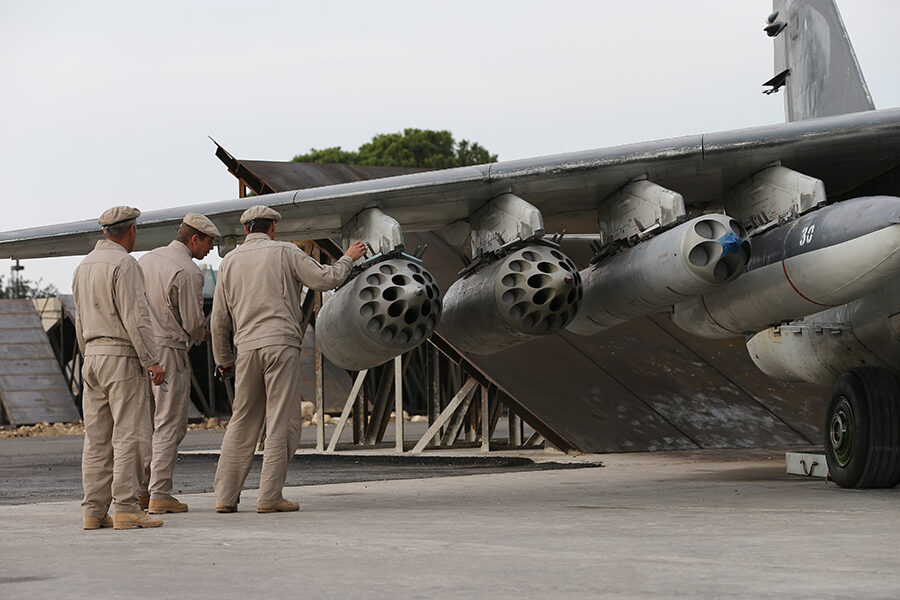
- Fired from five-tube B-13L launchers on aircraft and B-13L1 on helicopters [1]
- Range
- 1.1–3 km (0.6–1.6 NM) for the S-13; up to 4 km for the S-13T [1]
- Carried by
- Su-17/20/22, Su-24, Su-25Su-25 Frogfoot AircraftAn armoured Soviet close air support jet; the Su-25T adds Vikhr anti-tank missiles., Su-27Su-27 Flanker AircraftA large, long-range Soviet air superiority fighter with ten missile stations., MiG-23BN, MiG-27, MiG-29MiG-29 Fulcrum AircraftA twin-engine Soviet fighter with a helmet sight and R-73 missiles, built to counter the F-15 and F-16. [1]
- Helicopters: Mi-24Mi-24P Hind-F AircraftThe Soviet gunship that could also carry eight troops; the Mi-24P has a fixed twin-barrel 30 mm cannon., Mi-28, Ka-29TB, Ka-50Ka-50 Black Shark AircraftA single-seat Russian attack helicopter with coaxial rotors and the first helicopter ejection seat in service., Ka-52 [1]
Filling a gap
In the 1970s Soviet aircraft had 80 mm and 240 mm rockets but nothing in between. The S-13 was developed to fill that gap: a 122 mm rocket able to crater runways and penetrate hardened aircraft shelters, bunkers and pillboxes, in a role similar to the American 127 mm ZuniZuni 5 in rocket OrdnanceThe Navy's 5 in rocket of 1957, fired from four-tube LAU-10 pods and credited with an A-4 Skyhawk's only MiG kill.. [1] It is conventional in layout, a solid rocket motor with folding tail fins that steady it after launch. Its first trials were in 1973, but it entered service only in 1983. [1]
Built to dig
The basic S-13 is 2.54 m long and weighs 57 kg. Its 21 kg warhead holds only 1.82 kg of explosive and can penetrate 3 m of earth or 1 m of reinforced concrete; against a runway it leaves a damaged area of about 20 square metres. [1] The later S-13T uses two warheads in tandem to go deeper, while the S-13OF of 1993 trades penetration for 450 heavy fragments that can pierce lightly armoured vehicles, and the S-13D carries fuel-air explosive. [1]
Five at a time
S-13s are fired from five-tube launchers: the B-13L, carried by most Soviet and Russian attack aircraft and newer fighters from the Su-17 family to the MiG-29MiG-29 Fulcrum AircraftA twin-engine Soviet fighter with a helmet sight and R-73 missiles, built to counter the F-15 and F-16., and the B-13L1 for helicopters such as the Mi-24Mi-24P Hind-F AircraftThe Soviet gunship that could also carry eight troops; the Mi-24P has a fixed twin-barrel 30 mm cannon., Mi-28 and Ka-52. [1]
Sources
- S-13 rocket. Wikipedia (secondary source). https://en.wikipedia.org/wiki/S-13_rocket (accessed 2026-10-26).
Wikipedia articles are secondary sources and can change; they are cited with the date they were read. NAVEDTRA training manuals and budget justification exhibits are official US publications, but each describes the weapons in service when it was written.