
Drafted — not technically validated
Record revision 1 · The utility helicopter that defined the Vietnam War and served every US armed service; more than 16,000 built.
Real-world aircraft as described in public sources. Figures vary between variants, loads and sources; the data plate names the variant its figures describe, and differences are noted beside the number they affect.
UH-1H Iroquois "Huey" · Bell UH-1H Iroquois
- Role
- Utility and transport helicopter: air assault, medical evacuation, cargo, search and rescue, and armed escort [1] [2]
- Origin
- United States
- Manufacturer
- Bell Helicopter; built under licence in Germany, Italy, Japan, Taiwan, Turkey and elsewhere [1] [2]
- Crew
- 1–4 (normally two pilots plus crew chief and door gunner); 11–14 troops or six stretchers and an attendant [1] [2]
- First flight
- 20 October 1956 (XH-40); stretched Model 205 on 16 August 1961 [1]
- Status
- More than 16,000 of the UH-1 family built [1]. Retired from active US Army service in early 2005 and from the Army entirely in late 2016; still flown by many air arms, and the twin-engined UH-1N and UH-1Y serve with the US Air Force and Marine Corps [1]
- Powerplant
- One Lycoming T53-L-13 turboshaft, 1,400 shp, limited to 1,100 shp by the transmission [1] [2]
- Maximum speed
- 127 mph (110 kt) at maximum take-off weight, also the never-exceed speed at that weight [1] [2]
- Service ceiling
- 12,600 ft at maximum take-off weight [1]
- Range
- 511 km (276 NM) with maximum fuel, no reserves [1]; the FAS sheet gives 467 km for the UH-1D [2]
- Armament
- Purchase
- DCS WorldDCS: UH-1H Huey by BelsimtekDCS Store
- Microsoft Flight SimulatorUH-1H Huey by Taog's HangarTaog's Hangar
Store pages checked 2026-10-28. Prices and availability change.
The sound of a war
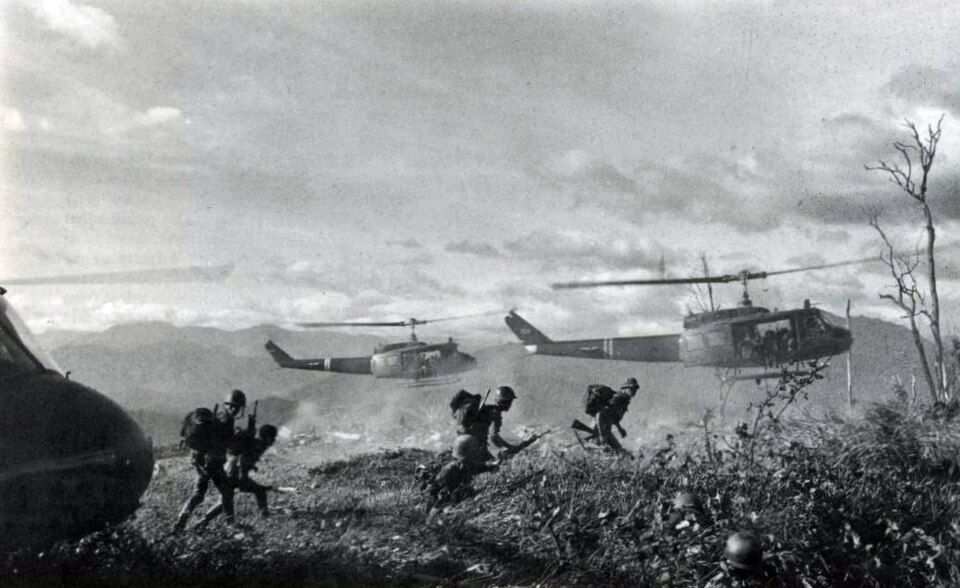
Ask anyone who was in Vietnam what the war sounded like and many will describe the Huey: a deep, rhythmic “thump” from its two big rotor blades, loudest as it descends and turns. The image of soldiers jumping from a Huey has become the iconic picture of that war, and the helicopter is one of the most recognised in the world. [1]
A helicopter with a jet engine
It began in 1952, when the US Army asked for a new helicopter for medical evacuation, instrument training and general utility work, because the ones it had were too big, too weak or too hard to maintain. Twenty companies bid; in February 1955 Bell won with its Model 204. [1] The prototype, the XH-40, first flew on 20 October 1956 at Fort Worth with Bell’s chief test pilot Floyd Carlson at the controls. Its Lycoming turboshaft made it the first turbine-powered helicopter in US military service, and a jet engine gave far more power for its weight than the piston engines of the day. [1]
The Army called it the HU-1A and officially named it Iroquois, after the Native American nations, but the name was almost never used. Soldiers pronounced “HU-1” as Huey; the nickname was so popular that Bell cast it into the helicopter’s tail-rotor pedals, and it survived the 1962 change of designation to UH-1. [1]
Early Hueys were underpowered, so Bell kept adding power. Then the Army asked for more seats, and Bell stretched the fuselage by 41 inches, added seats facing out beside the transmission and fitted bigger doors that could be taken off altogether. That became the Model 205, the UH-1D. In 1966 Bell fitted the 1,400 shp T53-L-13 and moved the pitot tube from the nose to the cabin roof, where landings would not damage it: the result was the UH-1H, the most-produced Huey of all. [1] [2]
Slicks, Hogs and Frogs
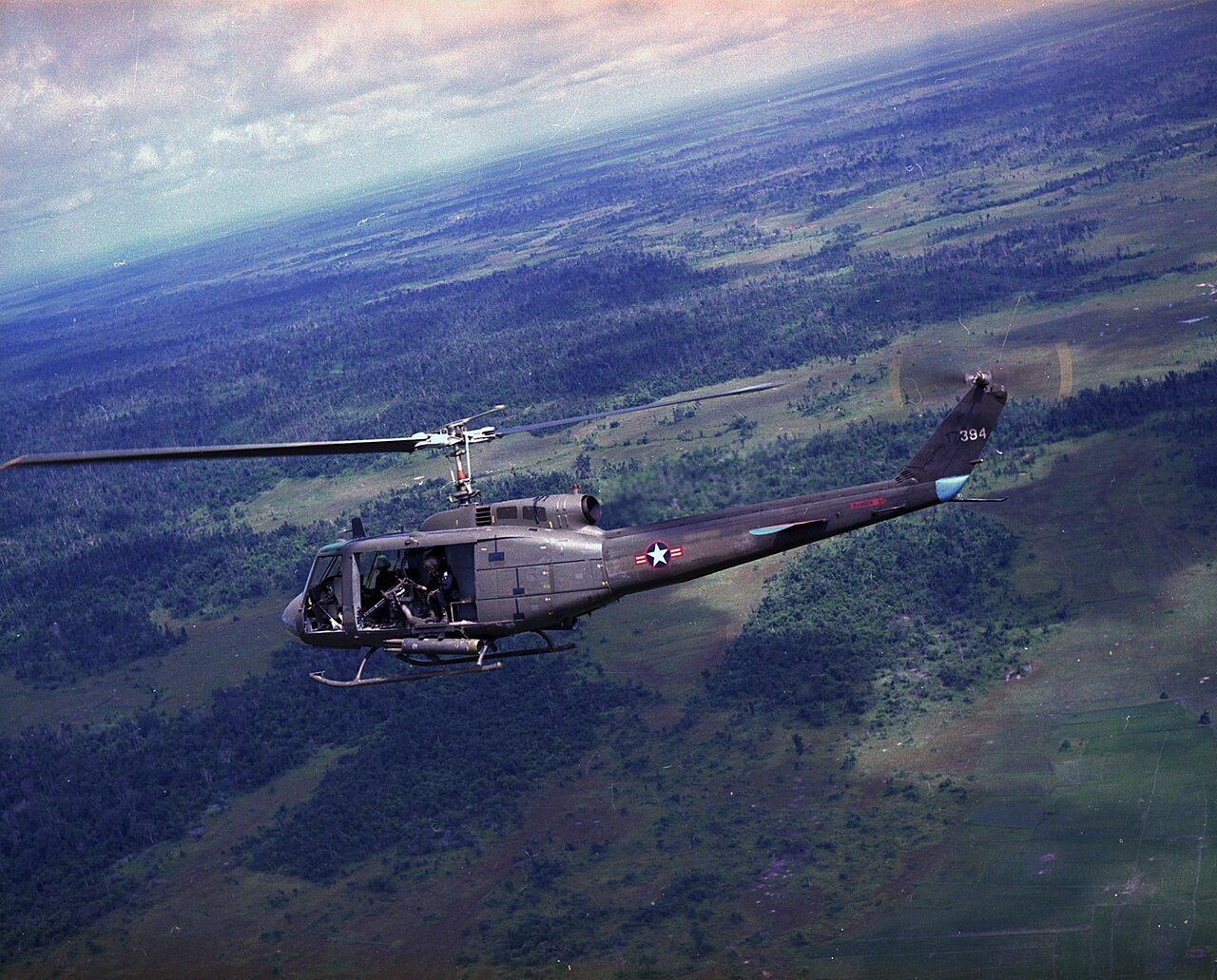
The Army meant its first Hueys for evaluation, but pressed them into service: Hueys of the 57th Medical Detachment arrived in South Vietnam in March 1962, and the stretched UH-1D followed: the FAS sheet dates its arrival to 1963 [2], while Wikipedia says the first batch of 77 reached South Vietnam in April 1965. [1] Their crews developed a language of their own. Troop carriers with only door guns were Slicks. Gunships carrying rockets were Hogs or Frogs, those with guns just Guns; units in the field built their own weapon mounts as early as 1962. [1]
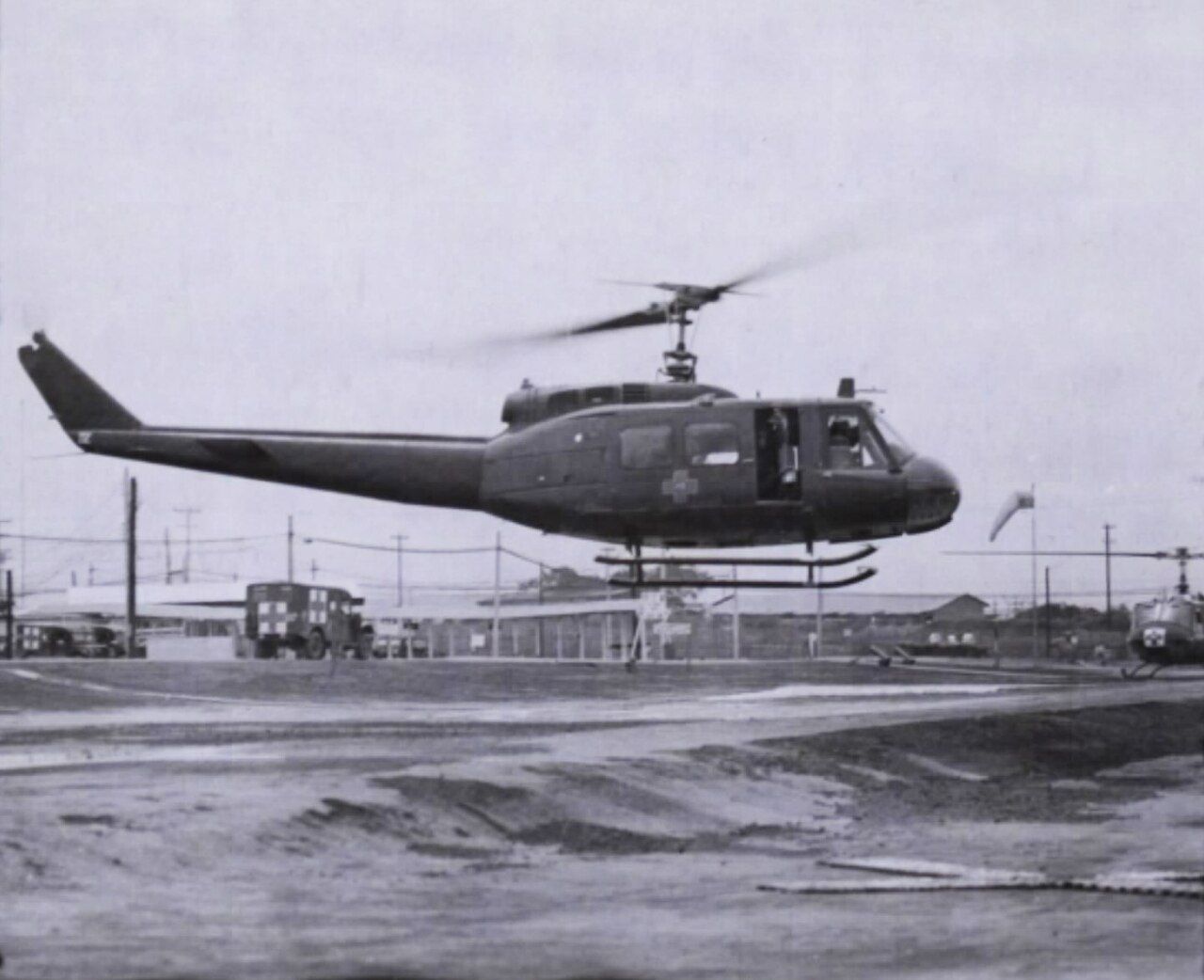
Hueys flew medical evacuation, command and control and cargo missions as well as assaults. [2] Air cavalry troops combined Huey-borne infantry with scout helicopters and gunships in colour-coded hunter-killer teams. At night, UH-1H “Nighthawks” with a searchlight and a minigun found and lit up targets for AH-1 Cobras on “Firefly” missions. [1] [2] In the 1972 Easter Offensive, two experimental Hueys armed with TOW missiles were rushed to Vietnam; their crews had never fired a TOW, yet 151 of the 162 they fired hit, including tanks. [1]
The cost was terrible. Of the 7,013 Hueys that served in Vietnam, 3,305 were destroyed, and 1,151 pilots and 1,231 other crew members were killed. [1]
Every service, many nations
The Huey served all the US armed forces. The Marine Corps chose it in 1962 and built the UH-1E with an all-aluminium airframe against corrosion and a rotor brake for shipboard use. [1] The Air Force’s 20th Special Operations Squadron, the Green Hornets, flew Hueys in Laos and Cambodia in the “Secret War”, inserting and extracting reconnaissanceReconnaissance GlossaryJoint terms: A mission undertaken to obtain, by visual observation or other detection methods, information about the activities and resources of an enemy or adversary, or to secure data concerning the meteorological, hydrographic, or… teams; Lieutenant James P. Fleming earned the Medal of Honor in a UH-1F on 26 November 1968. [1] The Navy turned surplus Army gunships into the Seawolves, working alongside its river patrol boats. [1] Australian Hueys flew in Vietnam too, some converted to “Bushranger” gunships with miniguns and rockets. [1]
After Vietnam the Huey flew in Grenada, Panama and the 1991 Gulf War, where more than 400 made up over a fifth of all coalition helicopters. [1] The UH-60 Black Hawk gradually replaced it: the Huey left active Army service in early 2005, and the last Army Huey was retired in late 2016. [1] It has not gone away. Germany flew its licence-built UH-1Ds until April 2021, the Air Force still flies the twin-engined UH-1N, the Marines fly the four-bladed UH-1Y Venom, and more than 16,000 of the Huey family have been built. [1]


Sources
- Bell UH-1 Iroquois. Wikipedia (secondary source). https://en.wikipedia.org/wiki/Bell_UH-1_Iroquois (accessed 2026-10-25).
- UH-1 Huey Helicopter. Federation of American Scientists, Military Analysis Network. https://man.fas.org/dod-101/sys/ac/uh-1.htm (accessed 2026-10-25).
Wikipedia articles are secondary sources and can change; they are cited with the date they were read. The Federation of American Scientists (FAS) Military Analysis Network pages largely reproduce US service fact sheets of the late 1990s and early 2000s, so later upgrades are not covered there.