
Drafted — not technically validated
Record revision 1 · The US Army's twin-engine attack helicopter, flown from Panama and Desert Storm to Afghanistan; the Longbow adds a mast-mounted radar.
Real-world aircraft as described in public sources. Figures vary between variants, loads and sources; the data plate names the variant its figures describe, and differences are noted beside the number they affect.
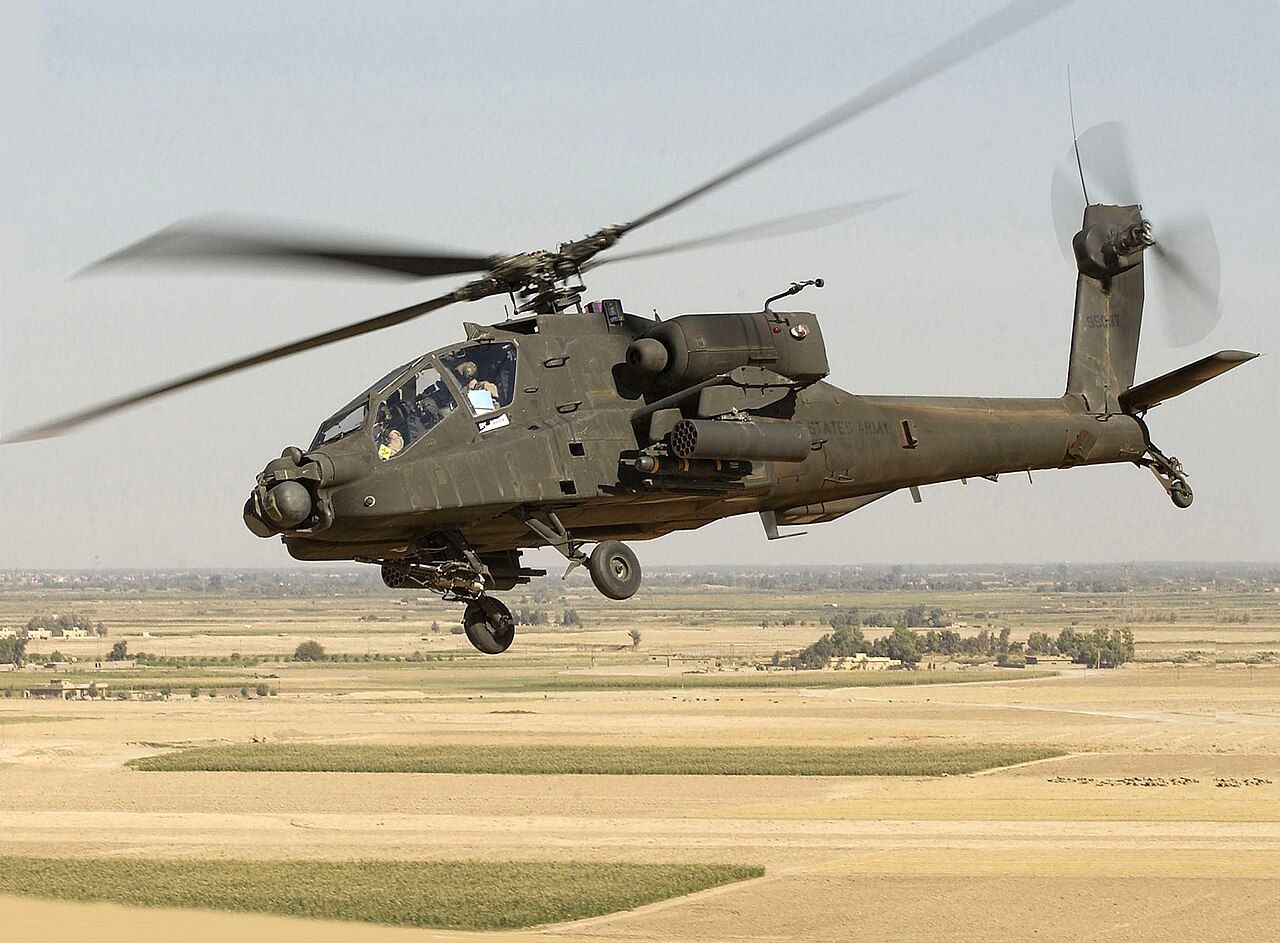
AH-64D Apache Longbow · Boeing AH-64D Apache Longbow
- Variant described
- AH-64D Apache Longbow [1]
- Origin
- United States
- Manufacturer
- Hughes Helicopters, then McDonnell Douglas from 1984 and Boeing from 1997 [1]
- First flight
- 30 September 1975 (YAH-64); AH-64D prototype 15 April 1992 [1]
- Entered service
- April 1986 (AH-64A); first production AH-64D delivered 31 March 1997 [1]
- Status
- In service with the US Army and 18 other countries; more than 2,700 delivered by March 2024 [1]
- Maximum speed
- 158 kt; never-exceed speed 197 kt [1]
- Service ceiling
- 20,000 ft [1]
- Range
- 257 NM with the Longbow radar; ferry range 1,024 NM [1]; combat radius about 150 km, or about 300 km with one external tank [2]
- Armament
- One 30 mm M230 Chain Gun under the nose, 1,200 rounds [1] [2]
- Four stub-wing pylons for up to 16 AGM-114 Hellfire missiles or up to 76 Hydra 70Hydra 70 (2.75 in) rocket OrdnanceThe 2.75 in rocket that began as the 'Mighty Mouse' bomber-killer and became the standard rocket of US attack helicopters. rockets, or a mix [1] [2]
- AIM-92 Stinger air-to-air missiles on wingtip stations (Longbow) [1]
- Sensors and avionics
- AN/APG-78 Longbow fire-control radar in a dome above the main rotor; tracks up to 128 targets and engages up to 16 [1]
- TADS/PNVS nose sights with day TV, thermal imaging and a laser rangefinder/designator, later replaced by Arrowhead [1] [2]
- IHADSS helmet sight that can slave the gun to the crew member's head [1]
- Purchase
- DCS WorldDCS: AH-64D by Eagle DynamicsDCS Store
Store pages checked 2026-10-28. Prices and availability change.
A tank killer the Army could own
In 1972 the US Army’s AH-56 Cheyenne attack helicopter was cancelled. Under the 1948 Key West Agreement it was not allowed to own fixed-wing combat aircraft, so if it wanted its own anti-armour aircraft it would have to be a helicopter, one with more firepower, performance and range than the AH-1 Cobra and agile enough to fly nap-of-the-earth, hugging the ground among trees and hills. The Advanced Attack Helicopter competition began that November. [1]
Hughes Helicopters’ YAH-64 first flew on 30 September 1975, a day before Bell’s rival. The Army chose the Hughes design in 1976, partly because its four-bladed rotor could take more damage and the Bell’s tricycle undercarriage was unstable. Named the Apache in 1981, after the Apache people, in the Army tradition of naming helicopters after Native American nations, it entered service in April 1986. [1]
Built to take a hit
The pilot sits behind and above the co-pilot/gunner, and either can fly the aircraft or fire its weapons. The crew compartment and rotor blades were designed to survive hits from 23 mm rounds, about 2,500 lb of protection is built into the airframe, the fuel system self-seals, and a transparent blast shield between the two seats is meant to ensure that at least one crew member survives a direct hit. [1]
Its most famous feature is the IHADSS helmet sight. Either crew member can slave the 30 mm chain gun under the nose to their helmet, so that the gun points wherever they look. Sensors in the nose give day TV, thermal imaging and a laser to guide HellfireAGM-114 Hellfire OrdnanceThe helicopter tank buster with laser or radar seekers, now also the drone strike weapon. missiles, and with them the Apache was designed to fight by day, by night and in bad weather. [1] [2]
Panama and the desert
The Apache’s first combat came in the invasion of Panama in 1989, mostly at night. The operation’s commander, General Carl Stiner, said: “You could fire that Hellfire missile through a window from four miles away at night.” [1] In the early hours of 17 January 1991, eight Apaches guided by MH-53 Pave Low helicopters made the first attack of Desert Storm, destroying part of Iraq’s radar network to open a path for the attack aircraft behind them. [1] [2] In the 100-hour ground war 277 Apaches destroyed 278 tanks and hundreds of other vehicles, for the loss of one helicopter, whose crew survived. The war also showed the price of a complicated machine: to keep the Apaches in the Gulf supplied with spare parts, the Army unofficially grounded all its others worldwide. [1]
The Longbow
The AH-64D Apache Longbow was approved in 1990 and first flew on 15 April 1992. Its signature is the dome on top of the main rotor, which houses the AN/APG-78 millimetre-wave radar. Because the dome sits so high, the crew can find targets while the helicopter hides behind trees, hills or buildings, track up to 128 of them, engage up to 16 and pass targets to other Apaches over a data link. In trials, six AH-64Ds were pitted against a larger force of AH-64As and proved seven times more survivable and four times more lethal. The first production AH-64D was delivered on 31 March 1997. [1]
Lessons and longevity
Not every deployment went well. In 1999, 24 Apaches sent to Albania for the Kosovo campaign needed 550 C-17 flights to move their equipment, and none flew a combat mission against Yugoslav air defencesAir defense GlossaryJoint terms: Defensive measures designed to destroy attacking enemy aircraft or missiles in the atmosphere, or to nullify or reduce the effectiveness of such attack.. On 24 March 2003, during the invasion of Iraq, Iraqi tank crews set a “flak trap” near Karbala that damaged 31 Apaches and brought one down, and the Army concluded that its supposed “flying tanks” were highly vulnerable to small-arms fire and stopped sending them on deep attacks. [1]
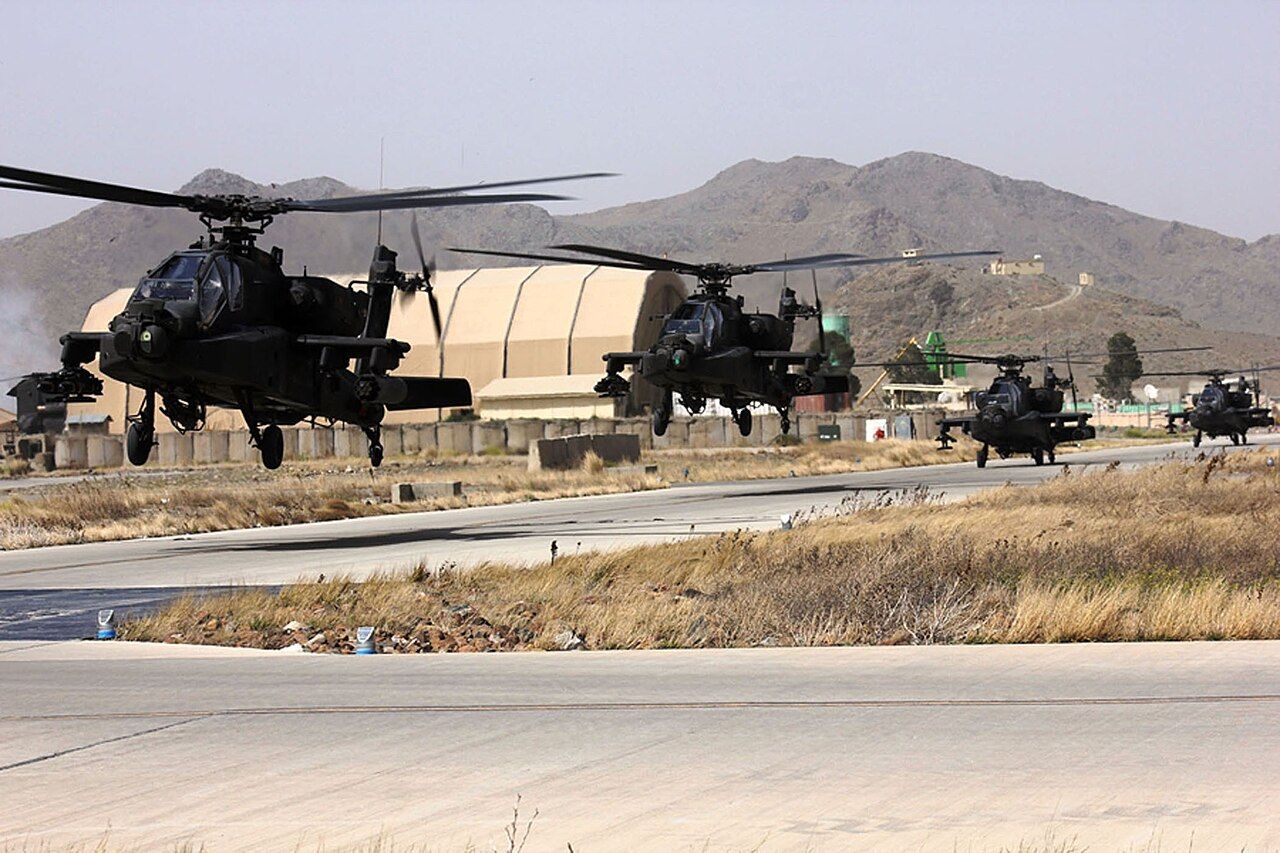
In Afghanistan, though, the Apache was the only Army aircraft able to give accurate close air supportCAS GlossaryJoint terms: Close air support. Air action by fixed- and rotary-wing aircraft against hostile targets that are in close proximity to friendly forces and that require detailed integration of each air mission with the fire and movement… during Operation Anaconda in 2002, often taking fire and being quickly repaired. Its successor, the AH-64E Guardian, entered service in 2013, and by 2024 more than 2,700 Apaches had been delivered to the US Army and 18 other nations, among them Britain, Israel, Japan, the Netherlands and Saudi Arabia. [1]

Sources
- Boeing AH-64 Apache. Wikipedia (secondary source). https://en.wikipedia.org/wiki/Boeing_AH-64_Apache (accessed 2026-10-25).
- AH-64 Apache. Federation of American Scientists, Military Analysis Network. https://man.fas.org/dod-101/sys/ac/ah64.htm (accessed 2026-10-25).
Wikipedia articles are secondary sources and can change; they are cited with the date they were read. The Federation of American Scientists (FAS) Military Analysis Network pages largely reproduce US service fact sheets of the late 1990s and early 2000s, so later upgrades are not covered there.