
Drafted — not technically validated
Record revision 1 · The tandem-rotor heavy-lift helicopter that has carried troops, guns and supplies for every war since Vietnam.
Real-world aircraft as described in public sources. Figures vary between variants, loads and sources; the data plate names the variant its figures describe, and differences are noted beside the number they affect.
CH-47F Chinook · Boeing CH-47F Chinook
- Variant described
- CH-47F [1]
- Origin
- United States
- Manufacturer
- Vertol, part of Boeing from 1960 (Boeing Vertol, now Boeing Defense, Space & Security); licence-built in Italy and Japan [1]
- Crew
- 3 in the specifications (pilot, co-pilot, flight engineer or loadmaster) [1]; US Army tactical minimum of 4 [2]
- First flight
- 21 September 1961 (YHC-1B); first production CH-47F 23 October 2006 [1]
- Status
- In service with the US Army and many other forces; over 1,200 built by 2012 [1]
- Powerplant
- Two Honeywell (Lycoming) T55-GA-714A turboshafts, 4,733 shp each [1]
- Service ceiling
- 20,000 ft [1]
- Range
- 400 NM; combat radius 165 NM; ferry range 1,216 NM [1]
- Armament
- Sensors and avionics
- Rockwell Collins Common Avionics Architecture System cockpit and digital advanced flight control system [1]
- Purchase
- DCS WorldDCS: CH-47F by Eagle DynamicsDCS Store
- Microsoft Flight SimulatorCH47D (the earlier D model) by Miltech SimulationsMiltech SimulationsOrbx
Store pages checked 2026-10-28. Prices and availability change.
Too heavy, too light, then just right
In the late 1950s the US Army wanted a turbine-powered helicopter to replace its piston-engined CH-37, but it could not decide how big it should be. One faction wanted a tactical transport for a squad of about 15 troops; another wanted something big enough to lift artillery and even the Pershing missile. Vertol’s tandem-rotor V-107 was judged too heavy for assault and too light for transport. The Army gave the assault role to the smaller UH-1 HueyUH-1H Huey AircraftThe utility helicopter that defined the Vietnam War and served every US armed service; more than 16,000 built., the Marines took the V-107 as the CH-46 Sea Knight, and Vertol enlarged the design into the Model 114. It made its first hovering flight on 21 September 1961 and was named Chinook, after the Chinook people of the Pacific Northwest. [1]
Two rotors, no tail rotor
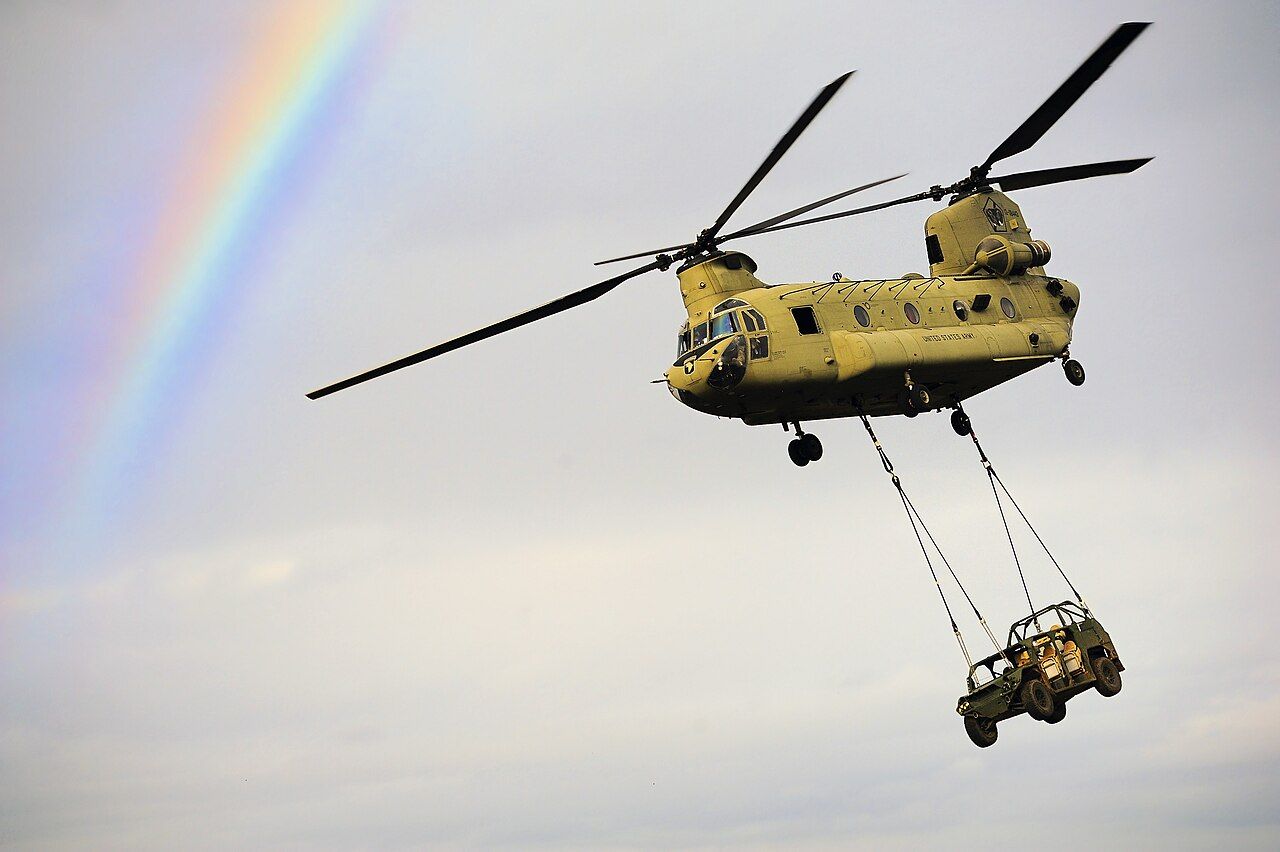
The Chinook’s two big three-bladed rotors turn in opposite directions, so it needs no tail rotor and all of its engines’ power goes into lift and thrust. Because the pilot can shift lift between the front and rear rotors, it copes well with an off-centre load, and it stays steady in the hover while troops climb ropes or cargo is dropped. If one engine fails, the other can drive both rotors. [1] With its rotors turning it is about 100 ft long, [2] and from its introduction it was faster than the utility and attack helicopters of its day, with a top speed of 170 kt; it is still one of the fastest helicopters in US service. [1]
Guns on the mountaintops
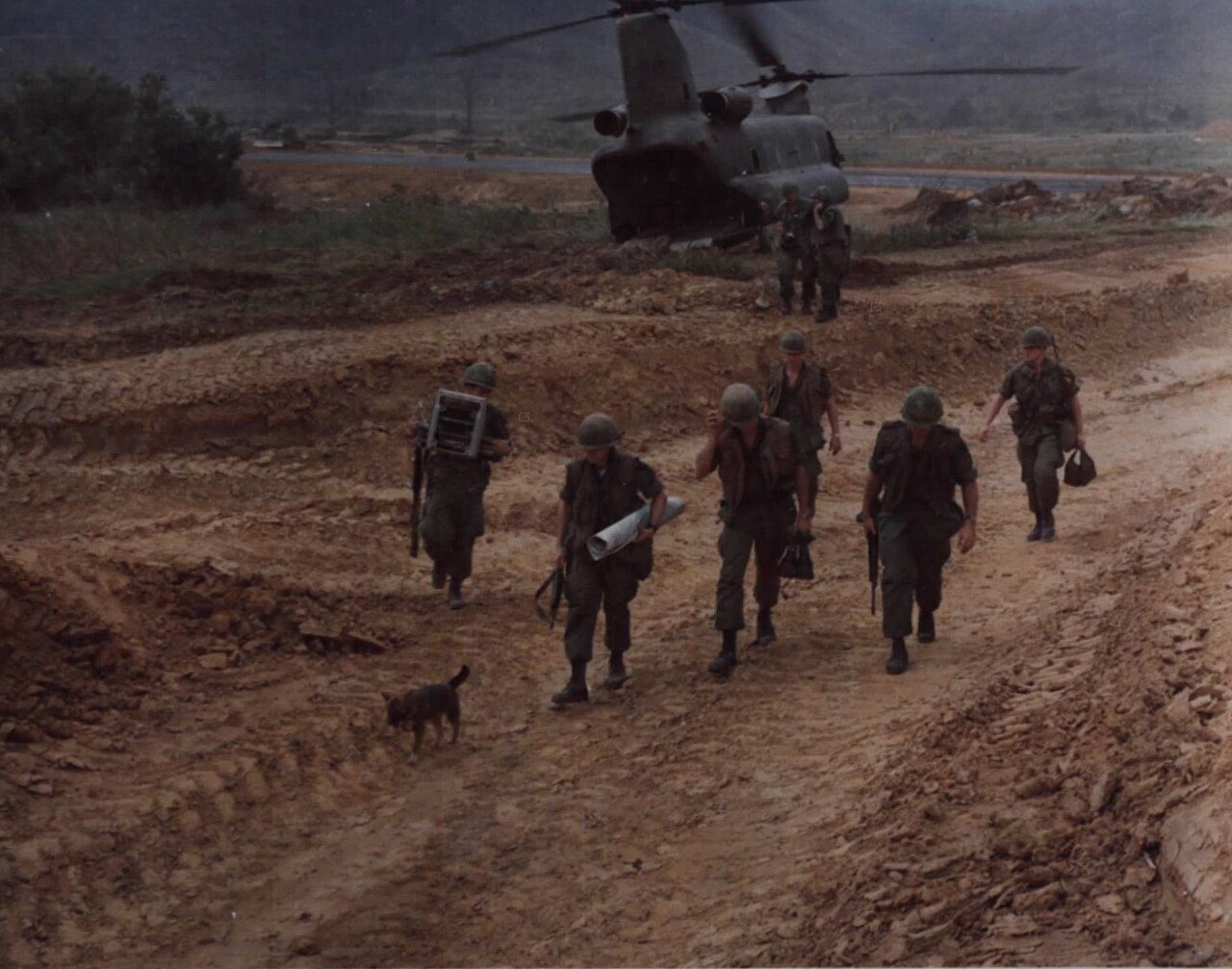
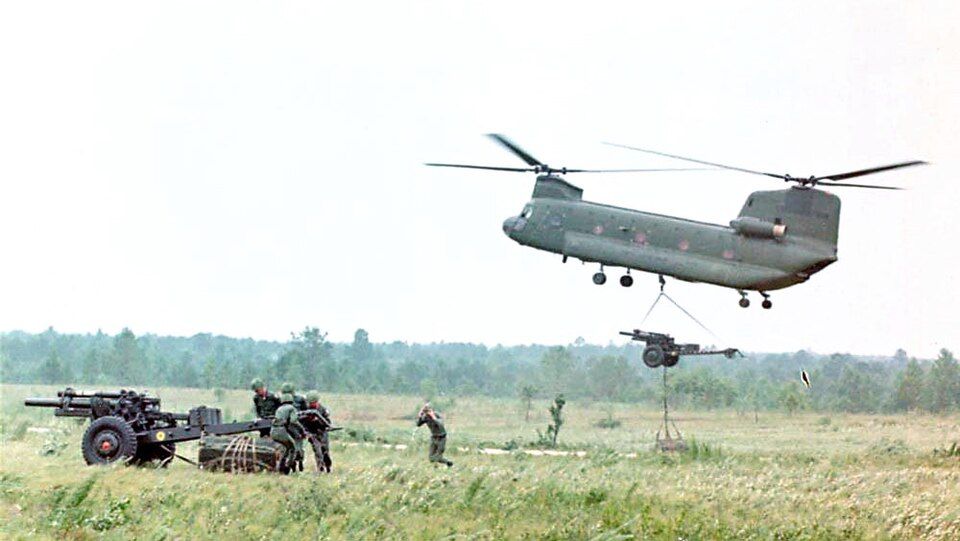
In Vietnam the Chinook’s most spectacular job was placing artillery batteries on mountaintops that nothing else could reach, then keeping them supplied with ammunition. It proved so valuable for artillery and heavy logistics that it was seldom used to carry assault troops. Crews had to watch that eager soldiers did not overload the tempting cargo bay, and in the heat and humidity the early CH-47A lost more than a fifth of its lift, so stronger transmissions and airframes followed in 1968. Perhaps its most cost-effective work was recovering other downed aircraft. Of nearly 750 Chinooks in the US and South Vietnamese fleets, about 200 were lost to combat or wartime accidents. [1]
Bravo November
Both sides flew Chinooks in the 1982 Falklands War. Three British Chinooks went down with the container ship Atlantic Conveyor when an Exocet missile struck it on 25 May. The sole survivor, Bravo November, did outstanding service for the rest of the campaign, once lifting 81 troops at a time, and has been on display at the RAF Museum Cosford since 2022. [1]
High, hot and heavy
In the 1991 Gulf War, Forward Operating Base Cobra, deep in Iraq, was deliberately placed within the combat radius of a fully loaded CH-47D; by the end of the first day Chinooks had lifted 131,000 gallons of fuel there. [2] In Afghanistan’s mountains, where altitude and heat limit lighter helicopters, one Chinook could reportedly do the air-assault work of up to five UH-60 Black Hawks. Its losses there included the deadliest single incident of the war for US forces, on 6 August 2011, when a Chinook carrying special operations troops was shot down and all 38 aboard were killed. [1]
The Chinook has also served far from the battlefield: it lifted relief supplies after Hurricane Andrew in 1992, and in 2011 Japanese Chinooks with lead plates on their floors dropped sea water on the damaged Fukushima reactors. [1]
The CH-47F
The CH-47F first flew in 2001, and production aircraft followed from 2006. Its machined airframe vibrates less and needs less inspection and repair, it has more powerful engines, a digital cockpit and digital flight controls, and it can carry more than 21,000 lb at over 175 mph. The US Army plans to keep the Chinook in service beyond 2060, more than a century after the first one flew. [1]


Sources
- Boeing CH-47 Chinook. Wikipedia (secondary source). https://en.wikipedia.org/wiki/Boeing_CH-47_Chinook (accessed 2026-10-25).
- CH-47 Chinook. Federation of American Scientists, Military Analysis Network. https://man.fas.org/dod-101/sys/ac/h-47.htm (accessed 2026-10-25).
Wikipedia articles are secondary sources and can change; they are cited with the date they were read. The Federation of American Scientists (FAS) Military Analysis Network pages largely reproduce US service fact sheets of the late 1990s and early 2000s, so later upgrades are not covered there.