
Drafted — not technically validated
Record revision 1 · The light Franco-British helicopter that introduced the fenestron tail fan; the SA 342M hunts tanks with HOT missiles.
Real-world aircraft as described in public sources. Figures vary between variants, loads and sources; the data plate names the variant its figures describe, and differences are noted beside the number they affect.
SA 342 Gazelle · Aérospatiale SA 342M Gazelle
- Variant described
- SA 342M, the French Army anti-tank version; figures are for the SA 342 where FAS gives them, otherwise for the earlier SA 341G [1] [2]
- Origin
- France, with production in the United Kingdom, Yugoslavia and Egypt
- Manufacturer
- Sud Aviation, then Aérospatiale; Westland in the UK; SOKO and ABHCO under licence [1] [2]
- First flight
- 7 April 1967 (SA 340 prototype) [1]
- Status
- In service with the French Army and other users; production ended in 1996 after about 1,700 [1]; retired by the British Army on 31 October 2023 [1]
- Powerplant
- One Turbomeca Astazou XIV turboshaft on the SA 342 (870 shp on the SA 342K/J); the SA 341 has the 590 shp Astazou III [1] [2]
- Service ceiling
- 5,000 m (16,400 ft) for the SA 342; 4,100 m for the SA 341 [2]
- Armament
- SA 342M: four Euromissile HOT wire-guided anti-tank missiles [1]; FAS lists four to six [2]
- Gazelle Mistral: Mistral air-to-air missiles; SA 341F: 20 mm GIAT M.621 cannon [1] [2]
- Optional 7.62 mm machine guns, 68 mm SNEB or 2.75 in rocket pods; older options include AS.11 and AS.12 wire-guided missiles [1] [2]
- Sensors and avionics
- Purchase
- DCS WorldDCS: SA342 Gazelle by Polychop SimulationsDCS Store
Store pages checked 2026-10-28. Prices and availability change.
A fan in the tail
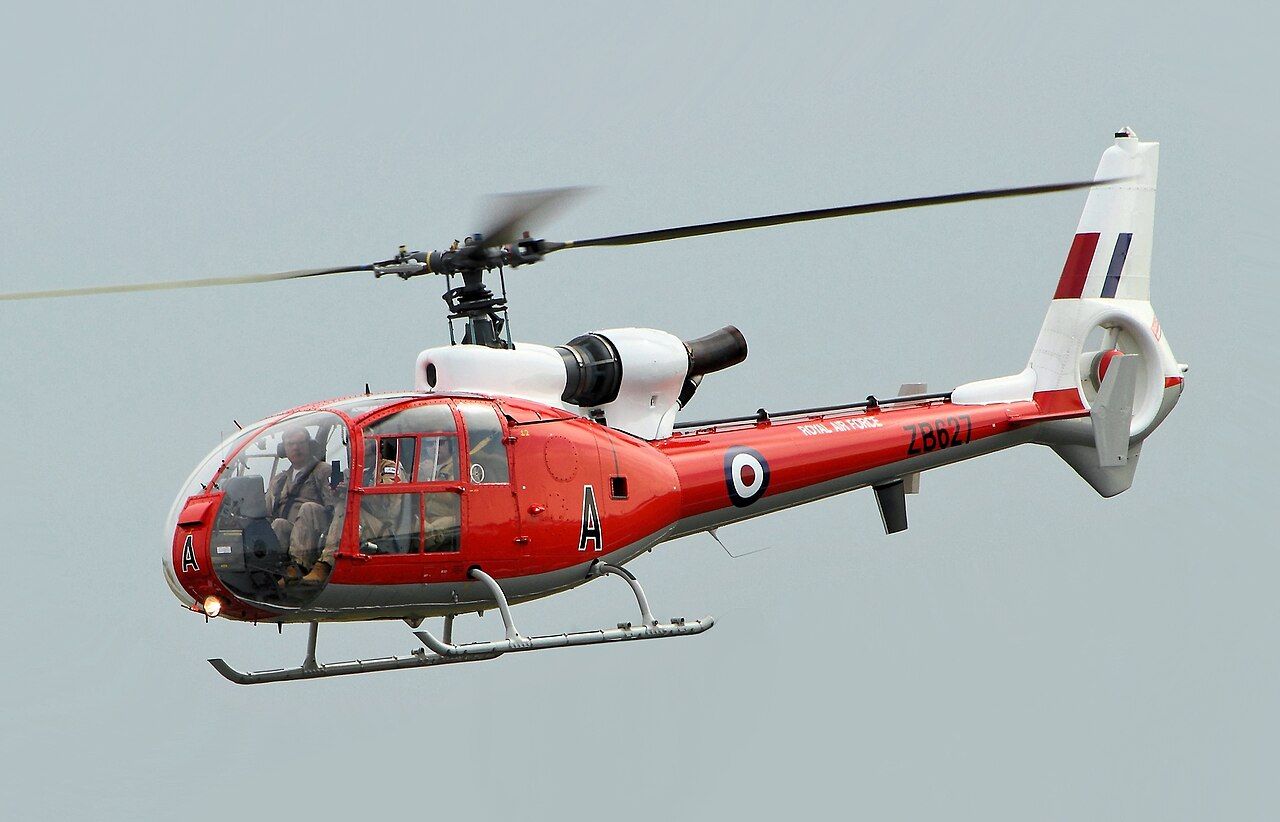
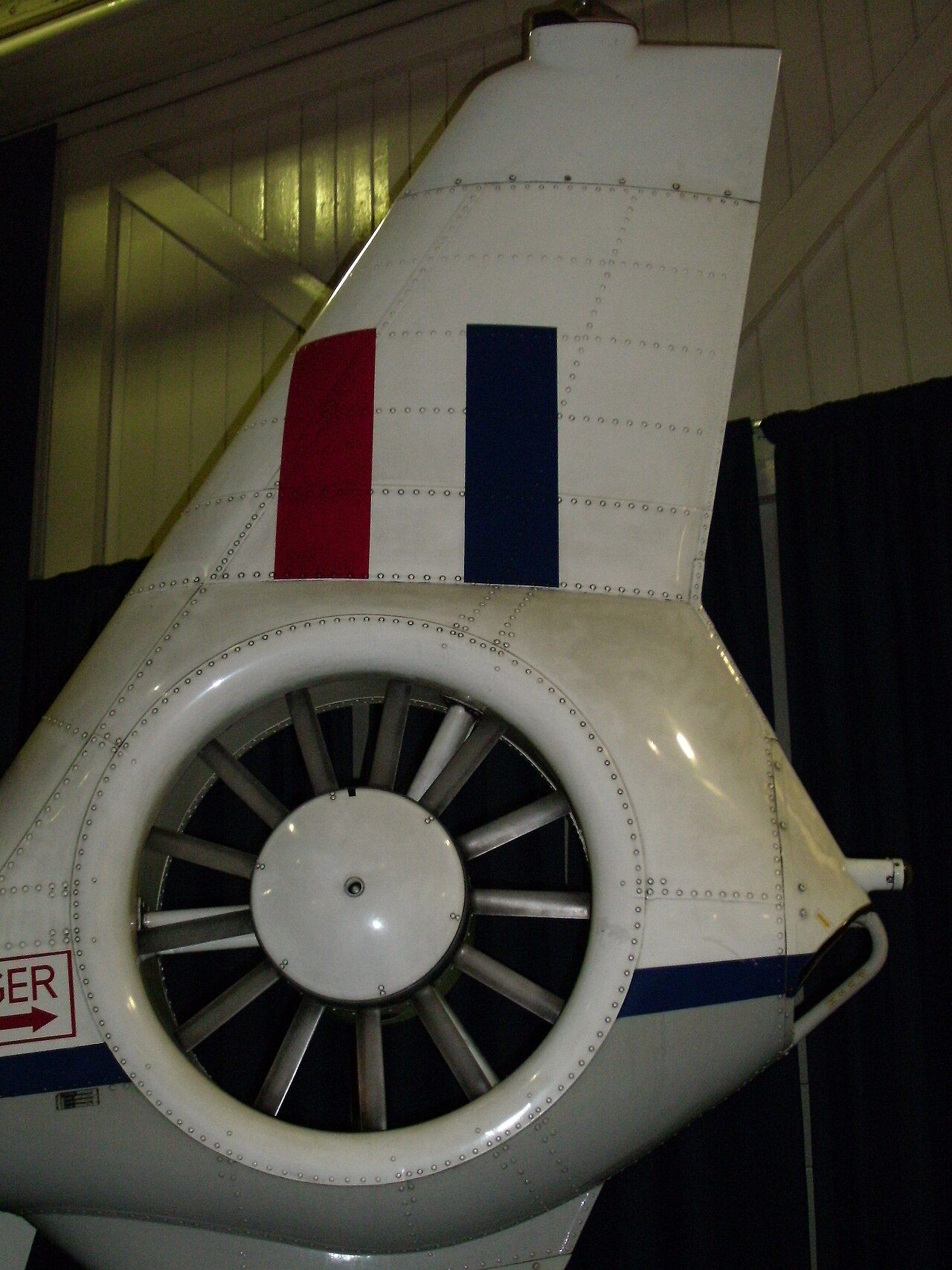
Look at the back of a Gazelle and something is missing: there is no tail rotor. In its place, built into the fin, is a ring of 13 small blades inside a shroud, the fenestron. The Gazelle was the first helicopter to have one. The shrouded fan costs a little more power when hovering, but it is far harder to damage, much safer for anyone walking near the helicopter, and needs less power at cruising speed. [1] [2] The first prototype flew on 7 April 1967 with an ordinary tail rotor borrowed from the Alouette II; the second prototype got the fenestron in early 1968. [1]
The rotor blades were new as well: made mostly of fibreglass, they were designed for an extremely long life, and composite blades later became common across the industry. Getting the main rotor right took a long time. The first design was a rigid rotorRigid rotor GlossaryFlight: A rotor with no flapping or lead-lag hinges; the blades bend to allow those motions. It is very responsive and usually not susceptible to mast bumping. based on the Bo 105’s, but it gave control problems at high speed and production aircraft used an articulated rotor instead. [1] The result was fast. On 13 May 1967 a Gazelle set two world speed records on a closed course, 307 km/h over 3 km and 292 km/h over 100 km, and the fenestron has been credited with making it the fastest helicopter in its class. [1]
Easy to fly, easy to keep
Pilots found the Gazelle docile. It is reported to fly comfortably at up to 100 knots even with its main hydraulic system out, and unusually it has no throttle and no trim system. It was the first helicopter adapted for a single pilot to fly on instruments, with a Honeywell duplex autopilot; it was chosen for that work because it was fast, stable and known to be easy to fly. [1] Maintenance was cut to the bone: bearings were life-rated and needed no regular lubrication, and many components were designed to run 700 hours, some 1,200, before replacement. [1]
An Anglo-French helicopter
Britain wanted it from the start. In February 1967 France and the UK signed a deal under which Westland would build Gazelles and Pumas for the British forces while Sud Aviation shared in the Lynx. [1] The Gazelle went on to serve all three British services. The British Army’s first operational unit, No. 660 Squadron Army Air Corps in Germany, received it on 6 July 1974 to replace the Sioux, and used it for reconnaissanceReconnaissance GlossaryJoint terms: A mission undertaken to obtain, by visual observation or other detection methods, information about the activities and resources of an enemy or adversary, or to secure data concerning the meteorological, hydrographic, or…, directing artillery fire, casualty evacuation and anti-tank work. [1] In the Falklands War in 1982 Gazelles were rushed into action with rocket pods, armour and flotation gear: two Royal Marines Gazelles were shot down on the first day of the San Carlos landings, and on 6 June an Army Gazelle was mistaken for a low-flying Argentine C-130C-130J Super Hercules AircraftThe modernised four-turboprop tactical transport: new engines, glass cockpit, three crew. and shot down by the destroyer HMS Cardiff. [1] The British Army’s Cold War Gazelles flew more than 660,000 hours. The last ones were retired on 31 October 2023 after almost 50 years, with a farewell flypast from Northern Ireland a week before. [1]
Tank hunter
In the French Army the Gazelle was above all a tank hunter. The SA 342M carries four HOT wire-guided missiles and a stabilised sight on the cabin roof; other French versions carry a 20 mm cannon or Mistral missiles to shoot down enemy helicopters, and the Gazelle Viviane adds a thermal imager for night work. [1] [2] The Tiger has replaced it as France’s front-line attack helicopter. [1]
The Gazelle’s HOT missiles made their name in the 1982 Lebanon War. Syrian Gazelles struck the advancing Israeli army repeatedly, using Western-style “pop-up” tactics; panic spread among Israeli tank crews after the first raid on 8 June, and the missiles’ range was a key reason. Syria later claimed 30 tanks destroyed for the loss of five helicopters, while Israel admitted seven tanks lost and claimed 12 Gazelles shot down. One analyst judged the raids psychologically effective but low on actual kills. [1]
Everywhere at once
The Gazelle has fought on both sides of more wars than most aircraft. Iraq flew about 100 against Iran in the 1980s; in 1991 Kuwaiti Gazelles that had escaped to Saudi Arabia flew back to attack Iraqi tanks, and more than 50 French Gazelles strafed Iraqi armour in continuous high-speed waves. [1] On 27 June 1991 a Yugoslav Air Force Gazelle was brought down by a shoulder-launched missile over Ljubljana, the first aircraft lost in the break-up of Yugoslavia. [1] French Gazelles have flown from Chad to Afghanistan, fired on Somali pirates in 2008, struck Libyan forces from the assault ship Tonnerre in 2011, and attacked Gbagbo’s compound in Côte d’Ivoire the same year. [1] As recently as 2021, three Gazelles supported Mozambican forces and helped evacuate civilians during the Battle of Palma. [1]

Sources
- Aérospatiale Gazelle. Wikipedia (secondary source). https://en.wikipedia.org/wiki/A%C3%A9rospatiale_Gazelle (accessed 2026-10-25).
- SA 341 Gazelle / SA 342 Gazelle. Federation of American Scientists, Military Analysis Network. https://man.fas.org/dod-101/sys/ac/row/gazelle.htm (accessed 2026-10-25).
Wikipedia articles are secondary sources and can change; they are cited with the date they were read. The Federation of American Scientists (FAS) Military Analysis Network pages largely reproduce US service fact sheets of the late 1990s and early 2000s, so later upgrades are not covered there.