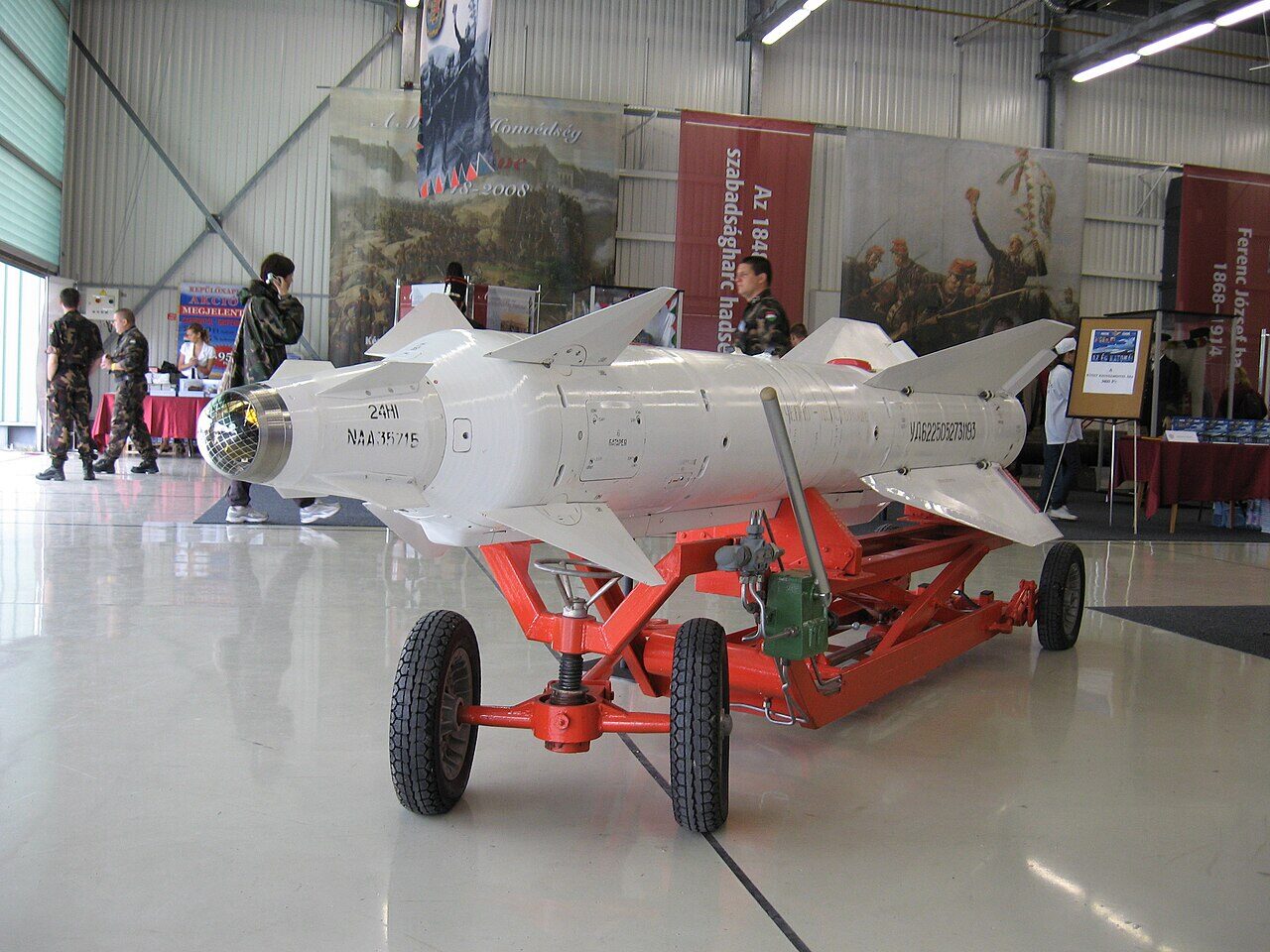

Drafted — not technically validated
Record revision 1 · A heavy Soviet tactical missile with a 320 kg warhead and laser or TV guidance.
Real-world weapon as described in public sources. Weights and dimensions change with the fins, fuzes and variant fitted; the data plate names the variants its figures describe, and differences are noted beside the number they affect. The record describes the weapon; it is not a guide to employing it.
Kh-29 (AS-14 Kedge) · Kh-29 / AS-14
- Type
- Tactical air-to-surface missile with a heavy warhead [1]
- Origin
- Soviet Union
- In service
- 1980 [1]
- Weight
- 660 kg (1,455 lb) Kh-29L; 685 kg (1,510 lb) Kh-29T [1]
- Dimensions
- Length 3.9 m (12.8 ft); diameter 38 cm (15 in); wingspan 1.1 m (3.6 ft) [1]
- Warhead or payload
- 320 kg (705 lb) high-explosive armour-piercing [1]
- Guidance
- Semi-active laser (Kh-29L), passive TV (Kh-29T/TE), imaging infrared (Kh-29D) or active radar (Kh-29MP) [1]
- Fuzing
- Impact [1]
- Delivery
- Gives tactical aircraft a standoff attack on large targets [1]
- Range
- 10 km (5.4 NM) Kh-29L; 12 km (6.5 NM) Kh-29T; 30 km (16 NM) Kh-29TE [1]
- Carried by
- MiG-29MiG-29 Fulcrum AircraftA twin-engine Soviet fighter with a helmet sight and R-73 missiles, built to counter the F-15 and F-16., MiG-27K, Su-22, Su-24, Su-30, Su-34 [1]
- Su-25Su-25 Frogfoot AircraftAn armoured Soviet close air support jet; the Su-25T adds Vikhr anti-tank missiles. (Kh-29L only); Su-33Su-33 Flanker-D AircraftThe carrier-based Flanker: canards, folding wings and a ski-jump launch from Admiral Kuznetsov. [1]
- Iraqi Mirage F1EMirage F1 AircraftA swept-wing French fighter sold to eleven countries and flown in many wars. [1]
A big warhead
The Kh-29 carries a 320 kg warhead and a choice of laser, TV, infrared or radar guidance, giving tactical aircraft such as the Su-24, Su-30, MiG-29MiG-29 Fulcrum AircraftA twin-engine Soviet fighter with a helmet sight and R-73 missiles, built to counter the F-15 and F-16. and Su-25Su-25 Frogfoot AircraftAn armoured Soviet close air support jet; the Su-25T adds Vikhr anti-tank missiles. a longer standoff. [1] It is meant mainly for large battlefield targets and infrastructure, such as factories, depots and bridges, but can also attack ships of up to 10,000 tonnes, hardened aircraft shelters and concrete runways. [1]
Borrowed parts
The Molniya bureau, better known for air-to-air missiles, began the design in the late 1970s, and Vympel finished it when Molniya moved to space work. It was first fired in 1976 and entered service in 1980. [1] Its layout follows the R-60R-60 "Aphid" OrdnanceA tiny 44 kg Soviet dogfight missile, among the lightest and most agile in the world when it appeared in the 1970s. air-to-air missile; its laserLGW GlossaryWeapons: Laser-guided weapon. A weapon that uses a seeker to detect laser energy reflected from a laser marked/designated target and through signal processing provides guidance commands to a control system, which guides the… seeker came from the Kh-25Kh-25 OrdnanceA light Soviet tactical missile whose laser, radar-homing or radio seekers swap on one body. and its TV seeker from the Kh-59Kh-59 Ovod OrdnanceA Soviet standoff cruise missile flown inertially, then steered onto the target by TV.. [1] It is often compared with the AGM-65 MaverickAGM-65 Maverick OrdnanceThe West's most widely produced precision-guided missile: TV, infrared or laser seekers, launched and left., but it is a much bigger missile, more than twice as heavy, with a warhead of 320 kg against 136 kg. [1]
In combat
Russian Su-34s and Su-24s used the Kh-29L in Syria from 2015. [1]
Sources
- Kh-29. Wikipedia (secondary source). https://en.wikipedia.org/wiki/Kh-29 (accessed 2026-10-27).
Wikipedia articles are secondary sources and can change; they are cited with the date they were read. NAVEDTRA training manuals and budget justification exhibits are official US publications, but each describes the weapons in service when it was written.