
Drafted — not technically validated
Record revision 1 · A swept-wing French fighter sold to eleven countries and flown in many wars.
Real-world aircraft as described in public sources. Figures vary between variants, loads and sources; the data plate names the variant its figures describe, and differences are noted beside the number they affect.
Mirage F1C · Dassault Mirage F1C/CE
- Variant described
- Mirage F1C and export F1CE/F1EE [1]
- Origin
- France
- Manufacturer
- Dassault Aviation [1]
- Powerplant
- One SNECMA Atar 9K-50 afterburningAfterburner GlossaryFlight: An additional combustion area aft of the turbine section of a turbojet, with fuel nozzles and flameholders, that burns fuel in the engine's large excess of air. It adds only 10 to 20 percent to the engine's weight but 40… turbojet, 70.6 kN (15,900 lbf) with afterburnerAfterburner GlossaryFlight: An additional combustion area aft of the turbine section of a turbojet, with fuel nozzles and flameholders, that burns fuel in the engine's large excess of air. It adds only 10 to 20 percent to the engine's weight but 40… [1]
- Range
- Combat radius 425 km (229 NM) hi-lo-hi with 14 × 250 kg bombs; ferry range 3,300 km (1,782 NM) [1]
- Armament
- Sensors and avionics
The Mirage without a delta
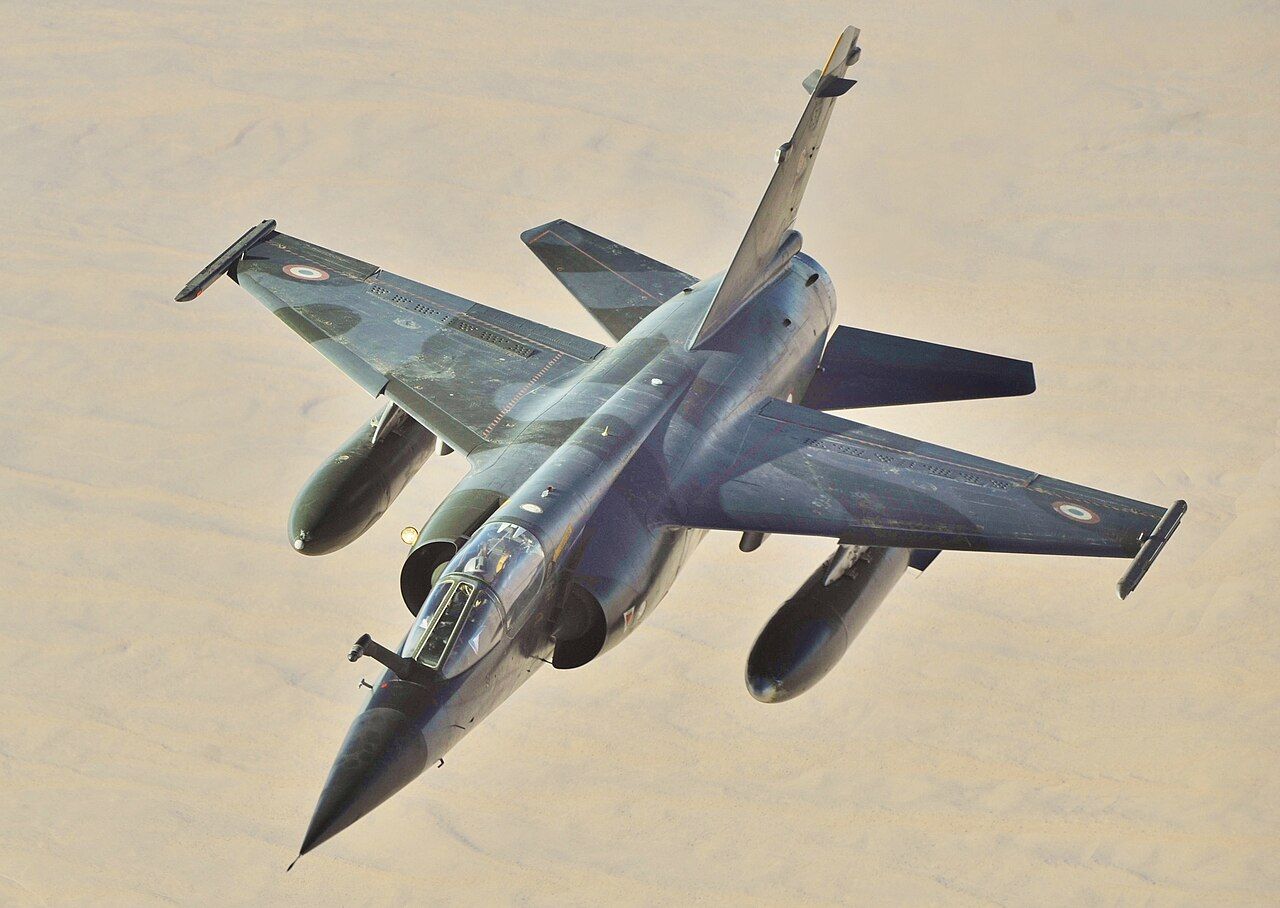
For a decade “Mirage” had meant a delta wing. The F1 broke the pattern. In the mid-1960s, with two big projects cancelled and its design team short of work, Dassault began a smaller fighter as a successor to the Mirage III and Mirage 5, aimed at a French Air Force requirement for an all-weather interceptor. [1] It used a swept wing mounted high on the fuselage and a conventional tail, unlike the deltas before and after it. [2] Although its wingspan was smaller than the Mirage III’s, it carried more fuel, needed a shorter take-off run and was more manoeuvrable. [1]
The prototype flew on 23 December 1966 and passed MachMach number GlossaryFlight: The ratio of the true airspeed to the speed of sound. All compressibility effects depend on it. 2 on its fourth flight, but on 18 May 1967 it broke up after encountering flutter, killing its pilot. The programme survived, and the larger, costlier Mirage F2 was dropped in its favour. [1]
Interceptor
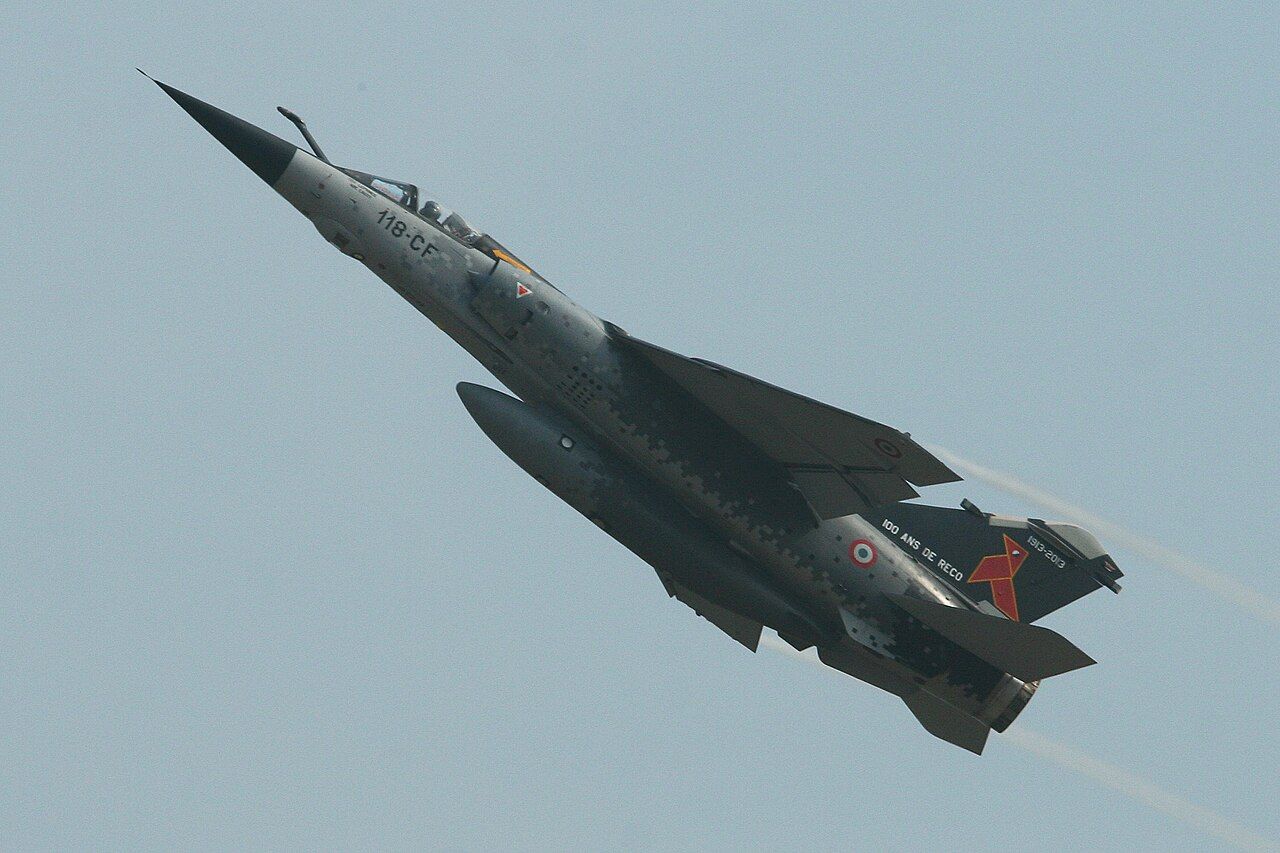
The first production F1C carried the Cyrano IV radar to meet the all-weather requirement; the later Cyrano IV-1 added a limited ability to look down at low-flying targets, though pilots reported that the radar tended to overheat. [1] It entered service in 1973 and was France’s standard fighter until the Mirage 2000Mirage 2000C AircraftFrance's fly-by-wire delta interceptor, armed with Super 530D and Magic II missiles. arrived in 1984, then moved on to reconnaissanceReconnaissance GlossaryJoint terms: A mission undertaken to obtain, by visual observation or other detection methods, information about the activities and resources of an enemy or adversary, or to secure data concerning the meteorological, hydrographic, or…. [1] [2] The F1C-200 added a fixed refuelling probe, and missiles usually ride on the wingtips. [1] [2]
French F1C-200s first went into action over Chad, flying top cover for Jaguar strike aircraft against Libyan-backed forces in 1984 and for the raid on Ouadi Doum airbase in February 1986. [1] The last French F1s were retired in June 2014, and six made a farewell flypast over Paris on Bastille Day. [1]
A fighter for a dozen air forces
More than 700 F1s were sold to 11 countries, and the type fought in more wars than most fighters of its era. [2] It saw combat in the Western Sahara, in Ecuador’s wars with Peru, in the Iran–Iraq War, the Gulf War, the South African Border War and over Afghanistan, among others. [1]
Iraq was its biggest combat user. Iraqi F1EQs flew intensively on interception, ground attack and anti-shipping missions against Iran, and could reach far deeper into Iran than earlier Iraqi aircraft. In November 1981 an Iraqi F1 became the first aircraft to shoot down an Iranian F-14F-14 Tomcat AircraftThe Navy's swing-wing fleet defence fighter: two crew, AWG-9 radar and AIM-54 Phoenix., and Iraqi F1EQs claimed at least 35 Iranian aircraft during the war. They paid heavily too: by one researcher’s count, Iranian F-14sF-14 Tomcat AircraftThe Navy's swing-wing fleet defence fighter: two crew, AWG-9 radar and AIM-54 Phoenix. shot down 33 of them. [1] The war made the F1 a problem for its own makers: in 1991 French reconnaissanceReconnaissance GlossaryJoint terms: A mission undertaken to obtain, by visual observation or other detection methods, information about the activities and resources of an enemy or adversary, or to secure data concerning the meteorological, hydrographic, or… F1CRs were grounded for the first days of Desert Storm so that they would not be mistaken for Iraqi Mirages. [1]
South Africa bought F1s just before a 1977 arms embargo, and its F1CZs shot down two Angolan MiG-21sMiG-21 AircraftThe small delta-wing Mach 2 fighter: the most-produced supersonic jet in history. in 1981 and 1982. On both occasions Major Johan Rankin made the kill with his cannon, the first time after his missiles failed to lock on. [1]
Spain flew F1Cs and F1Es as its main air defenceAir defense GlossaryJoint terms: Defensive measures designed to destroy attacking enemy aircraft or missiles in the atmosphere, or to nullify or reduce the effectiveness of such attack. interceptors and upgraded them to F1M standard in the late 1990s, with a longer life, better avionics and anti-ship capability. Spain and Greece integrated the AIM-9 Sidewinder. [1] Even now the F1 has a role in American training: former Spanish F1Ms fly with a private company as adversary aircraft supporting the US Air Force. [1]

Sources
- Dassault Mirage F1. Wikipedia (secondary source). https://en.wikipedia.org/wiki/Dassault_Mirage_F1 (accessed 2026-10-25).
- Mirage F-1. Federation of American Scientists, Military Analysis Network. https://man.fas.org/dod-101/sys/ac/row/mirage-f1.htm (accessed 2026-10-25).
Wikipedia articles are secondary sources and can change; they are cited with the date they were read. The Federation of American Scientists (FAS) Military Analysis Network pages largely reproduce US service fact sheets of the late 1990s and early 2000s, so later upgrades are not covered there.