
Drafted — not technically validated
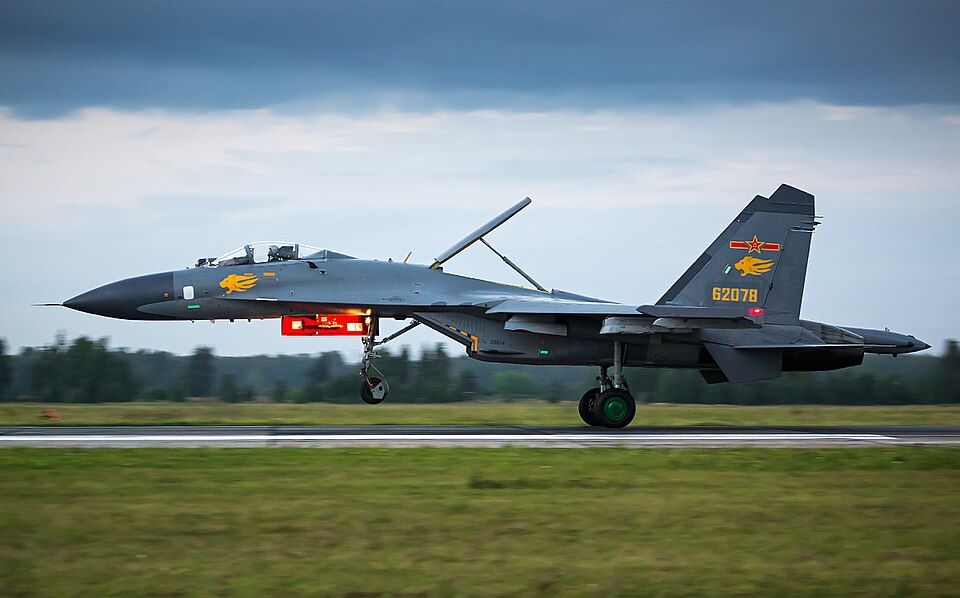
Record revision 1 · China's licence-assembled Su-27SK, with new displays and the R-77 missile.
Real-world aircraft as described in public sources. Figures vary between variants, loads and sources; the data plate names the variant its figures describe, and differences are noted beside the number they affect.
J-11A · Shenyang J-11A
- Variant described
- J-11A, an improved Chinese-assembled Su-27SKSu-27 Flanker AircraftA large, long-range Soviet air superiority fighter with ten missile stations.; performance figures are for the Su-27Su-27 Flanker AircraftA large, long-range Soviet air superiority fighter with ten missile stations. [1] [2]
- Origin
- China (Soviet design)
- Manufacturer
- Shenyang Aircraft Corporation [1]
- Crew
- 1 [1]
- First flight
- 1998 (first Chinese-assembled J-11) [1]
- Entered service
- 1998; J-11A production began in 2000 [1]
- Status
- In service with the People's Liberation Army Air Force; 104 or 105 J-11 and J-11A built [1]
- Powerplant
- Two Saturn AL-31F afterburningAfterburner GlossaryFlight: An additional combustion area aft of the turbine section of a turbojet, with fuel nozzles and flameholders, that burns fuel in the engine's large excess of air. It adds only 10 to 20 percent to the engine's weight but 40… turbofans, 122.6 kN (27,560 lbf) each with afterburnerAfterburner GlossaryFlight: An additional combustion area aft of the turbine section of a turbojet, with fuel nozzles and flameholders, that burns fuel in the engine's large excess of air. It adds only 10 to 20 percent to the engine's weight but 40… [1] [2]
- Maximum speed
- Mach 2.35, 2,500 km/h (1,350 kt) at altitude (Su-27) [2]
- Service ceiling
- 18,500 m (60,700 ft) without external stores (Su-27) [2]
- Armament
- Sensors and avionics
- Purchase
- DCS WorldDCS: Flaming Cliffs 2024 (the J-11A comes only in this bundle) by Eagle DynamicsDCS Store
Store pages checked 2026-10-28. Prices and availability change.
A fighter bought after an embargo
After the Tiananmen Square crackdown of 1989, Western countries embargoed arms sales to China, and Beijing turned to Moscow. It chose the Su-27Su-27 Flanker AircraftA large, long-range Soviet air superiority fighter with ten missile stations. over the MiG-29MiG-29 Fulcrum AircraftA twin-engine Soviet fighter with a helmet sight and R-73 missiles, built to counter the F-15 and F-16. and became the Flanker’s first export customer. [1] In 1991 China bought 24 Su-27sSu-27 Flanker AircraftA large, long-range Soviet air superiority fighter with ten missile stations. for about US$1 billion; they arrived in late 1992 and were based at Wuhu, 250 km west of Shanghai, and a second batch followed in 1996. [3] China had spent years trying to develop a fighter of equivalent capability at home, and US analysts read the purchase as a sign of little confidence in its own industry. [3]
Assembled in Shenyang
In 1996 China and Russia agreed that the Shenyang Aircraft Corporation would build up to 200 Su-27SKsSu-27 Flanker AircraftA large, long-range Soviet air superiority fighter with ten missile stations. from Russian kits, with no right to export them. [3] Engines, radars and avionics would still come from Russia. The first two Shenyang aircraft, completed in December 1998, were so poorly assembled that Russian help was needed to rebuild them, and only five had been built by 2000. By 2003 the quality was high and the factory was using Chinese-made airframe parts. [1]
The Chinese-built aircraft was named the J-11, and NATO calls it Flanker-B+. [1] The J-11A was a later production batch with new cockpit displays and the ability to fire the R-77 active-radar missile. About 105 J-11s and J-11As were built in all. [1] Beneath the new displays it is still a Su-27SKSu-27 Flanker AircraftA large, long-range Soviet air superiority fighter with ten missile stations.: a large, long-range, fly-by-wire fighter with a cannon and up to ten air-to-air missiles. [2]
Flanker becomes “Flaming Dragon”
China wanted to stop depending on Russia. In 2004, reportedly breaking the co-production agreement, it ended licence assembly and moved to the J-11B “Flaming Dragon”, with a Chinese radar, glass cockpit and flight controls and, eventually, the Chinese WS-10 engine. By 2011 about 90% of the J-11B’s subsystems and parts were reported to be of Chinese design. [1] The J-11A fleet was upgraded too: in the mid-2010s some aircraft received four Chinese missile approach warning sensors. [1]
Close encounters
The Flanker gave China a long-range fighter, with an operational radius of about 1,500 km, that could also strike targets on the ground and at sea. [3] During exercises in the Taiwan Strait in March 1996, Chinese Su-27sSu-27 Flanker AircraftA large, long-range Soviet air superiority fighter with ten missile stations. fired rockets and dropped retarded bombs, the first time such bombs had been shown in public. [3] Its successors have since made headlines of their own: in August 2014 a J-11B intercepted a US Navy P-8 Poseidon over the South China Sea, passing within 20 ft of its wingtip and rolling over the top of it, in what the Pentagon called an unsafe and unprofessional intercept. [1]

Sources
- Shenyang J-11. Wikipedia (secondary source). https://en.wikipedia.org/wiki/Shenyang_J-11 (accessed 2026-10-25).
- Sukhoi Su-27. Wikipedia (secondary source). https://en.wikipedia.org/wiki/Sukhoi_Su-27 (accessed 2026-10-25).
- J-11 [Su-27 Flanker]. Federation of American Scientists, Military Analysis Network. https://nuke.fas.org/guide/china/aircraft/j-11.htm (accessed 2026-10-25).
Wikipedia articles are secondary sources and can change; they are cited with the date they were read. The Federation of American Scientists (FAS) Military Analysis Network pages largely reproduce US service fact sheets of the late 1990s and early 2000s, so later upgrades are not covered there.