
Drafted — not technically validated
Record revision 1 · Spain's two-seat jet trainer with an internal weapons bay.
Real-world aircraft as described in public sources. Figures vary between variants, loads and sources; the data plate names the variant its figures describe, and differences are noted beside the number they affect.
C-101 Aviojet · CASA C-101EB
- Variant described
- C-101EB (Spanish Air Force E.25 Mirlo) [1]
- Role
- Advanced jet trainer and light attack aircraft [1]
- Origin
- Spain
- Manufacturer
- CASA [1]
- Crew
- 2 [1]
- First flight
- 27 June 1977 [1]
- Entered service
- 17 March 1980 [1]
- Status
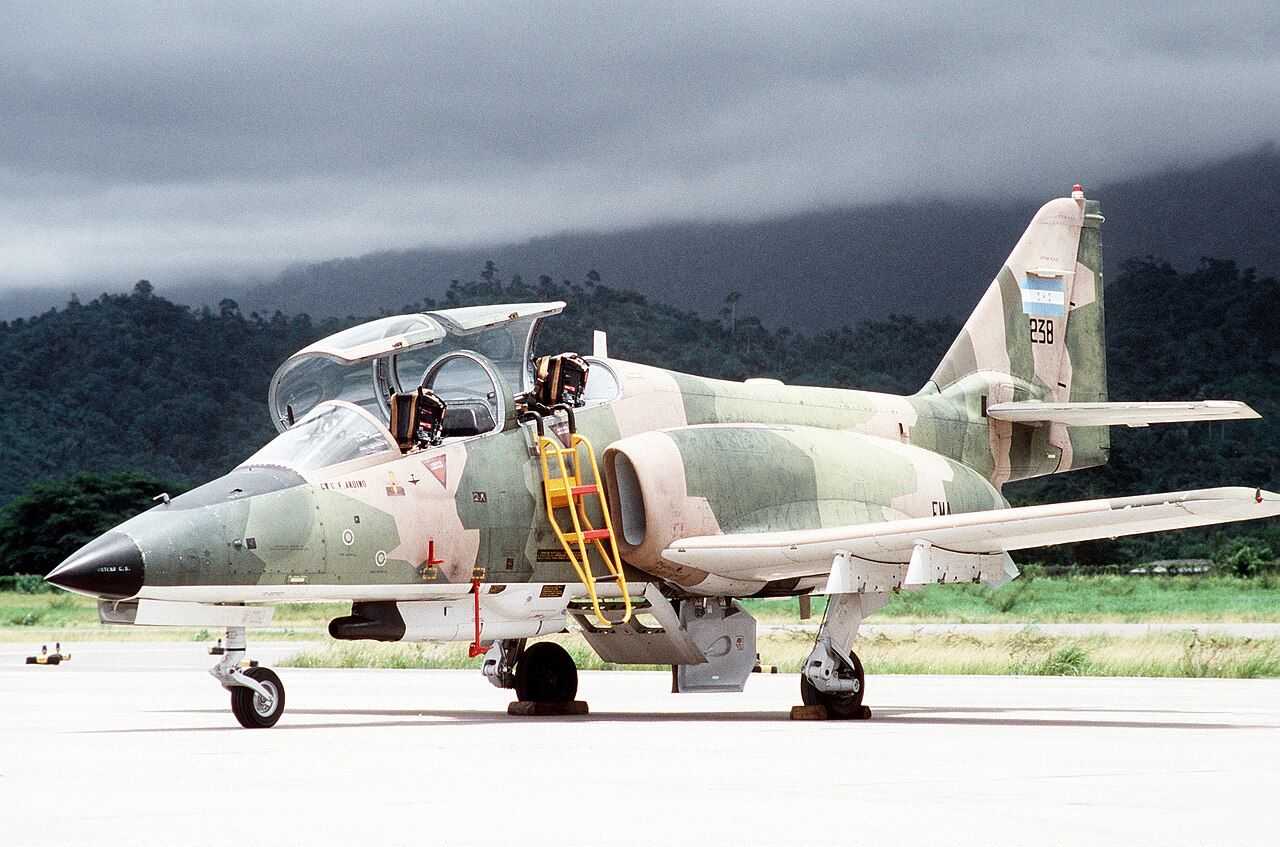
- Retired from Spanish service in 2025; 166 built, also flown by Chile, Honduras and Jordan [1]
- Powerplant
- One Honeywell TFE731-5-1J turbofan, 19.13 kN (4,300 lbf) [1]
- Maximum speed
- 769 km/h (415 kt) at sea level [1]
- Service ceiling
- 12,800 m (42,000 ft) [1]
- Range
- Combat radius 519 km (280 NM) lo-lo-lo with four 250 kg bombs and a 30 mm gun pod; ferry range 2,000 km (1,080 NM) [1]
- Armament
Simple on purpose
In 1975 the Spanish Air Force needed a jet trainer to replace its ageing Hispano HA-200 Saetas, with a limited ability to attack ground targets, as most European trainers of the day had. CASA won the contract that October and looked abroad for help: engineers at Germany’s MBB designed the rear fuselage and tail, and Northrop’s team the wing and engine intakes. [1] What came out was deliberately conventional. Simplicity and economy mattered more than high performance, and the C-101 has a straight, unswept wing where its contemporaries, the Hawk and the Alpha Jet, had more sophisticated aerodynamics. [1]
Two crew sit in tandem, the rear seat raised so that the instructor can see past the student. [1] The engine is a Honeywell TFE731 turbofan, a commercial engine reworked for military use, chosen for its good performance and fuel economy. [1] The aircraft needed long legs: the requirement asked it to fly itself from mainland Spain to the Canary Islands. [1]
Its one unusual feature is a large internal bay beneath the rear cockpit. It can hold a gun pod, other weapons or reconnaissanceReconnaissance GlossaryJoint terms: A mission undertaken to obtain, by visual observation or other detection methods, information about the activities and resources of an enemy or adversary, or to secure data concerning the meteorological, hydrographic, or… equipment, adding to six underwing hardpoints. [1]
The Blackbird
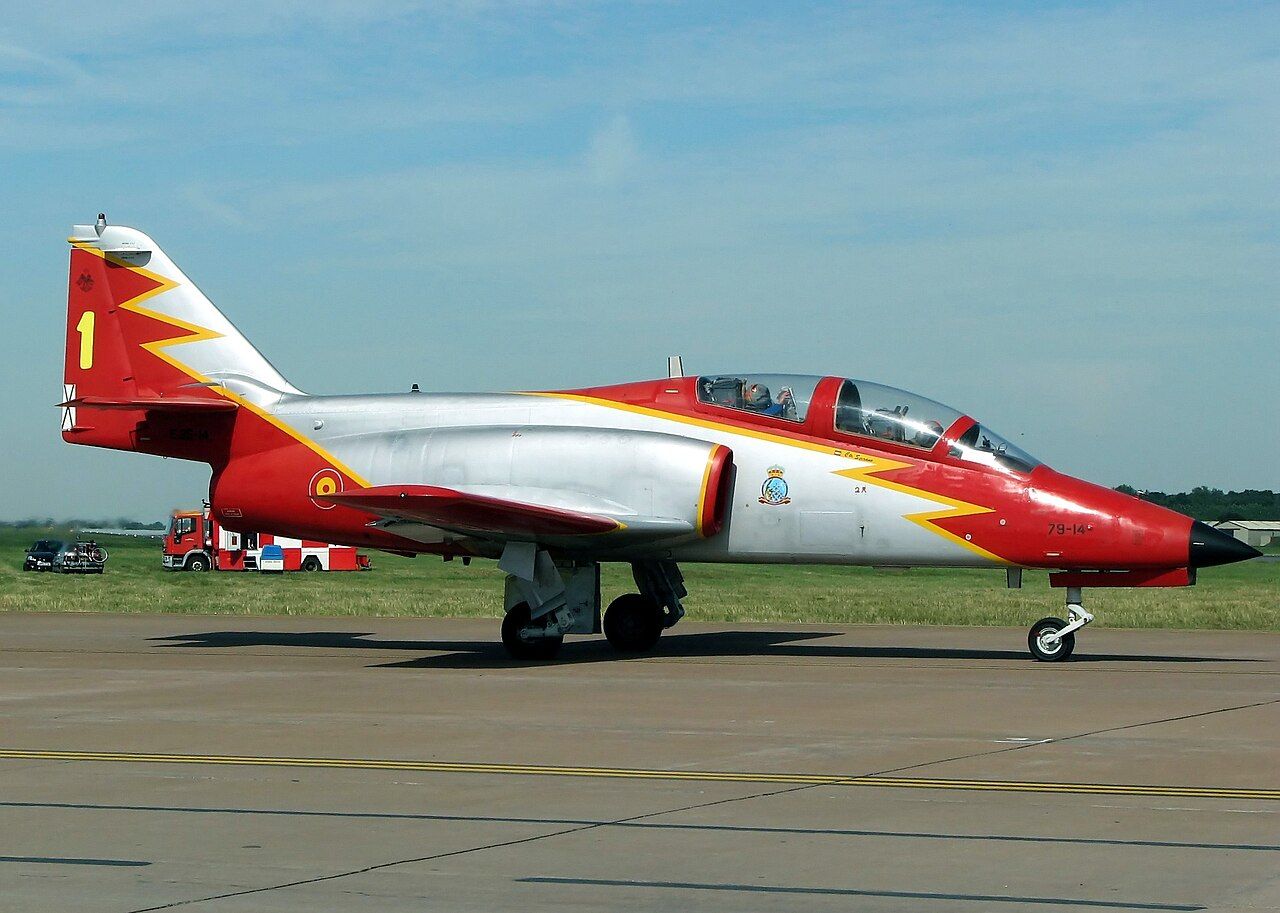
The first of four prototypes flew on 27 June 1977, and the aircraft performed better than its designers had predicted. [1] Spain ordered 88 as pure trainers, designated E.25 Mirlo, “Blackbird”, and the first entered service on 17 March 1980. [1] For more than four decades it was where Spanish military pilots learned to fly jets, and for forty years it was the mount of the Patrulla Águila aerobatic team. [1]
Armed versions followed. Chile built its own under licence as the T-36 and A-36 Halcón (“Falcon”), and Honduras and Jordan also bought them. [1] A final C-101DD, with a head-up displayHUD GlossaryJoint terms: Head-up display. A special type of flight viewing screen that allows the pilot to watch the flight instruments and other data while looking through the windshield of the aircraft for other traffic, the approach lights…, hands-on-throttle-and-stick controls, a radar warning receiver and the ability to fire Maverick missiles, was demonstrated in 1985 but found no buyers. [1]
Spain ended regular training flights in 2022. In June 2025, after 45 years of service and some 285,000 training flight hours, the Spanish Air and Space Force retired the C-101 after a final display at the Aire25 festival at San Javier. [1]

Sources
- CASA C-101 Aviojet. Wikipedia (secondary source). https://en.wikipedia.org/wiki/CASA_C-101_Aviojet (accessed 2026-10-25).
Wikipedia articles are secondary sources and can change; they are cited with the date they were read. The Federation of American Scientists (FAS) Military Analysis Network pages largely reproduce US service fact sheets of the late 1990s and early 2000s, so later upgrades are not covered there.