
Drafted — not technically validated
Record revision 1 · A single-engine multirole fighter: fly-by-wire, 9 g, and the US Air Force's main strike and SEAD aircraft.
Real-world aircraft as described in public sources. Figures vary between variants, loads and sources; the data plate names the variant its figures describe, and differences are noted beside the number they affect.
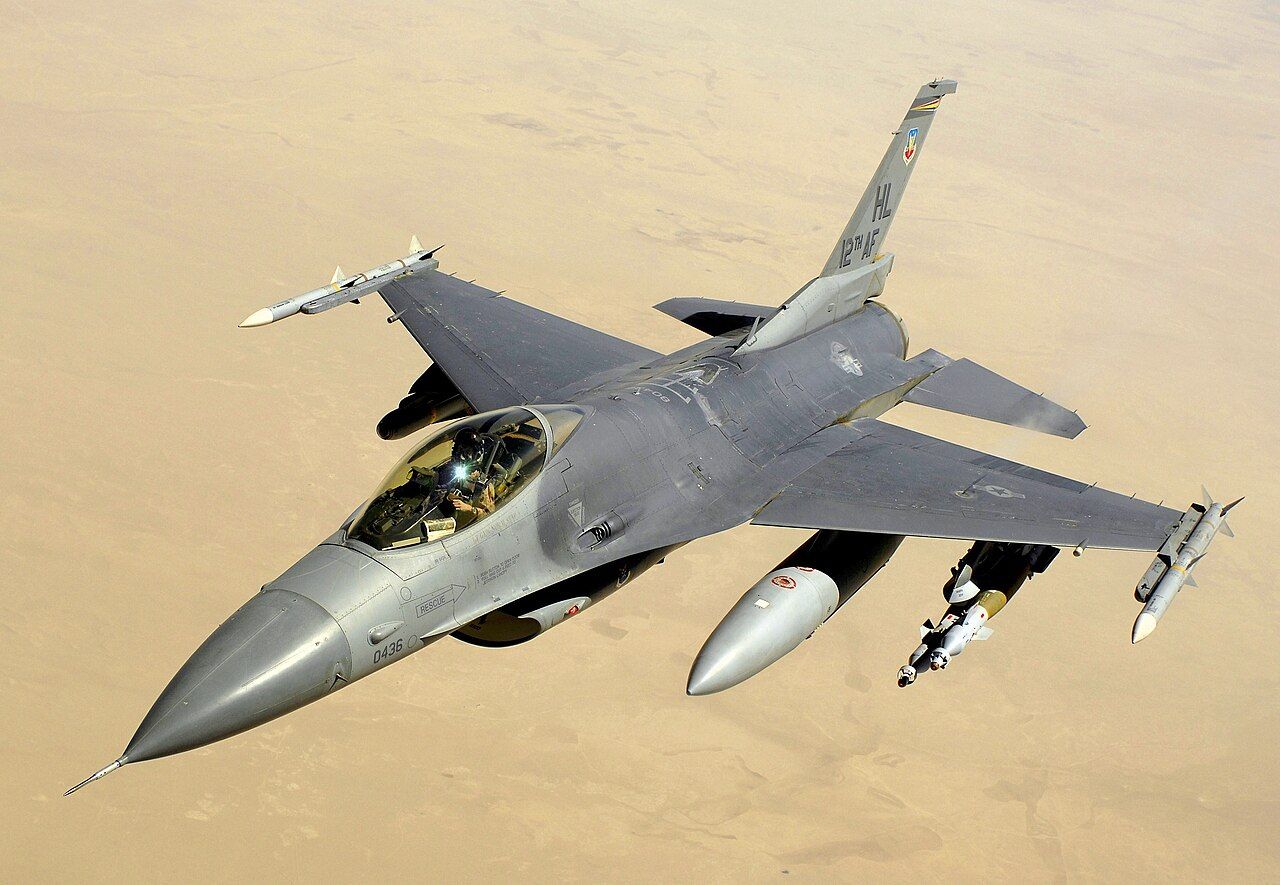
F-16C Fighting Falcon · General Dynamics F-16C
- Variant described
- F-16C Block 50/52 [1]
- Origin
- United States
- Manufacturer
- General Dynamics, then Lockheed Martin from 1993 [1]
- Crew
- 1 (F-16D: 2) [1]
- First flight
- 20 January 1974 (unplanned, YF-16); 2 February 1974 (official) [1]
- Entered service
- 17 August 1978 (US Air Force) [1]
- Status
- In service with the US Air Force and 25 other air forces; over 4,600 built [1]
- Powerplant
- One afterburningAfterburner GlossaryFlight: An additional combustion area aft of the turbine section of a turbojet, with fuel nozzles and flameholders, that burns fuel in the engine's large excess of air. It adds only 10 to 20 percent to the engine's weight but 40… turbofan: General Electric F110-GE-129 on the Block 50 (29,500 lbf) or Pratt & Whitney F100-PW-229 on the Block 52 [1]; the FAS sheet gives 27,000 lb thrust for the F-16C/D [2]
- Maximum speed
- Mach 2.05, 1,176 kt at 40,000 ft clean; Mach 1.2 (800 kt) at sea level [1]
- Range
- Combat radius 295 NM on a hi-lo-hi mission with four 1,000 lb bombs; ferry range 2,277 NM with three drop tanks [1]
- Armament
- One 20 mm M61A1 Vulcan six-barrel rotary cannon, 500 rounds [1] [2]
- Two wingtip missile rails, six underwing and three underfuselage stations; up to 17,000 lb of stores [1]
- Air-to-air: AIM-9 Sidewinder, AIM-120 AMRAAM, AIM-7 Sparrow [1]
- Air-to-ground: AGM-65 Maverick, AGM-88 HARM, Mk 80-series bombs, Paveway laser-guidedLGW GlossaryWeapons: Laser-guided weapon. A weapon that uses a seeker to detect laser energy reflected from a laser marked/designated target and through signal processing provides guidance commands to a control system, which guides the… bombs, JDAM, cluster munitions [1] [2]
- Sensors and avionics
- Purchase
- DCS WorldDCS: F-16C Viper by Eagle DynamicsDCS Store
- Falcon BMSFalcon BMS (F-16 family) by Benchmark SimsFree, but Falcon BMS only installs over a bought copy of Falcon 4.0Falcon BMSFalcon 4.0 on SteamFalcon Collection on GOG
Store pages checked 2026-10-28. Prices and availability change.
The jet that flew before it was meant to
On 20 January 1974 the YF-16 was only supposed to be taxiing. Test pilot Phil Oestricher was running it fast down the runway at EdwardsEdwards Air Force Base AirfieldThe Air Force's flight test centre beside Rogers Dry Lake, where the X-1 broke the sound barrier and the Space Shuttle first landed. when a roll oscillation set in: a fin of the left wingtip missile and then the right tailplane scraped the concrete, and the little jet began to veer off the runway. Rather than risk a crash, Oestricher lifted off and stayed airborne for six minutes before landing safely. The slight damage was quickly repaired, and the “official” first flight went ahead on schedule on 2 February. [1]
The Fighter Mafia’s fighter
The F-16 began as a protest. Vietnam had shown the US Air Force that it needed agile air superiorityAir superiority GlossaryJoint terms: That degree of dominance in the air battle by one force that permits the conduct of its operations at a given time and place without prohibitive interference from air and missile threats. fighters and better-trained fighter pilots. Colonel John Boyd, a Korean War pilot and fighter tactics instructor, worked with the mathematician Thomas Christie on energy–maneuverability theory, which asks how well an aircraft keeps its energy in a fight. Boyd’s conclusion was a small, light fighter with a high thrust-to-weight ratio, and the group of like-minded officers around him became known as the “Fighter Mafia”. [1]
Their Lightweight Fighter programme asked for a 20,000 lb class day fighter optimised for the speeds and heights where studies predicted air combat would really happen. General Dynamics’ YF-16 flew off against Northrop’s twin-engined YF-17. Pilots who flew both chose the YF-16 unanimously: it was markedly quicker going from one manoeuvre to the next. It won the Air Combat Fighter competition on 13 January 1975, helped by its lower operating cost and by sharing the F-15F-15C Eagle AircraftA twin-engine air superiority fighter with more than 104 air-to-air victories and no losses.’s F100 engine. The YF-17 did not die; the Navy chose it as the basis of the F/A-18 HornetF/A-18 Hornet AircraftA carrier-capable fighter and attack aircraft that one pilot can switch between roles on the same sortie.. [1]
Four NATO air forces, Belgium, Denmark, the Netherlands and Norway, were looking for a replacement for their F-104G Starfighters. At the 1975 Paris Air Show they ordered 348 F-16s, built on production lines in the Netherlands and Belgium. Licensed lines later followed in Turkey and South Korea. [1]
“You don’t fly an F-16; it flies you”
The F-16 was the first production fighter deliberately designed to be slightly unstable. That relaxed stability cuts drag and sharpens the turn, but no human could fly it unaided, so a four-channel fly-by-wire system makes thousands of corrections a second and keeps the jet inside its angle-of-attackAOA GlossaryJoint terms: Angle of attack. The angle at which relative wind meets an airfoil. It is the angle that is formed by the chord of the airfoil and the direction of the relative wind or between the chord line and the flight path. and gLoad factor GlossaryFlight: The ratio of lift to weight, felt as G. In a level, coordinated turn it is 1 ÷ cos(bank), and the stall speed in the turn is the wings-level stall speed times its square root. limits. With no mechanical linkage at all between stick and control surfaces, early pilots called it “the electric jet”. [1] It was also the first fighter built from the outset to pull 9 g. [1] Earlier fighters were designed for about 7 g, because it was believed a pilot could not handle more even with a g-suit. [2]
Everything about the cockpit serves the fight. A single-piece, frameless bubble canopy gives an all-round view, the ACES II seat is tilted back 30 degrees to help the pilot tolerate g, and the stick sits on the right-hand armrest. The first side-sticks did not move at all; pilots found them hard to fly precisely, so later sticks were given a little play. [1] The wing blends into the fuselage, adding lift and making room for fuel. [2]
It was named the Fighting Falcon on 21 July 1980, but almost nobody uses the name. Crews call it the Viper, after the snake and after the starfighters of Battlestar Galactica, which was on television when the F-16 entered service. [1]
From dogfighter to workhorse
The F-16C and two-seat F-16D entered production in 1984. The first of them, the Block 25, brought the AN/APG-68 radar and with it all-weather, beyond-visual-range fighting with the AIM-7AIM-7 Sparrow OrdnanceThe West's main radar-guided missile from the late 1950s to the 1990s, which homes on radar energy the fighter reflects off its target. and AIM-120AIM-120 AMRAAM OrdnanceThe active-radar "fire and forget" missile that replaced the Sparrow, carried by US fighters of every service since 1991.. The blocks that followed were the 30/32, 40/42 and 50/52; the second number of each pair marks the Pratt & Whitney-engined version. [1] An M61A1M61 Vulcan OrdnanceThe six-barrel 20 mm Gatling gun that has armed US fighters of every service since 1959. cannon sits in the left wing root, and missiles, bombs, tanks and pods hang from the wingtip rails and nine more stations. [1]
Built as a dogfighter, the F-16 spent most of its US career dropping bombs. It replaced the F-105, A-7 and F-4F-4 Phantom II AircraftThe big two-seat Cold War fighter-bomber; the F-4E added an internal gun and slats after Vietnam., flew strike and suppression of enemy air defencesSEAD GlossaryJoint terms: Suppression of enemy air defenses. Activity that neutralizes, destroys, or temporarily degrades surface-based enemy air defenses by destructive and/or disruptive means. (SEADSEAD GlossaryJoint terms: Suppression of enemy air defenses. Activity that neutralizes, destroys, or temporarily degrades surface-based enemy air defenses by destructive and/or disruptive means.) missions, and by 1996 had taken over the Wild Weasel role from the F-4GF-4 Phantom II AircraftThe big two-seat Cold War fighter-bomber; the F-4E added an internal gun and slats after Vietnam.. [1]
In combat
Israel drew first blood. On 28 April 1981 an Israeli F-16 shot down a Syrian Mi-8Mi-8MTV-2 Hip AircraftThe armed transport version of the Mi-8, the most-produced helicopter in the world. helicopter with its gun over the Bekaa Valley, and on 7 June 1981 eight F-16s, escorted by F-15sF-15C Eagle AircraftA twin-engine air superiority fighter with more than 104 air-to-air victories and no losses., struck the Osirak reactor near Baghdad. In the 1982 Lebanon War, during one of the largest jet air battles ever fought, Israeli F-16s were credited with 44 air-to-air kills. [1]
US Air Force, Reserve and Air National Guard F-16s flew in Desert Storm in 1991, over the Balkans, in the Iraqi no-fly zones, and in Afghanistan, Iraq and Libya. [1] Not every mission went their way: on 2 May 1999 an F-16 flown by David Goldfein, later the Air Force’s Chief of Staff, was shot down over western Serbia by a surface-to-air missile brigade. [1] On 11 September 2001 two unarmed F-16s were launched to ram and bring down the hijacked United Airlines Flight 93; the airliner crashed before they reached it, after its passengers stormed the cockpit. [1]
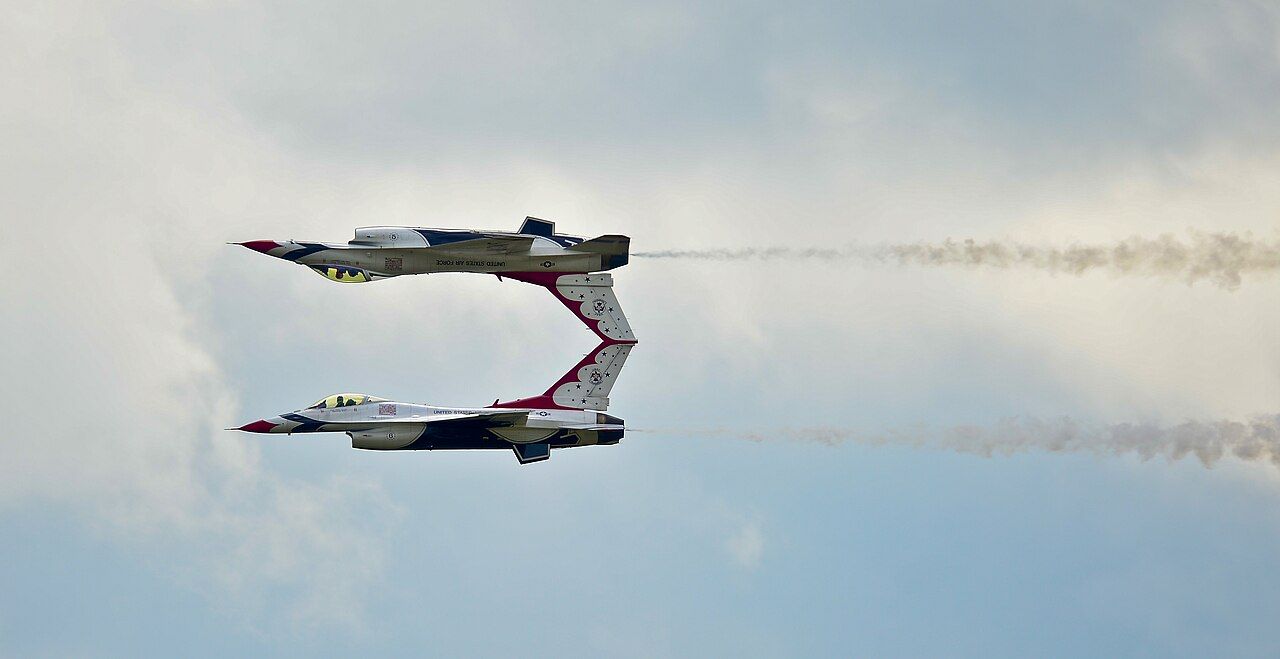
US F-16s also fly with the Thunderbirds demonstration team and as aggressor aircraft for the US Navy. With 25 other air forces flying it as well, it is the most numerous fixed-wing aircraft in military service, and in 2022 the Air Force announced it would keep its F-16s flying for another two decades. [1]

Sources
- General Dynamics F-16 Fighting Falcon. Wikipedia (secondary source). https://en.wikipedia.org/wiki/General_Dynamics_F-16_Fighting_Falcon (accessed 2026-10-25).
- F-16 Fighting Falcon. Federation of American Scientists, Military Analysis Network. https://man.fas.org/dod-101/sys/ac/f-16.htm (accessed 2026-10-25).
Wikipedia articles are secondary sources and can change; they are cited with the date they were read. The Federation of American Scientists (FAS) Military Analysis Network pages largely reproduce US service fact sheets of the late 1990s and early 2000s, so later upgrades are not covered there.