
Drafted — not technically validated
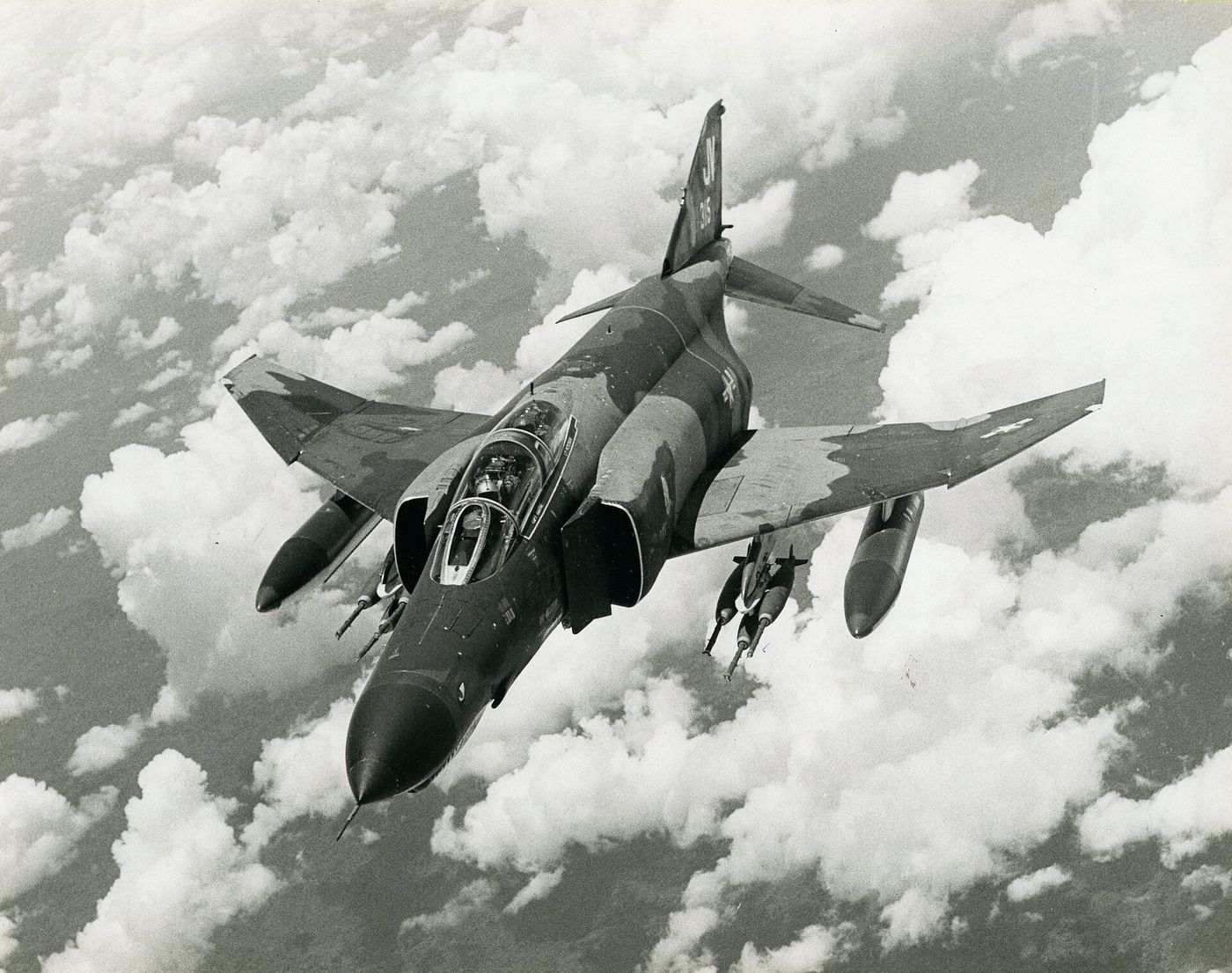
Record revision 1 · The big two-seat Cold War fighter-bomber; the F-4E added an internal gun and slats after Vietnam.
Real-world aircraft as described in public sources. Figures vary between variants, loads and sources; the data plate names the variant its figures describe, and differences are noted beside the number they affect.
F-4E Phantom II · McDonnell Douglas F-4E
- Origin
- United States
- Manufacturer
- McDonnell Aircraft, later McDonnell Douglas [1]
- Crew
- 2: pilot and weapon systems officer in tandem [1]
- First flight
- 27 May 1958 [1]
- Entered service
- 30 December 1960 (US Navy) [1]; first F-4E delivered to the US Air Force in October 1967 [2]
- Status
- In limited service; 5,195 built between 1958 and 1981 [1]
- Powerplant
- Two General Electric J79-GE-17A afterburningAfterburner GlossaryFlight: An additional combustion area aft of the turbine section of a turbojet, with fuel nozzles and flameholders, that burns fuel in the engine's large excess of air. It adds only 10 to 20 percent to the engine's weight but 40… turbojets, 17,845 lbf each with afterburnerAfterburner GlossaryFlight: An additional combustion area aft of the turbine section of a turbojet, with fuel nozzles and flameholders, that burns fuel in the engine's large excess of air. It adds only 10 to 20 percent to the engine's weight but 40… [1]
- Maximum speed
- Mach 2.23, 2,370 km/h (1,280 kt) at 40,000 ft [1]
- Range
- Combat radius 680 km (367 NM); ferry range 2,699 km (1,457 NM) [1]; the FAS sheet gives 1,130 NM [2]
- Armament
- One 20 mm M61A1 Vulcan cannon under the nose, 640 rounds [1]
- Four AIM-7 Sparrow in fuselage recesses and four AIM-9 Sidewinder on wing pylons [1] [2]
- Up to 18,650 lb on nine external hardpoints: general-purpose, cluster and guided bombs, AGM-65 Maverick, anti-radiation missiles, rocket and gun pods, nuclear weapons [1]
- Sensors and avionics
- Purchase
- DCS WorldDCS: F-4E Phantom II by Heatblur SimulationsHeatblur StoreDCS Store
- Microsoft Flight SimulatorF-4E, F-4J and FGR2 Phantom by DC DesignsJust Flight
Store pages checked 2026-10-28. Prices and availability change.
The triumph of thrust over aerodynamics
On 6 December 1959 Commander Lawrence Flint of the US Navy took the second Phantom prototype to MachMach number GlossaryFlight: The ratio of the true airspeed to the speed of sound. All compressibility effects depend on it. 2.5 at 47,000 ft, pulled up into a 45-degree climb, shut the engines down as the air thinned, and coasted on upward to a world record height of 98,557 ft. On the way back down he relit the engines and flew home. It was one of 16 world records the Phantom set to show off the Navy’s new fighter; five of its speed records stood until the F-15F-15C Eagle AircraftA twin-engine air superiority fighter with more than 104 air-to-air victories and no losses. arrived in 1975. [1]
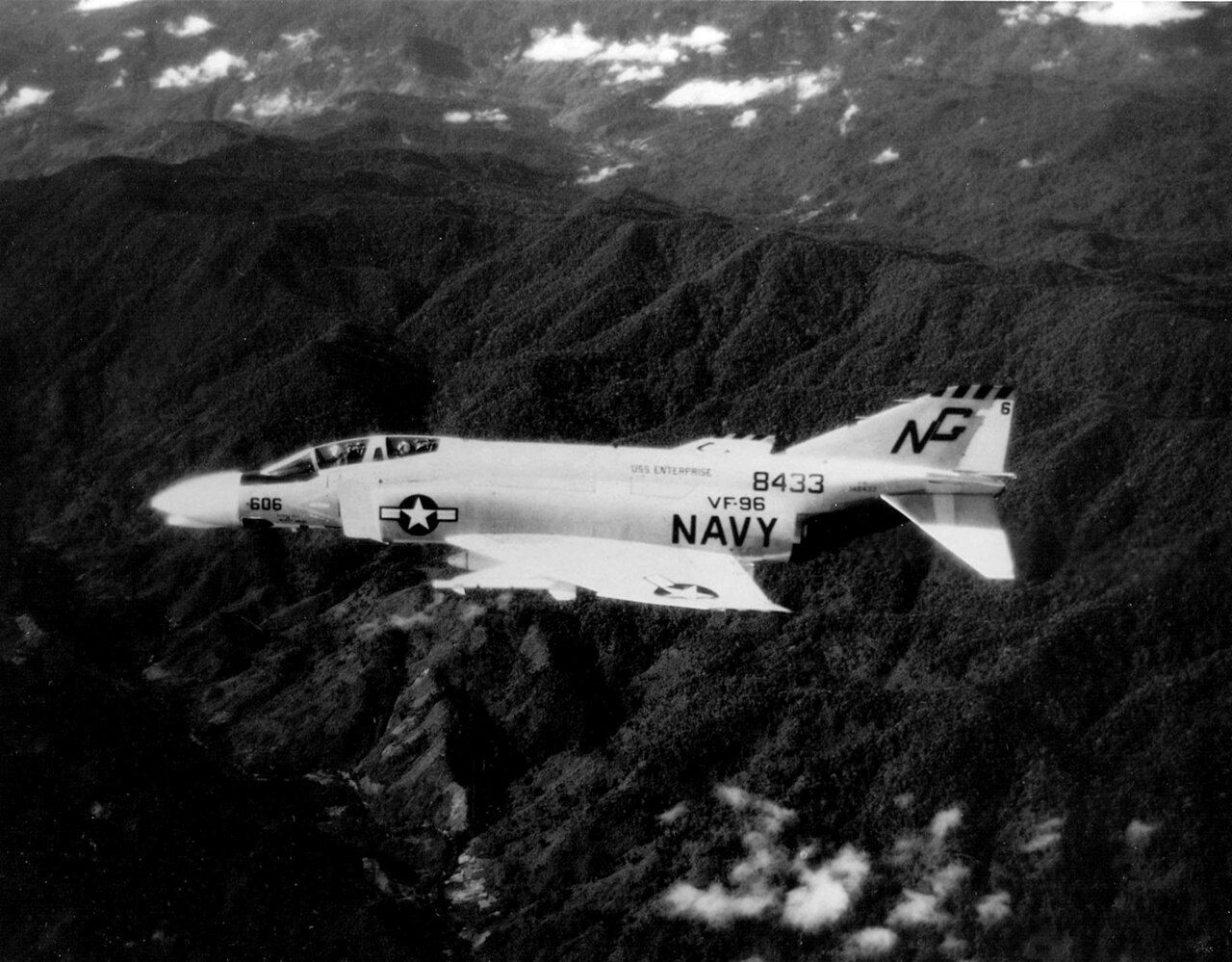
The Phantom was big, heavy and brutally powerful. It was designed as a fleet-defence interceptor: climb fast, fly high and fast, and shoot down attackers with radar-guided missiles at long range. Like other interceptors of its day it had no gun. [1] It entered Navy service in 1961 and was soon taken up by the US Marine Corps and the US Air Force, an unusual thing for a Navy fighter at the time. With 5,195 built, it is the most-produced American supersonicSupersonic GlossaryFlight: The regime of flight from about Mach 1.20 to 5.00, with definite supersonic flow on all parts of the aircraft. Above Mach 5.00 is hypersonic. military aircraft. [1] Its crews’ nicknames say a lot about it: “Rhino”, “Double Ugly”, “the Flying Brick”, and “the triumph of thrust over aerodynamics”. [1]
Speed is life
Vietnam put the Phantom into the kind of fight it had not been built for. Rules of engagementROE GlossaryJoint terms: Rules of engagement. Directives issued by competent military authority that delineate the circumstances and limitations under which United States forces will initiate and/or continue combat engagement with other forces… usually demanded that pilots identify a target by eye before firing, which threw away the advantage of long-range missiles, and the missiles of the day were often unreliable. Fights turned into close, slow dogfights, where the agile MiGs could usually out-turn the heavy Phantom. [1] Phantom pilots’ answer was their slogan, “Speed is life”: the F-4’s acceleration and thrust let a skilled pilot join or leave a fight at will. [1] Many still wanted a gun. “Bullets are cheap and tend to go where you aim them,” said John Chesire, who flew Phantoms from carriers. “I needed a gun, and I really wished I had one.” [1]
The Air Force’s F-4E, first delivered in October 1967, gave them one: an internal 20 mm multibarrel gun with a better fire-control system, plus an extra fuselage fuel tank and an improved engine. [2] In 1972 it gained leading-edge slats, which greatly improved handling at high angles of attackAOA GlossaryJoint terms: Angle of attack. The angle at which relative wind meets an airfoil. It is the angle that is formed by the chord of the airfoil and the direction of the relative wind or between the chord line and the flight path. at some cost in top speed. [1]
MiG killers
Phantom crews of all three services fought through the air war over Vietnam. On 2 January 1967 Colonel Robin Olds led the Air Force’s 8th Tactical Fighter Wing in Operation Bolo: his F-4Cs flew from Thailand mimicking a strike force of F-105 bombers, and the North Vietnamese MiG-21sMiG-21 AircraftThe small delta-wing Mach 2 fighter: the most-produced supersonic jet in history. that rose to meet them found Phantoms instead. North Vietnam lost half of its MiG-21MiG-21 AircraftThe small delta-wing Mach 2 fighter: the most-produced supersonic jet in history. fleet without a single American loss. [1] On 10 May 1972 the Navy’s Randy Cunningham and William Driscoll shot down three MiG-17s in one fight to become the first American aces of the war, and that August Captain Steve Ritchie became the Air Force’s first. [1] The Phantom remains the last aircraft in which a member of any US service has become an ace, and its admirers called it the “World’s Leading Distributor of MiG Parts”. [1]
It was not one-sided. North Vietnam’s lighter MiG-21sMiG-21 AircraftThe small delta-wing Mach 2 fighter: the most-produced supersonic jet in history. took a steady toll, and the Air Force lost 528 F-4s and RF-4Cs in the war; with Navy and Marine Corps losses the total was 761 Phantoms. [1]
Pave Tack and the Wild Weasel
From 1973, Air Force F-4Es received a zoom-lens TV camera for identifying aircraft and ground targets at long range, and Pave Tack, a pod that let the crew find, track and laser-designate ground targets by day or night. A digital computer worked out launch solutions for the Sidewinder and Sparrow. [2] The F-4E carries four AIM-7 SparrowsAIM-7 Sparrow OrdnanceThe West's main radar-guided missile from the late 1950s to the 1990s, which homes on radar energy the fighter reflects off its target. semi-recessed under its fuselage and AIM-9 SidewindersAIM-9 Sidewinder OrdnanceThe heat-seeking dogfight missile of the US Navy since 1956, copied by the Soviets and still in production as the AIM-9X. on the wing pylons. [1]
Its final US combat job was the most dangerous. The F-4G Wild Weasel, an F-4E with electronic warfareEW GlossaryJoint terms: Electronic warfare. Military action involving the use of electromagnetic and directed energy to control the electromagnetic spectrum or to attack the enemy. equipment in place of its gun, hunted surface-to-air missile sites in Desert Storm, often paired with an F-16F-16 Fighting Falcon AircraftA single-engine multirole fighter: fly-by-wire, 9 g, and the US Air Force's main strike and SEAD aircraft.. The last Air Force combat Phantoms, F-4Gs of the Idaho Air National Guard, retired after a deployment that ended in December 1995. [2] At sea, the last Phantom carrier landing was made by a Naval Reserve F-4S on 18 October 1986. [1]
The last of all 5,195 Phantoms was built in Japan by Mitsubishi on 21 May 1981, and a few Phantoms remain in service abroad. [1] The aircraft’s emblem, a cartoon ghost called “The Spook”, still turns up wherever it has flown. [1]

Sources
- McDonnell Douglas F-4 Phantom II. Wikipedia (secondary source). https://en.wikipedia.org/wiki/McDonnell_Douglas_F-4_Phantom_II (accessed 2026-10-25).
- F-4 Phantom II / F-4G Advanced Wild Weasel. Federation of American Scientists, Military Analysis Network. https://man.fas.org/dod-101/sys/ac/f-4.htm (accessed 2026-10-25).
Wikipedia articles are secondary sources and can change; they are cited with the date they were read. The Federation of American Scientists (FAS) Military Analysis Network pages largely reproduce US service fact sheets of the late 1990s and early 2000s, so later upgrades are not covered there.