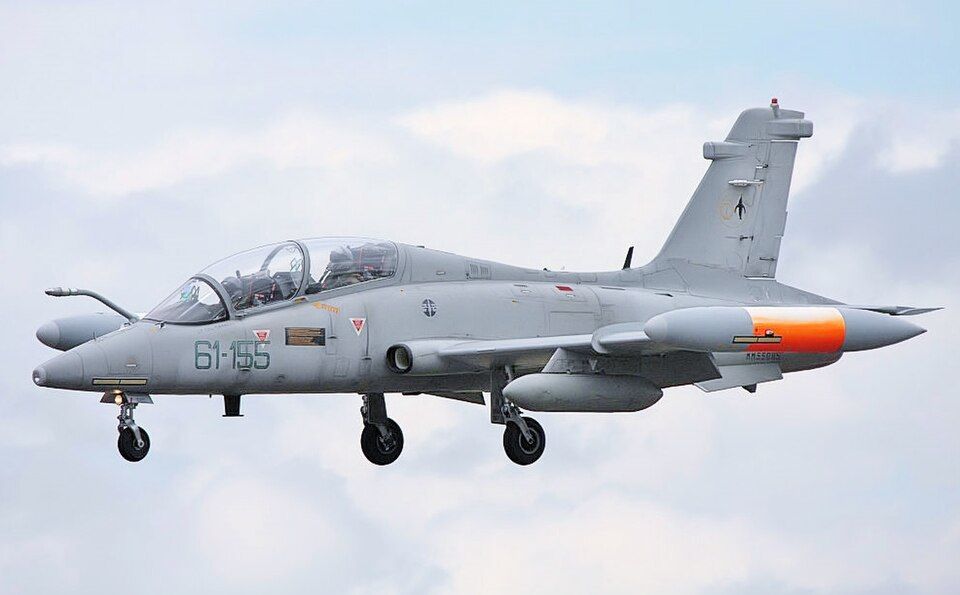

Drafted — not technically validated
Record revision 1 · Italy's two-seat jet trainer and light attack aircraft, flown by the Frecce Tricolori.
Real-world aircraft as described in public sources. Figures vary between variants, loads and sources; the data plate names the variant its figures describe, and differences are noted beside the number they affect.
MB-339A · Aermacchi MB-339A
- Variant described
- MB-339A and the MB-339PAN aerobatic version [1]
- Role
- Advanced trainer and light attack aircraft [1]
- Origin
- Italy
- Manufacturer
- Aermacchi [1]
- Crew
- 2 [1]
- First flight
- 12 August 1976 [1]
- Entered service
- 1979 [1]
- Status
- In service with the Italian Air Force and others; 230 built [1]
- Powerplant
- One Rolls-Royce Viper Mk 632 turbojet, 17.8 kN (4,000 lbf); later models the Viper 680 [1]
- Maximum speed
- 898 km/h (485 kt) at sea level [1]
- Service ceiling
- 14,630 m (48,000 ft) [1]
- Range
- 1,760 km (950 NM) on internal fuel; ferry range 2,110 km (1,140 NM) with two drop tanks [1]
- Armament
Improving on a classic
In 1972 the Italian Air Force asked Aermacchi to study a replacement for its MB-326, effectively the standard advanced jet trainer of the 1960s. The company drew up seven all-new designs and compared them with an improved MB-326. The improved version, the MB-339, met every requirement and was cheaper than any clean-sheet design, so in 1975 it was chosen to replace both the MB-326 and the Fiat G.91T. [1]
The biggest change was a redesigned front fuselage that raised the instructor’s seat behind the student, giving a clear view over the student’s head. [1] Much of the rest came from the MB-326: a low, straight wing with tip tanks, air intakes in the wing roots, and a Rolls-Royce Viper turbojet; later models such as the MB-339C have the more powerful Viper 680. [1] Under the wings it can carry gun pods, rockets and bombs for weapons training or light attack. [1] The prototype flew on 12 August 1976, and MB-339As reached the Italian Air Force from 1979. [1]
The Frecce Tricolori
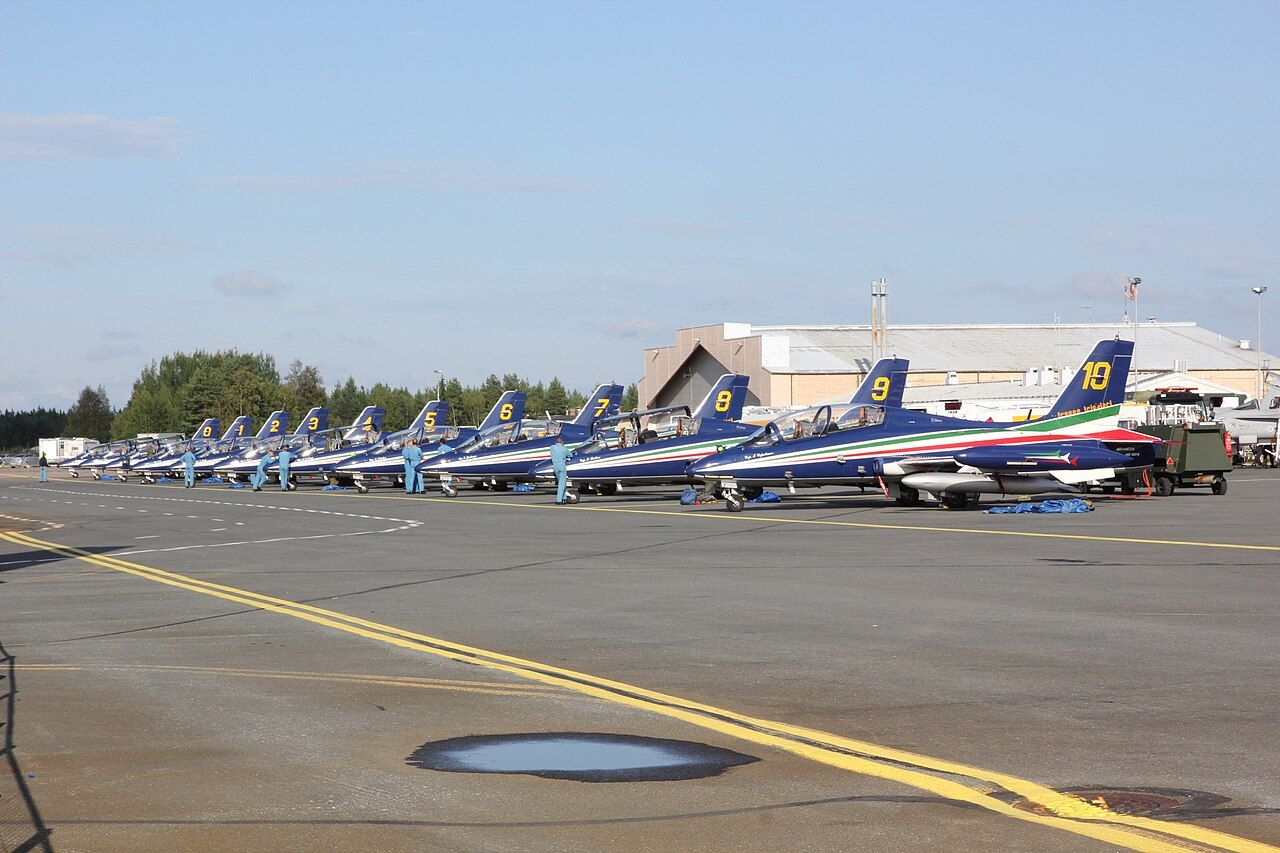
For decades the MB-339 has been the Italian Air Force’s main trainer, and it is the aircraft of the Frecce Tricolori, the national aerobatic team, which flies a special version, the MB-339PAN, with smoke generators and no tip tanks. In 1988 three of the team’s aircraft were lost in a display accident in Germany. [1] The M-345 is planned to replace the MB-339 in Italian training and with the team. [1]
A trainer at war
Twice the trainer has gone to war as an attack aircraft. [1] In the 1982 Falklands War, Argentine Naval Aviation based six MB-339As at Port Stanley, the only attack jets to fly from the islands. On 21 May, Lieutenant Owen Crippa, on a reconnaissanceReconnaissance GlossaryJoint terms: A mission undertaken to obtain, by visual observation or other detection methods, information about the activities and resources of an enemy or adversary, or to secure data concerning the meteorological, hydrographic, or… flight, came upon the British amphibious force and attacked it alone, lightly damaging a Royal Navy frigate. Six days later another MB-339 was shot down by a Blowpipe missile over Goose Green, and three were captured by the British at the end of the war. [1]
In June 1998, at the start of its war with Ethiopia, Eritrea sent its new MB-339s against targets inside Ethiopia, including the city of Mekelle; one was shot down the next day. [1]
Roughly half of all MB-339s were built for Italy, and the rest went to export customers, including New Zealand and the United Arab Emirates, whose Al Fursan aerobatic team flies them. [1]

Sources
- Aermacchi MB-339. Wikipedia (secondary source). https://en.wikipedia.org/wiki/Aermacchi_MB-339 (accessed 2026-10-25).
Wikipedia articles are secondary sources and can change; they are cited with the date they were read. The Federation of American Scientists (FAS) Military Analysis Network pages largely reproduce US service fact sheets of the late 1990s and early 2000s, so later upgrades are not covered there.