
Drafted — not technically validated
Record revision 1 · A gliding decoy that looks like an attacking aircraft to enemy radar, launched by the hundred on Desert Storm's first night.
Real-world weapon as described in public sources. Weights and dimensions change with the fins, fuzes and variant fitted; the data plate names the variants its figures describe, and differences are noted beside the number they affect. The record describes the weapon; it is not a guide to employing it.
ADM-141 TALD · ADM-141
- Type
- Air-launched decoy glider that imitates attacking aircraft to confuse and saturate air defences [1]
- Origin
- United States and Israel
- In service
- US Navy from 1987, after the Samson it was developed from entered US service in 1985 [1]
- Weight
- 180 kg (400 lb) [1]
- Dimensions
- Length 2.34 m (7 ft 8 in); wingspan 1.55 m (5 ft 1 in) [1]
- Warhead or payload
- None; the ADM-141B carries 36 kg (80 lb) of chaff instead [1]
- Guidance
- Preprogrammed flight control that can hold set speeds and fly set manoeuvres; passive and active radar enhancers make it look like a bigger aircraft [1]
- Fuzing
- Not applicable
- Delivery
- Glides from release; launched from 12,200 m it reaches up to 126 km, from low altitude about 26 km [1]
- Range
- Up to 126 km (68 NM) gliding; over 300 km for the turbojet ADM-141C [1]
- Carried by
- Mainly the F/A-18 HornetF/A-18 Hornet AircraftA carrier-capable fighter and attack aircraft that one pilot can switch between roles on the same sortie.: up to six on one pylon, on two triple ejector racks [1]
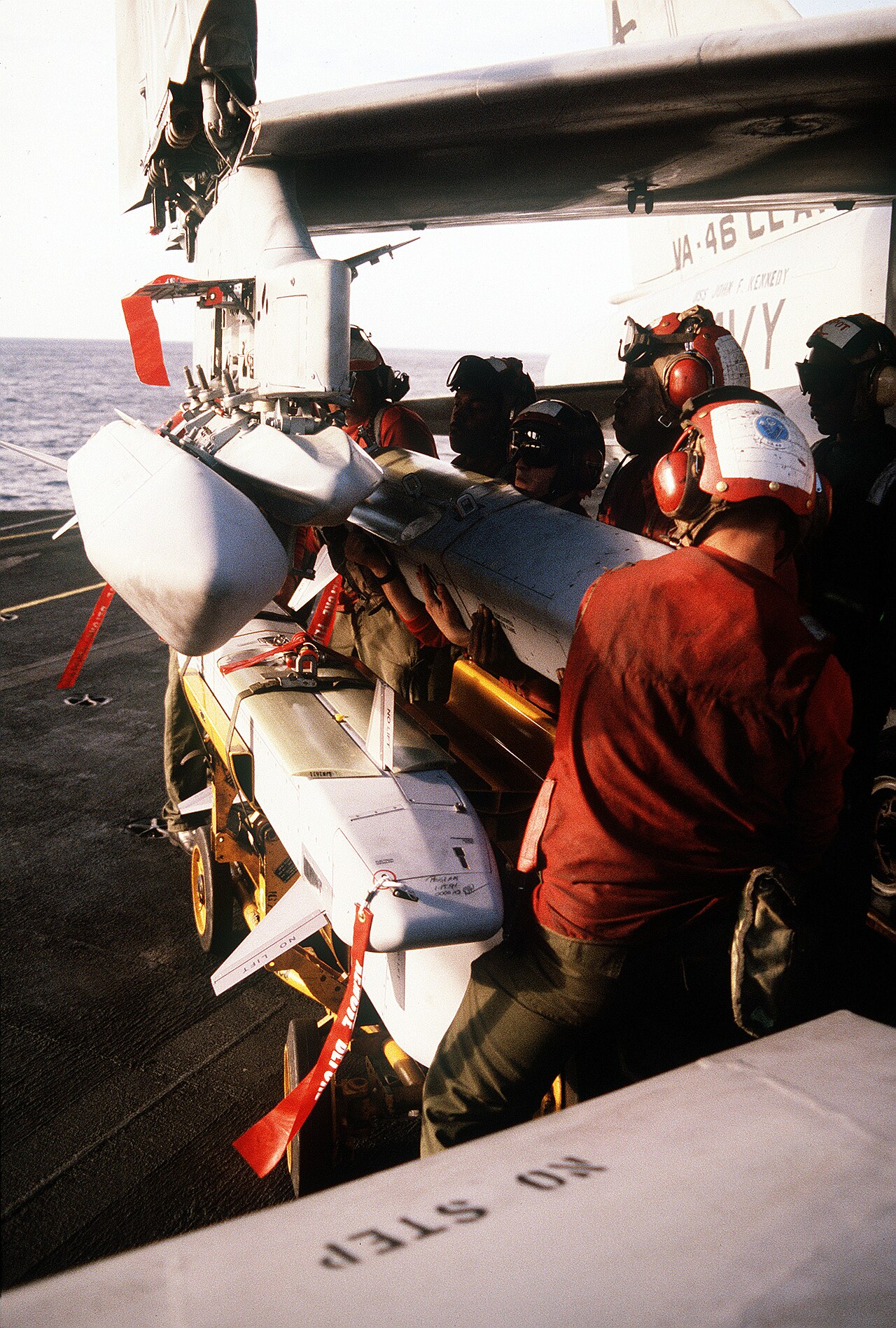
- US Navy A-7 Corsair II in the Gulf War [1]
A target that is not there
The Tactical Air-Launched Decoy is an unpowered glider, released from a strike aircraft to confuse and saturate enemy air defences as part of a SEADSEAD GlossaryJoint terms: Suppression of enemy air defenses. Activity that neutralizes, destroys, or temporarily degrades surface-based enemy air defenses by destructive and/or disruptive means. plan, so that the real attackers and weapons are more likely to get through. [1] Its flight controls can hold set speeds and fly set manoeuvres, so it can imitate a particular aircraft, and a Luneburg lens reflects radar energy straight back to make it look much larger, like a bomber. [1]
From Samson to TALD
It grew out of the Samson, a winged unpowered decoy developed in the United States and built in Israel, which did well in Israeli service in the 1982 Lebanon War. The US Navy bought about 2,000 Samsons in the mid to late 1980s, and the improved TALD entered US service in 1987. [1]
The opening night of Desert Storm
More than 100 TALDs were launched on the opening night of the 1991 Gulf War. They made Iraqi air defences switch on many of their radars, most of which were then destroyed by anti-radiation missilesARM GlossaryJoint terms: Antiradiation missile. A missile which homes passively on a radiation source.. [1] Strikes that night had decoys and drones in their escort both to “take the hit” for the manned aircraft and to make the Iraqis reveal their positions when they tracked or fired on the lures. [2]
Sources
- ADM-141 TALD. Wikipedia (secondary source). https://en.wikipedia.org/wiki/ADM-141_TALD (accessed 2026-11-03).
- Suppression of Enemy Air Defenses. Wikipedia (secondary source). https://en.wikipedia.org/wiki/Suppression_of_Enemy_Air_Defenses (accessed 2026-11-03).
Wikipedia articles are secondary sources and can change; they are cited with the date they were read. NAVEDTRA training manuals and budget justification exhibits are official US publications, but each describes the weapons in service when it was written.