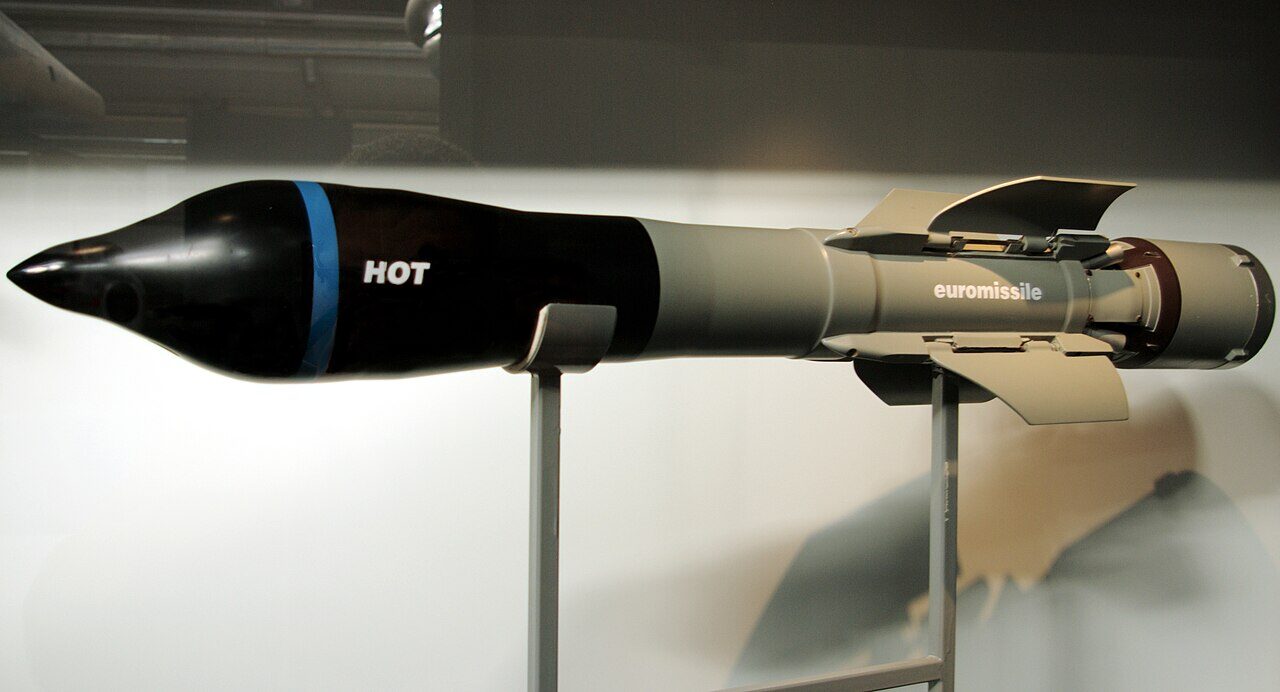

Drafted — not technically validated
Record revision 1 · The Franco-German anti-tank missile of the Gazelle and Bo 105 helicopters.
Real-world weapon as described in public sources. Weights and dimensions change with the fins, fuzes and variant fitted; the data plate names the variants its figures describe, and differences are noted beside the number they affect. The record describes the weapon; it is not a guide to employing it.
HOT anti-tank missile · HOT
- Type
- Second-generation, tube-launched anti-tank guided missile for vehicles and helicopters [1]
- Origin
- France and West Germany
- In service
- Fielded in 1978 [1]
- Weight
- 24.5 kg (54 lb), HOT 3 [1]
- Dimensions
- Length 1.30 m (4.3 ft); diameter 0.15 m (5.9 in); wingspan 0.31 m [1]
- Warhead or payload
- Tandem-charge HEAT (HOT 3) [1]
- Guidance
- SACLOS: the gunner keeps the sight on the target [1]
- Fuzing
- Not given in the cited source
- Delivery
- Fired from a tube on a vehicle or helicopter, at high subsonic speed, 864 km/h [1]
- Range
- 75–4,300 m [1]
- Carried by
- French Army Gazelle SA 342MSA 342 Gazelle AircraftThe light Franco-British helicopter that introduced the fenestron tail fan; the SA 342M hunts tanks with HOT missiles., four in two dual launchers [1]
- German Army Bo 105 PAH-1, six [1]
- Variants
- HOT 2 (1985); HOT 2MP multipurpose warhead (1992); HOT 3 [1]
High subsonic, optical, tube
HOT stands for the French “Haut subsonique Optiquement Téléguidé Tiré d’un Tube”: high subsonic, optically remote-guided, tube-launched. [1] Nord Aviation and Bölkow developed it to replace the older SS.11 wire-guided missile. Compared with the SS.11 it flies farther and faster, and it is guided semi-automatically instead of by hand. [1] Mass production began in 1976 and the first missiles were fielded in 1978. [1]
Anti-tank helicopters
Soon after fitting HOT to ground vehicles, France and West Germany both introduced dedicated anti-tank helicopters to fire it: the French chose the Gazelle SA 342MSA 342 Gazelle AircraftThe light Franco-British helicopter that introduced the fenestron tail fan; the SA 342M hunts tanks with HOT missiles., carrying four missiles in two dual launchers, and the Germans the Bo 105 PAH-1, carrying six. [1] The Viviane night sight for firing from helicopters followed in the early 1980s. [1] HOT is reaching the end of its life in Europe, where France has bought Hellfire II for its Tiger helicopters, but it remains in wide use elsewhere. [1]
Sources
- HOT (missile). Wikipedia (secondary source). https://en.wikipedia.org/wiki/HOT_(missile) (accessed 2026-10-27).
Wikipedia articles are secondary sources and can change; they are cited with the date they were read. NAVEDTRA training manuals and budget justification exhibits are official US publications, but each describes the weapons in service when it was written.