
Drafted — not technically validated
Record revision 1 · The 1982 Falklands War, the Black Buck raids and Exocet attacks, and RAF Mount Pleasant today.
A real-world region and its military history. Its airfields and the sim maps that represent it are listed from their own records.
The South Atlantic
- Region
- The Falkland Islands and the southern tip of South America, from Patagonia and Tierra del Fuego to the islands offshore
- Countries and territories
- Argentina, Chile, Falkland Islands (UK overseas territory, claimed by Argentina)
- Airfields in this encyclopedia
Sim maps
- DCS: South Atlantic (DCS World): No period is stated; the map depicts the terrain of Argentina, Chile and the Falkland Islands
- Falcon BMS: Falklands (Falcon BMS): No period is stated; its aircraft range from the Canberra, Buccaneer and Super Étendard to F-16s in Argentine markings and a retro-version Eurofighter
The South Atlantic and the Falkland Islands
Historical significance
Argentina invaded the Falkland Islands on 2 April 1982 and South Georgia the next day. On 5 April the British government sent a naval task force to retake them. The ten-week war ended with the Argentine surrender on 14 June. In all, 649 Argentine and 255 British service personnel and three Falkland Islanders were killed. [1]
The war was fought at the limit of both sides’ reach. The British had 42 aircraft, including 28 Sea Harriers and 6 Harrier GR.3s, available for air combat. [1] In the seven Black Buck missions, RAF Vulcan bombers flew from Ascension Island, refuelled again and again in the airAR GlossaryJoint terms: Air refueling. The refueling of an aircraft in flight by another aircraft. by Victor tankers. Five of them completed attacks: three on Port Stanley’s airfield and two on Argentine radars with Shrike missilesAGM-45 Shrike OrdnanceThe Vietnam-era anti-radiation missile built from a Sparrow, lofted at Fan Song radars by Wild Weasels.. [2] On 4 May HMS Sheffield was hit by an Exocet from the Argentine Navy’s 2nd Naval Air Fighter/Attack Squadron, whose Étendards were based at Río Grande in Tierra del Fuego; she sank on 10 May, the first Royal Navy ship sunk in action since the Second World War. [1] The United States supplied the British with 200 Sidewinder missilesAIM-9 Sidewinder OrdnanceThe heat-seeking dogfight missile of the US Navy since 1956, copied by the Soviets and still in production as the AIM-9X. for the Harriers, Stinger and Harpoon missilesAGM-84 Harpoon and SLAM OrdnanceThe sea-skimming anti-ship missile and its SLAM land-attack derivative, first fired in combat in 1991., and fuel for the task force at Ascension. [1]
Forces deployed
- British task force: the carrier HMS Hermes was made its flagship. [3] Sea Harriers of No. 801 Naval Air Squadron fought Argentine Mirage IIIs, downing one with an AIM-9L SidewinderAIM-9 Sidewinder OrdnanceThe heat-seeking dogfight missile of the US Navy since 1956, copied by the Soviets and still in production as the AIM-9X.. [1]
- Ascension Island: by mid-April 1982 the RAF had set up a base at Wideawake Airfield, in the mid-Atlantic, with Vulcan bombers, Victor tankers and PhantomF-4 Phantom II AircraftThe big two-seat Cold War fighter-bomber; the F-4E added an internal gun and slats after Vietnam. fighters to protect them. [1]
- Stanley: the Argentine strongpoint throughout the war. Despite the Black Buck and Harrier raids its airfield was never put entirely out of action; no fast jets were based there, and it was defended by Roland and Tigercat missiles and 35 mm guns. [1]
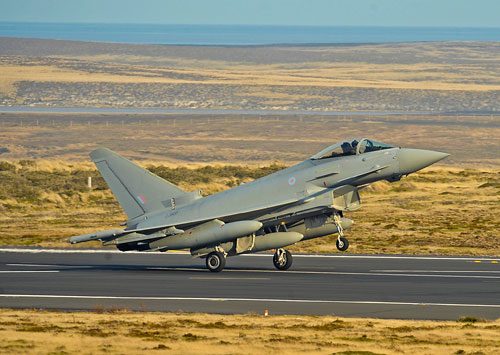
- RAF Mount Pleasant: opened on 12 May 1985 to replace the RAF’s facilities at Port Stanley Airport, it is the newest purpose-built RAF station, home to between 1,000 and 2,000 British military personnel, and part of British Forces South Atlantic Islands. [4]
Sources
- Falklands War. Wikipedia (secondary source). https://en.wikipedia.org/wiki/Falklands_War (accessed 2026-10-28).
- Operation Black Buck. Wikipedia (secondary source). https://en.wikipedia.org/wiki/Operation_Black_Buck (accessed 2026-10-28).
- HMS Hermes (R12). Wikipedia (secondary source). https://en.wikipedia.org/wiki/HMS_Hermes_(R12) (accessed 2026-10-28).
- RAF Mount Pleasant. Wikipedia (secondary source). https://en.wikipedia.org/wiki/RAF_Mount_Pleasant (accessed 2026-10-28).
Wikipedia articles are secondary sources and can change; they are cited with the date they were read.